Introduction
In our last lesson, we delved into the term structure of interest rates, exploring the theories that explain the shape of the yield curve and its profound impact on valuing long-term actuarial liabilities. We established how the market determines the rates for discounting future cash flows. Now, we will focus on the practical machinery of using those rates: the Discounted Cash Flow (DCF) valuation method.
This lesson directly addresses the learning outcome: Discuss the practical application and limitations of discounted cashflow valuation methods in an actuarial context. While your CM-series exams have equipped you with the fundamental mathematics of DCF, our focus here will be on the practical judgments, complexities, and significant limitations that arise when this powerful tool is applied in the real world of actuarial practice. We will move beyond the formula to explore the art and science of its application.
The Core of DCF: From Theory to a Practical Model
At its heart, the DCF method is built on a simple, elegant principle: the intrinsic value of any asset or business is the sum of all its future expected cash flows, discounted back to their present value.
There are two primary variants of DCF, distinguished by which cash flows and discount rates are used:
- Free Cash Flow to the Firm (FCFF): This represents the total cash flow available to all capital providers (both debt and equity holders). It is discounted using the Weighted Average Cost of Capital (WACC), which blends the cost of equity and the cost of debt.
- Free Cash Flow to Equity (FCFE): This represents the cash flow available only to equity holders after all other obligations, including debt payments, have been met. It is discounted using the cost of equity.
[PDF] P&C Insurance Company Valuation - Casualty Actuarial Society
This paper from the Casualty Actuarial Society provides a concise overview of different valuation methods.
Please read the initial sections on the Discounted Cash Flow (DCF) method, focusing on the distinction between the FCFF approach and the FCFE approach. Then, read the section on why the FCFF approach is challenging for insurers and why FCFE is often preferred: the rationale for focusing on FCFE.
As the reading notes, for financial institutions like insurance companies, the FCFE method is often more practical. The complex interplay of policyholder liabilities and regulatory capital makes it very difficult to define and calculate a stable WACC, which is essential for the FCFF method. The FCFE approach, by focusing directly on the cash distributable to shareholders, aligns more closely with the equity value an actuary is often asked to determine.
Let's now watch a video that provides a clear, step-by-step guide to building a DCF model. This will serve as our framework for the rest of the lesson.
Discounted Cash Flow | DCF Model Step by Step Guide
The video "Discounted Cash Flow | DCF Model Step by Step Guide" from Kenji Explains walks through the entire process from forecasting to valuation.
Watch the video from the beginning, paying close attention to the five key steps he outlines. We will analyze each of these steps in more detail. Introduction and Key Steps: Familiarize yourself with the five-step process. Step 1: Free Cash Flow: Understand how Unlevered Free Cash Flow (a component of FCFF) is calculated. The logic is similar for FCFE, with adjustments for debt. Step 2: WACC: See how the discount rate is built up, particularly the cost of equity via the Capital Asset Pricing Model (CAPM). Step 3: Terminal Value: Note the two common methods: perpetuity growth and exit multiple. Step 4 & 5: Discounting and Valuation: Observe how the pieces are assembled to arrive at an implied share price.
The video provides a solid mechanical overview. Now, let's unpack the significant actuarial judgments and practical challenges hidden within each of those steps.
The Actuary's Challenge: Judgment and Limitations
A DCF model is not an objective truth-machine; it's a structured framework for articulating a set of assumptions about the future. The final number is only as good as the judgments that go into it.
1. Forecasting "Forever": The Two-Part Model
A key theoretical assumption is that a business is a "going concern" that will operate indefinitely. How can we forecast cash flows forever? The practical solution is a two-part forecast.
DCF Valuation Modeling: From Theory to Practice | Course Module
This video from the Corporate Finance Institute explains the practical solution to forecasting indefinitely.
Please watch the segment from discussing how long to forecast. Focus on the distinction between the discrete forecast period (when the company may grow at a different rate than the economy) and the terminal value (when the company reaches a steady state).
This two-part approach introduces two major areas of subjectivity:
- Forecast Horizon: How long should the discrete period be? 5 years? 10 years? This depends on how long you believe the company can sustain a competitive advantage before its growth converges with the broader economy.
- Terminal Value: As we will see, this single number often represents a huge portion (frequently >70%) of the total calculated value, making the entire valuation exquisitely sensitive to the assumptions used to calculate it (i.e., the long-term growth rate or exit multiple).
2. The Numerator-Denominator Consistency Principle
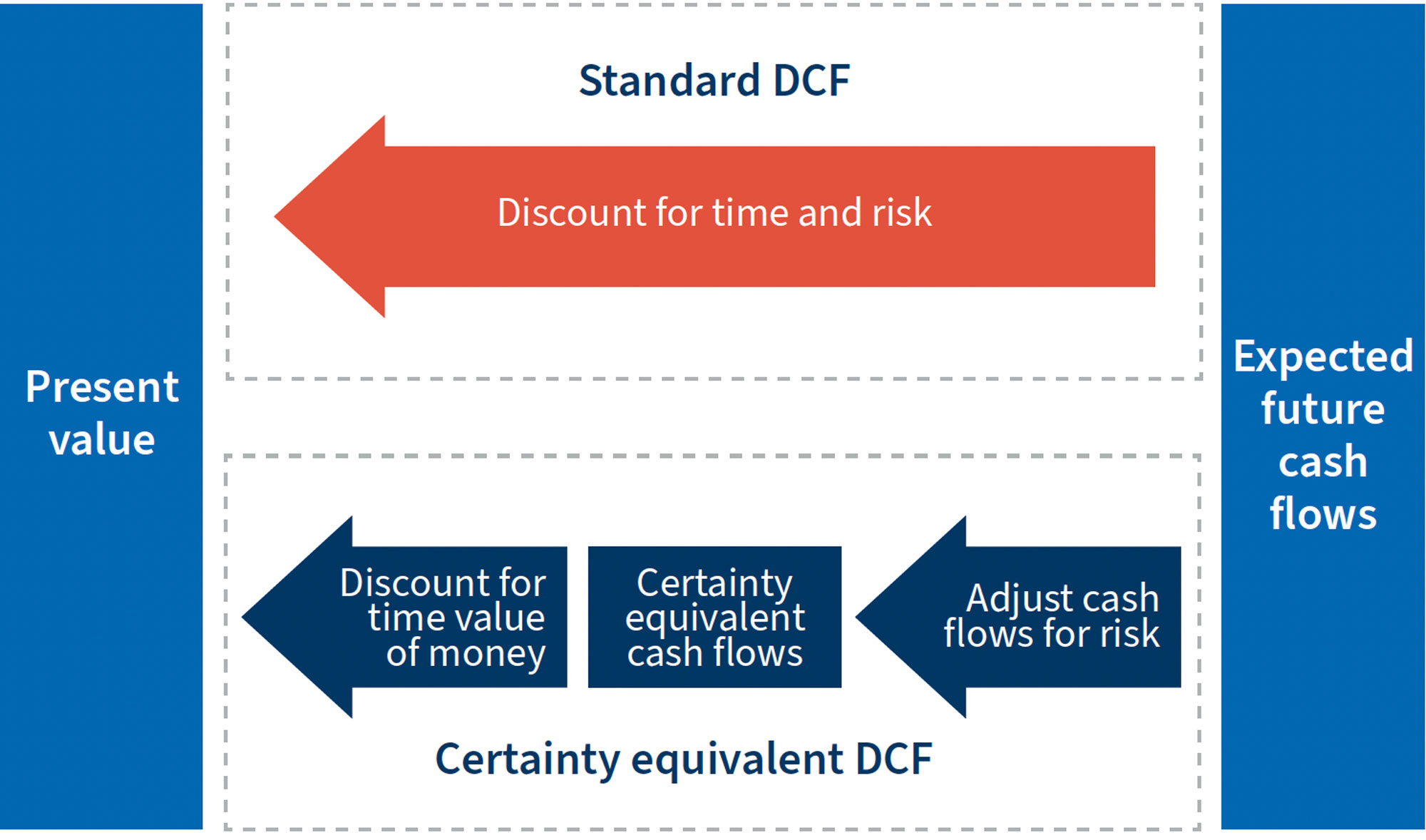
A critical, and often violated, principle in DCF is that the cash flows in the numerator must be consistent with the capital providers reflected in the discount rate in the denominator.
DCF Valuation Modeling: From Theory to Practice | Course Module
Let's return to the Corporate Finance Institute video to understand this crucial principle of consistency.
Watch the segment from on choosing the right cash flows and discount rates. The key takeaway is that cash flows available to all providers (FCFF) must be discounted by a rate reflecting the cost to all providers (WACC) to arrive at the enterprise value.
In an actuarial context, this principle becomes even more complex. When valuing a block of insurance liabilities, the discount rate must be consistent with the risks inherent in those liability cash flows. This is the foundation of Market-Consistent Valuation (MCV), a topic of immense importance in modern actuarial practice. An MCV framework seeks to value assets and liabilities consistently, where the allowance for risk is calibrated to market prices where possible.
3. The Overwhelming Weight of Terminal Value
The calculation of terminal value is one of the most significant limitations of DCF. A tiny change in the assumed perpetual growth rate or exit multiple can lead to a massive change in the valuation.
[PDF] P&C Insurance Company Valuation - Casualty Actuarial Society
The CAS paper provides a stark numerical example of this sensitivity.
Review "Example 4" and the subsequent sensitivity analysis tables (view the example and tables). Notice how changing the growth rate from 2.3% to 4.8% nearly doubles the terminal value and adds over 40% to the total equity value.
This extreme sensitivity means that a DCF valuation is often best presented as a range of possible values under different scenarios, rather than a single point estimate.
4. The Single Discount Rate Problem
Perhaps the most intellectually challenging limitation for an actuary is the use of a single discount rate. An insurer's net cash flow is a composite of cash flows from very different sources:
- Underwriting activities (premiums in, claims and expenses out)
- Investment returns on the asset portfolio
These components have vastly different risk profiles. Investment returns on government bonds have a different risk profile than returns on equity, and both are different from the risk of higher-than-expected insurance claims.
[PDF] P&C Insurance Company Valuation - Casualty Actuarial Society
The CAS paper highlights this fundamental issue.
Please read the subsection titled Market Value of Net Cash Flows. The author points out that applying a single, average discount rate to this bundle of cash flows is a major simplification and can lead to misleading results, as it won't correctly value any of the individual components.
This is a critical point. While more advanced techniques exist to value asset and liability cash flows separately using risk-adjusted rates (often called a "sum-of-the-parts" valuation), the standard DCF model masks this complexity.
5. Procyclicality and Systemic Risk
In a market-consistent framework, which is the direction of modern regulation (e.g., Solvency II), DCF methods can contribute to systemic risk. This is known as procyclicality.
Imagine a financial crisis begins.
- Market uncertainty rises, and investors demand higher returns. This increases the discount rates used in DCF models.
- The higher discount rate causes the calculated market-consistent value of an insurer's assets to fall.
- To maintain solvency, the insurer may be forced to sell assets to de-risk its portfolio.
- This forced selling into a falling market pushes asset prices down further, which in turn leads to even higher perceived risk and higher discount rates.
This creates a dangerous feedback loop where the valuation methodology itself exacerbates the crisis.
[PDF] Market-consistent valuations and the implications of the recent ...
This paper by Towers Watson, written in the wake of the 2008 financial crisis, explores these real-world challenges.
First, read the summary of commercial challenges in Section 5.1. Then, read Section 14.1, "Description of procyclicality," which explains this feedback loop.
This procyclical effect is a profound limitation of relying solely on market-consistent DCF valuations for regulatory purposes and highlights why regulators often build in dampeners or transitional measures.
Conclusion
The Discounted Cash Flow model is an indispensable tool in the actuary's toolkit. Its greatest strength lies in the intellectual discipline it imposes: forcing the analyst to think critically about every driver of value, from revenue growth and profit margins to capital needs and risk.
However, its output is not an unassailable fact. The method's heavy reliance on subjective assumptions and its inherent limitations mean that the final valuation is often more of a structured opinion than a precise calculation. For an actuary, understanding and communicating these limitations is just as important as performing the calculation itself.
Key Takeaways & Cheatsheet:
Here is a summary of the key judgments and limitations associated with DCF valuation in an actuarial context.

| Aspect | Practical Application / Judgment | Key Limitations |
|---|---|---|
| Cash Flow Forecast | - FCFE vs. FCFF: FCFE is often preferred for insurers due to complex capital structures. - Forecast Horizon: Must decide on a discrete forecast period (e.g., 5-10 years) before growth stabilizes. |
- Negative/Unstable FCF: Difficult to apply to start-ups, cyclical businesses, or companies with high new business strain. - Subjectivity: Forecasts are inherently subjective and prone to forecasting error. |
| Discount Rate | - Consistency: Must be consistent with the cash flows (e.g., Cost of Equity for FCFE). - Build-up: Typically built using CAPM (Cost of Equity) and market data, requiring judgment on risk-free rate, beta, and equity risk premium. |
- Single Rate Problem: Using one average rate for a mix of investment and underwriting cash flows with different risk profiles is a major simplification. - Volatility: The market-based discount rate can be highly volatile, leading to volatile valuations. |
| Terminal Value | - Method: Choose between Perpetuity Growth ( ) or Exit Multiple (e.g., based on comparable company multiples). | - Dominance: Often accounts for the majority (>70%) of the total value. - Extreme Sensitivity: The entire valuation is extremely sensitive to small changes in the long-term growth rate or the discount rate . |
| Actuarial Context | - Market-Consistent Valuation: Used to value assets and liabilities in a consistent, market-based framework. - Basis for Decisions: Informs strategic decisions on pricing, M&A, and capital allocation. |
- Procyclicality: In a crisis, rising discount rates can force asset sales, creating a downward spiral. - Static Model: Standard DCF struggles to capture the value of management flexibility and embedded options (e.g., lapse options), which require more advanced models. |
In our next lesson, we will move from valuing assets to selecting them. We will discuss the key factors that influence the choice of an investment strategy for an insurer or pension fund, a process that relies heavily on the valuation principles we have covered.