Introduction
Welcome to our new module on Enterprise Risk Management (ERM). In our last lesson, we explored reinsurance as a key strategy for financing new business strain. We noted that reinsurance is fundamentally a tool for risk mitigation—transferring risk to another party. This decision to transfer risk is not made in isolation; it is one part of a comprehensive, structured system for managing all of an organization's risks. This system is known as an Enterprise Risk Management framework.
Today's lesson addresses the learning outcome: "Describe the components of an enterprise risk management (ERM) framework." We will explore what an ERM framework is, how it formalizes the cyclical problem-solving approach you're familiar with from the Actuarial Control Cycle, and examine its essential components from both a high-level business perspective and a practical actuarial standpoint.
ERM as a Control Cycle
Before diving into specific frameworks, it's helpful to see ERM as a sophisticated, firm-wide application of a familiar concept: the Actuarial Control Cycle (ACC). The ACC provides a general problem-solving paradigm: define the problem, design a solution, and monitor the results. ERM applies this same iterative logic across the entire enterprise to manage the full spectrum of risks the organization faces in pursuit of its objectives.
The following resource explains this connection, showing how the stages of the ACC map directly onto the core pillars of an ERM framework.
Actuarial control cycle - Grokipedia
This section from Grokipedia's article on the Actuarial Control Cycle directly discusses how the ACC integrates into ERM frameworks.
Please read the section on ERM integration. As you read, focus on how the ACC's stages—specifying objectives, data analysis, modeling, and monitoring—correspond to ERM pillars like risk identification, assessment, mitigation, and oversight. This will help you see ERM not as a new list to memorize, but as a logical extension of a process you already know.
High-Level Frameworks: COSO and ISO 31000
To implement this control cycle across a complex organization, companies often adopt standardized frameworks. These provide a common language and structure for risk management. The video below gives a clear explanation of what a framework is and introduces one of the most prominent examples: the COSO ERM framework.
COSO ERM - Risk Management Framework (Simple Explanation)
This video from Stuployer introduces the concept of a risk management framework and provides a high-level overview of the widely used COSO ERM framework.
Please watch the first two sections of the video: Introduction to Frameworks (00:08 - 03:21): This explains the purpose of a framework in providing a systematic approach to risk management. ERM Definition and Benefits (03:21 - 06:21): This part defines ERM according to COSO, emphasizing the importance of culture, capabilities, and practices.
The COSO framework, updated in 2017, is built around five interrelated components, which are themselves supported by 20 underlying principles. The image below presents these components and principles, serving as an excellent visual summary.
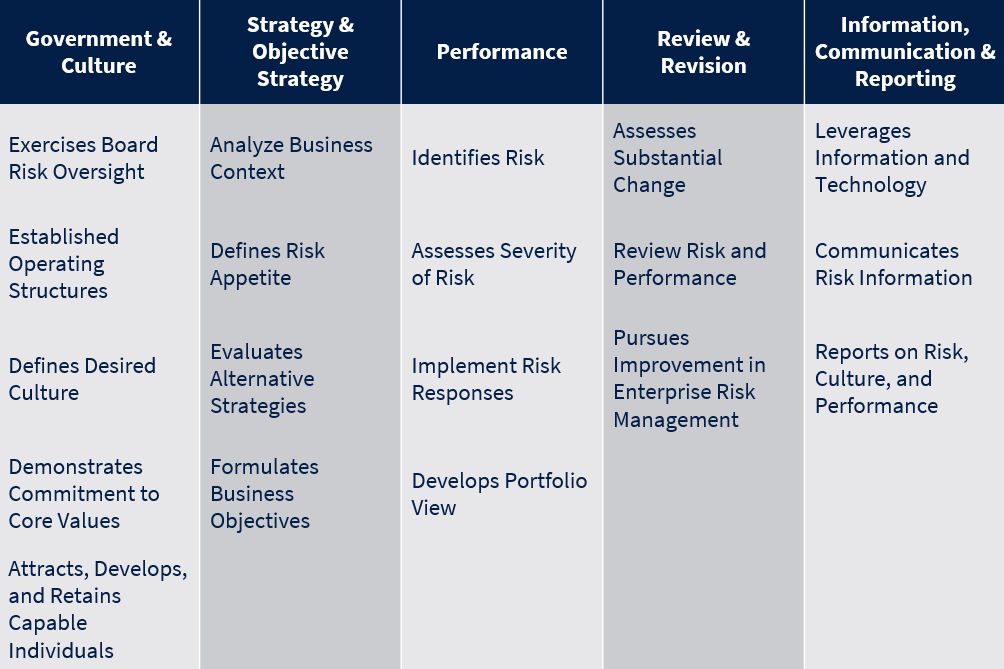
Let's briefly examine these five components. The same video provides a helpful walkthrough.
COSO ERM - Risk Management Framework (Simple Explanation)
This segment of the video provides a concise explanation of each of the five COSO components.
Please watch the section from 16:44 to 23:41, which details each component: Governance & Culture: Sets the organization's tone and establishes responsibilities for risk oversight. Strategy & Objective-Setting: Integrates ERM with strategic planning and defines the organization's risk appetite. Performance: Involves identifying, assessing, and responding to risks. Review & Revision: Focuses on reviewing the framework's performance and pursuing continuous improvement. Information, Communication & Reporting: Captures and shares risk information across the organization.
Another major global standard is ISO 31000. While COSO is often associated with financial controls and auditing, ISO 31000 provides a more generic, process-oriented guideline. It is structured around a cycle of Integration, Design, Implementation, Evaluation, and Improvement, all driven by Leadership and Commitment.
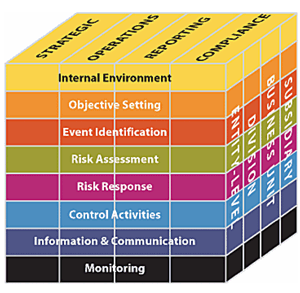
While you don't need to memorize every detail of both frameworks for the CP1 exam, it is important to understand that different but overlapping models exist. They all share the common goals of integrating risk management into decision-making, achieving objectives, and applying a continuous, cyclical process.
Core Components for Actuarial Practice
While high-level frameworks like COSO are useful, actuaries often work with a more granular set of functional components. The Actuarial Standard of Practice (ASOP) No. 58 provides a list of common components that form an ERM framework from an actuary's perspective. This list serves as an excellent "cheatsheet" for the exam.
[PDF] Enterprise Risk Management
This document from the Actuarial Standards Board provides guidance for actuaries working with ERM frameworks. This section lists the core components.
Please read section 1.2, focusing on the bulleted list of common components. This list forms the backbone of our practical understanding of an ERM framework's structure.
Let's break down each of these components.
-
Governance: This is the foundation. It defines the roles, responsibilities, and structures for managing risk. A key governance model is the "Three Lines of Defense".
- First Line: Business and process owners who own and manage risk as part of their daily jobs (e.g., underwriters, portfolio managers).
- Second Line: Oversight functions that support the first line and set risk management policy (e.g., the Risk Management department, Compliance).
- Third Line: The internal audit function, which provides independent assurance to the board that the first and second lines are effective.
The video below explains this crucial concept in detail.
COSO ERM - Risk Management Framework (Simple Explanation)
The "Three Lines of Defense" model is a cornerstone of modern risk governance. This video explains it clearly.
Please watch the segment from 08:06 to 11:30, which describes the roles of the first, second, and third lines.
-
Risk Identification: The process of finding, recognizing, and describing risks that could affect the achievement of objectives. This can involve workshops, interviews, and reviewing historical loss data.
-
Risk Classification: The process of organizing identified risks into a structured risk taxonomy. This helps in prioritizing and managing risks systematically. Common categories include market risk, credit risk, operational risk, and insurance risk.
-
Risk Appetite: This is one of the most critical components. It defines the amount and type of risk an organization is willing to accept in pursuit of its objectives. It is formally expressed in a Risk Appetite Statement and translated into quantitative risk limits and triggers.
-
Risk Mitigation: The process of selecting and implementing options for addressing risk. These options typically include:
- Accepting the risk (if it's within the risk appetite).
- Avoiding the risk (by not engaging in the activity that creates it).
- Transferring the risk (e.g., through insurance or reinsurance, as we discussed in the last lesson).
- Controlling the risk (by implementing controls to reduce its likelihood or impact).
-
Risk Metrics: The qualitative and quantitative measures used to assess and monitor risk exposures against risk limits. Examples include Value at Risk (VaR), stress test results, and Key Risk Indicators (KRIs).
-
Capital Management: This involves ensuring the organization has sufficient capital to absorb unexpected losses and support its strategic objectives. It links directly to regulatory capital requirements and internal economic capital models.
-
Stress Testing and Scenario Analysis: A set of tools used to explore the impact of severe but plausible events on the organization's financial position. This helps test resilience and validate risk appetite limits.
-
Own Risk and Solvency Assessment (ORSA): A report, required by many regulators (like under Solvency II), that summarizes the entire ERM process. It requires the insurer to document its risk profile, how it manages those risks, and how it assesses its own capital needs to remain solvent over a forward-looking period. It is the culmination of the entire ERM cycle.
Conclusion
An Enterprise Risk Management framework is the comprehensive structure of processes, policies, and culture by which an organization manages its full range of risks to achieve its strategic objectives. It is a formal, top-down application of the iterative control cycle that is fundamental to actuarial work.
While high-level models like COSO and ISO 31000 provide the conceptual architecture, for an actuary, the framework is best understood through its functional components. These components work together in a continuous cycle: governance sets the rules, risks are identified and classified, a risk appetite is defined, mitigation strategies are chosen, and performance is measured and monitored using metrics, stress tests, and capital models, with the entire process often summarized in an ORSA report.
In our next lesson, we will perform a deep dive into what is arguably the most important component of the ERM framework: risk appetite. We will explore how it is defined, articulated, and operationalized to guide all risk-taking activities within an organization.
Key Takeaways & Cheatsheet
This table maps the practical actuarial components to the COSO framework and the Actuarial Control Cycle, providing a consolidated view for your exam preparation.
| Actuarial Component (ASOP 58) | Corresponding COSO Component(s) | Corresponding ACC Stage(s) |
|---|---|---|
| Governance | Governance & Culture | Overarching principle of Professionalism |
| Risk Identification | Performance | Define the Problem / Data Collection |
| Risk Classification | Performance | Define the Problem / Data Collection |
| Risk Appetite | Strategy & Objective-Setting | Define the Problem (Specifying Objectives) |
| Risk Mitigation | Performance | Design the Solution |
| Risk Metrics | Performance / Review & Revision | Design the Solution / Monitor Results |
| Capital Management | Performance / Strategy | Design the Solution |
| Stress/Scenario Analysis | Performance / Review & Revision | Design the Solution (Modeling) |
| ORSA | Information, Communication & Reporting | Monitor Results & Feedback Loop |