Introduction
In our last lesson, we surveyed the essential components of an Enterprise Risk Management (ERM) framework, seeing it as a comprehensive system for managing an organization's risks in a structured, cyclical way. We identified 'Risk Appetite' as a cornerstone of this framework, representing the crucial link between high-level strategy and day-to-day risk decisions.
Today, we will delve into this critical concept. This lesson addresses the learning outcome: "Explain the concepts of risk appetite, risk tolerance, and risk limits in a business context." We will dissect these often-confused terms, understand their hierarchical relationship, and see how they are articulated and used to guide an organization's pursuit of its objectives. This is not just a matter of semantics; a clear understanding of this framework is fundamental to translating board-level strategy into actionable risk management.
Untangling the Terminology: Appetite, Tolerance, and Limits
The terms risk appetite, tolerance, and capacity are frequently used interchangeably, which can lead to confusion. Before we explore their roles, we need to establish clear, distinct definitions.
To begin, let's watch a short video that provides a clear, high-level overview of these related concepts.
What's the Difference: Risk Appetite - Risk Tolerance - Risk Capacity?
This video from Online PM Courses with Mike Clayton offers concise working definitions that distinguish between risk appetite, risk tolerance, and risk capacity.
Please watch the full video from the beginning to the end. Pay close attention to the core idea assigned to each term: Appetite: Willingness to take risk. Tolerance: Ability to cope with a risk. Capacity: Ability to bear the financial cost of a risk.
The video introduces a fourth important term, risk capacity, which is the maximum amount of risk an organization can absorb without failing (e.g., becoming insolvent). It's an objective boundary. In contrast, risk appetite is a subjective choice—a strategic decision about how much of that capacity the organization is willing to use.
A simple analogy helps to solidify the relationship between appetite and tolerance.
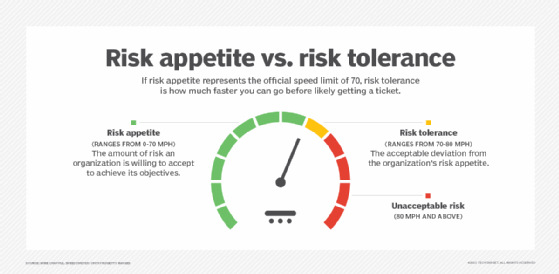
As the image suggests, if the risk appetite is the official speed limit (e.g., 70 mph), the risk tolerance is the zone above that limit where you might not get a ticket (e.g., 70-80 mph). The risk capacity, in this analogy, would be the maximum speed the car can physically handle before breaking down—a hard limit far beyond the chosen appetite.
The following table provides a more formal, structured comparison of risk appetite and risk tolerance across several dimensions.
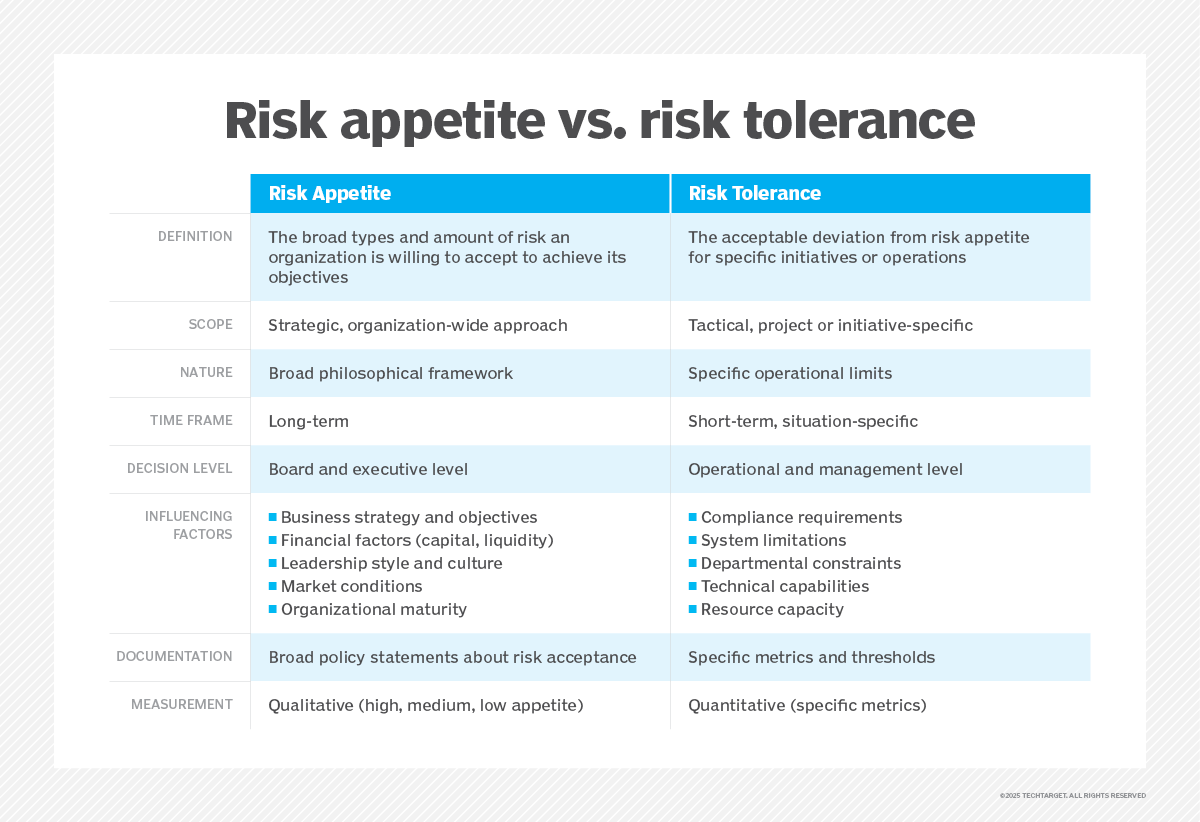
As the table shows, risk appetite is a broad, philosophical statement set at the board level, guiding long-term strategy. Risk tolerance translates this philosophy into more specific, tactical, and measurable boundaries for particular initiatives or departments.
To deepen this distinction, let's turn to a more detailed explanation.
Developing Risk Appetite Statements Ian Beale
In this segment from the Institute of Risk Management (IRM), Ian Beale provides a clear differentiation between risk appetite and risk tolerance, explaining their roles at different levels of an organization.
Please watch the section from 15:34 to 18:21. Note how risk appetite is positioned as a high-level guide for strategic decisions, while risk tolerance is described as a more granular, actionable tool for operational management, often linked to Key Risk Indicators (KRIs).
Finally, we have risk limits. These are the most granular of the concepts. They are firm quantitative thresholds (e.g., "no more than 15% of the portfolio invested in a single stock") that operational staff use to ensure that risk-taking stays within the defined tolerances. A breach of a risk limit serves as an early warning that an activity is approaching its risk tolerance boundary.
This creates a clear hierarchy:
- Risk Appetite (Highest Level): Broad, qualitative statements from the Board about the willingness to take risk to achieve strategic goals.
- Risk Tolerance: More specific, often quantitative statements that set the acceptable range of deviation from the appetite for a given area.
- Risk Limits (Most Granular): Hard, operational triggers and thresholds used to monitor daily activities and prevent tolerances from being breached.
The Strategic Importance of a Risk Appetite Framework
Defining a risk appetite is not merely a box-ticking exercise for regulators. It serves a vital strategic function by aligning the entire organization around a common understanding of how to balance risk and reward.
A well-defined risk appetite framework:
- Guides Decision-Making: It empowers managers to make decisions and take calculated risks with a clear understanding of the "guardrails" set by the board.
- Aligns Stakeholders: It communicates to investors, regulators, and employees the organization's approach to risk-taking, which builds confidence and ensures consistency.
- Optimizes Risk-Taking: It helps avoid both excessive, uncompensated risk-taking and overly cautious behavior that could cause the company to miss strategic opportunities.
The following video segment illustrates this balancing act perfectly.
Developing Risk Appetite Statements Ian Beale
This part of the IRM video uses a powerful graphic to show the ideal balance between an organization's risk appetite and its actual risk exposure.
Please watch from 09:39 to 11:34. Focus on the "balanced risk-taking" diagonal. This illustrates that the goal is not just to avoid taking too much risk (the bottom-right quadrant) but also to avoid being too risk-averse and missing opportunities (the top-left quadrant).
This hierarchy forms an implicit "risk contract" between the Board and management. The Board sets the overall appetite, and management is responsible for operating within that appetite, using tolerances and limits to guide their business units. This relationship is foundational to good governance.
[PDF] Linkage Between Risk Strategy, Appetite, Tolerances, and Limits ...
This presentation from Willis Towers Watson provides excellent visuals on the structure of a risk appetite framework.
Please review slides 13 and 14. You can find them by looking for the slide titles RISK "CONTRACT" and DEFINING RISK APPETITE. These slides visualize the "risk contract" and the cascading relationship from the Board's risk appetite down to the risk limits used by business unit leaders.
From Concept to Practice: Risk Appetite Statements
How is risk appetite formally expressed? The primary tool is the Risk Appetite Statement. These statements translate the high-level philosophy into tangible guidance. Effective statements are not vague; they are clear, communicated, and enable decisions. They can be both qualitative and quantitative.
Let's look at what constitutes a good statement and some concrete examples.
[PDF] Linkage Between Risk Strategy, Appetite, Tolerances, and Limits ...
These slides from the Willis Towers Watson presentation provide a range of well-defined risk appetite statements across different risk categories.
Please review slides 17 and 18, titled Example Risk Appetite Statements and Example Risk Appetite Statements (continued). Notice the mix of qualitative statements (e.g., regarding franchise value) and highly quantitative ones (e.g., regarding return on equity).
These statements are not static. They must be monitored. Organizations use dashboards and reports to track their current risk profile against their stated tolerances and limits. A powerful way to visualize this is the "tornado chart."
Developing Risk Appetite Statements Ian Beale
This final segment from the IRM video introduces the "tornado chart" as an effective way to report risk exposures against tolerances.
Please watch from 46:36 to 51:12. This is an excellent example of how the concepts of tolerance and limits are operationalized in a risk report. It shows, for various risk types, the upper and lower tolerance limits and the company's current performance relative to them.
Conclusion
In this lesson, we have dissected the critical concepts of risk appetite, tolerance, and limits. We have established that they form a clear hierarchy that cascades from the highest levels of strategic direction down to day-to-day operational controls.
- Risk Appetite is the strategic, board-level decision on the amount and type of risk an organization is willing to pursue to meet its objectives.
- Risk Tolerance defines the acceptable level of deviation from that appetite, providing tactical guardrails for different business areas.
- Risk Limits are the specific, measurable, operational triggers that ensure the organization stays within its defined tolerances.
Together, these elements form the backbone of the ERM framework, ensuring that risk-taking is intentional, aligned with strategy, and understood by all stakeholders.
In our next lesson, we will move to another fundamental ERM process. Now that we have a framework for how much risk to take, we need to ask: what are the actual risks we face? We will explore the methods for risk identification and classification.
Key Takeaways & Cheatsheet
This table summarizes the key distinctions between the core concepts we've discussed. It is a useful tool for recalling their specific roles for your exam.
| Feature | Risk Capacity | Risk Appetite | Risk Tolerance | Risk Limits |
|---|---|---|---|---|
| Core Idea | Maximum risk the firm can bear (the ceiling) | Amount of risk the firm wants to take (the goal) | Acceptable deviation from appetite (the buffer) | Operational triggers (the alarms) |
| Nature | Objective constraint | Strategic choice | Tactical boundary | Operational control |
| Scope | Overall organization | Organization-wide, linked to strategy | Specific to a risk category, business unit, or project | Granular, tied to a specific activity or metric |
| Measurement | Quantitative (e.g., total available capital) | Often qualitative, high-level principles | Usually quantitative (e.g., % loss, RBC ratio) | Strictly quantitative (e.g., exposure amount, VaR) |
| Set By | Determined by financial and operational reality | Board of Directors | Senior Management (C-Suite) | Business Unit / Operational Managers |
| Purpose | To define the boundary of survival | To guide strategic pursuit of objectives | To translate appetite into actionable boundaries | To monitor and control daily risk-taking |
| Analogy | Maximum speed of the car (e.g., 140 mph) | The official speed limit (e.g., 70 mph) | The speed at which you risk a ticket (e.g., 80 mph) | The speedometer needle hitting 80 mph |