Introduction
In our last lesson, we contrasted the major philosophical approaches to valuing liabilities, distinguishing between traditional, statutory, and the modern market-consistent bases. We established what these different valuation bases represent and why they are used. We now move from the "what" to the "how."
This lesson will equip you with the two fundamental computational techniques used to calculate technical provisions (liabilities): the prospective method and the retrospective method. Having mastered the underlying mathematics in your CM-series exams, our focus here will be on the conceptual framework, the intuition behind each method, and their practical application in the context of CP1. You will learn how these two approaches, though different in perspective, are intrinsically linked and should, in theory, produce the identical result.
Two Paths to the Same Destination
At any point during the life of a contract, like a pension plan or an insurance policy, we can calculate the necessary reserve or liability. We can think of this valuation date as a point on a timeline. The prospective method calculates the reserve by looking at everything that is expected to happen from this point forward. The retrospective method arrives at the same figure by looking at everything that has happened up to this point.
This key duality is captured perfectly in the following diagram.
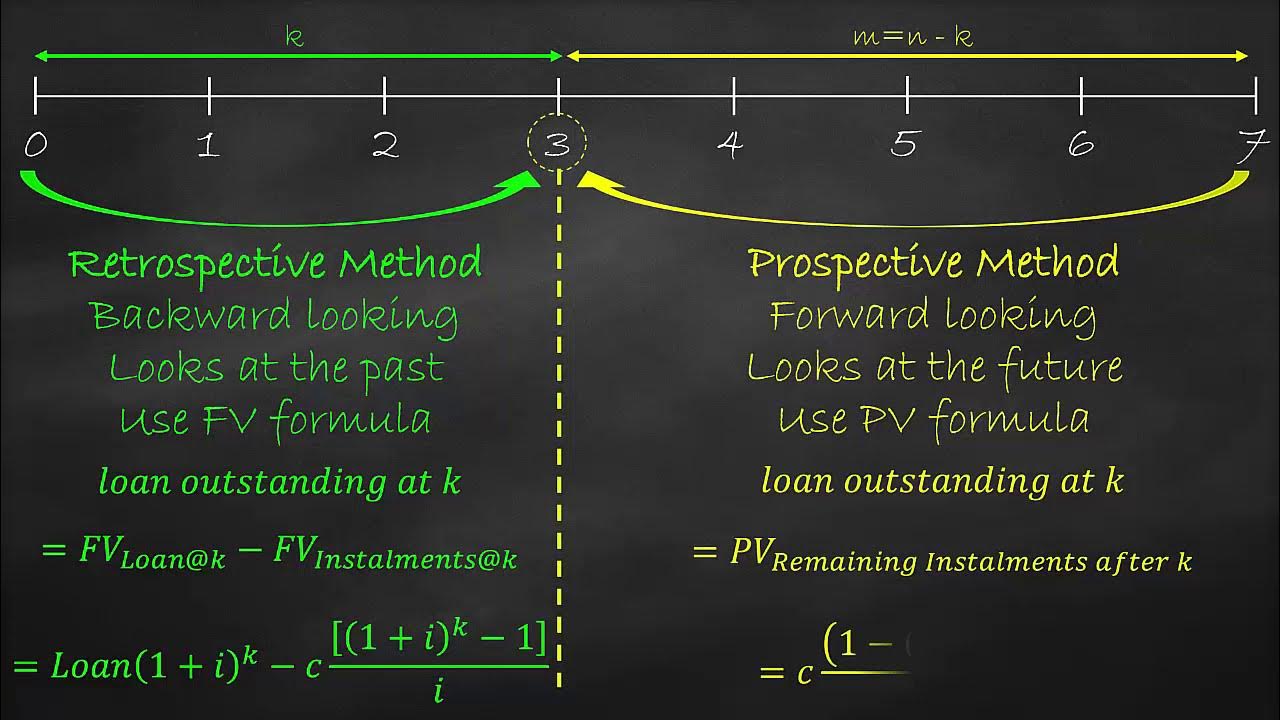
As you can see, the prospective method is "forward-looking" and uses present value (PV) formulas to discount future events. The retrospective method is "backward-looking" and uses future value (FV) or accumulation formulas to compound past events.
The Prospective Method: A Forward-Looking View
The prospective method is generally the more intuitive of the two. It answers the question: "As of today, what is the net amount of money we need to have on hand to meet all future obligations?"
The liability is calculated as the present value of all expected future outgo (benefits, expenses) minus the present value of all expected future income (premiums, contributions).
Prospective Liability = PV(Future Benefits + Expenses) - PV(Future Premiums)
This approach is the bedrock of modern valuation, as it directly aligns with the market-consistent principle of discounting expected future cash flows. Your work in CM1 on calculating policy values is a direct application of this method.
A key text on pension mathematics provides the formal definition for the actuarial liability, which is what we are calling the technical provision in this context.
[PDF] PENSION MATHEMATICS with Numerical Illustrations
This section from the text by Howard Winklevoss formalizes the prospective method.
Please read the short section titled "Prospective Liability Definition." Focus on equation (6.3a), which states that the actuarial liability, r(AL)x, is the present value of future benefits, r(PVFB)x, less the present value of future normal costs (which you can think of as premiums), r(PVFNC)x.
In practice, this is the standard method used for valuing most life insurance and pension liabilities. For example, a paper from the Society of Actuaries on valuing with-profits business notes that even for these complex products, a prospective approach is a valid and recognized method.
[PDF] Valuation of Life Insurance Liabilities on a Market-Consistent Basis
This paper by Christopher O'Brien gives a real-world regulatory context for the prospective method.
Read the paragraph that starts with The FSA recognizes. The key sentence is where it states that insurers can calculate the "with-profits benefits reserve" (the liability) by a prospective method as the excess of PV of benefits over PV of future premiums.
The Retrospective Method: A Backward-Looking View
The retrospective method answers a different, but equivalent, question: "What is the accumulated value of all the net contributions made on behalf of this policy or member to date?"
The liability is calculated as the accumulated value of all past income (premiums, contributions) minus the accumulated value of all past outgo (benefits paid, expenses incurred, or the cost of providing insurance cover).
Retrospective Liability = AV(Past Premiums + Expenses) - AV(Past Benefits Paid)
This method can feel less intuitive. A crucial component of the accumulation for a group of policies is the "benefit of survivorship." As some policyholders leave the group (due to death, lapse, or withdrawal), the funds held for them are effectively redistributed among the remaining members. Your background in probability theory will help you see this as a consequence of moving from an unconditional to a conditional probability space—we are calculating the reserve for those who have survived to the valuation date.
The Winklevoss text also provides a formal definition for this approach.
[PDF] PENSION MATHEMATICS with Numerical Illustrations
This section formalizes the retrospective method and introduces the concept of survivorship.
Read from the heading "Another definition of the actuarial liability." Focus on equation (6.4a), which states that the liability, r(AL)x, is equal to the accumulated value of past normal costs (premiums), r(AVPNC)x. Pay close attention to the explanation of the "benefit of survivorship," which is a critical concept in retrospective calculations.
While the prospective method is more common for statutory reporting, the retrospective method is vital in certain contexts. Its most prominent use is in the calculation of an asset share for with-profits policies. An asset share is the policy's notional share of the firm's assets, built up by accumulating its premiums at the actual investment return achieved by the fund, and deducting charges for expenses, costs, and profits.
The SOA paper you looked at earlier provides an excellent description of this.
[PDF] Valuation of Life Insurance Liabilities on a Market-Consistent Basis
This reading describes the asset share, a classic retrospective calculation.
First, read Appendix 1, starting from The asset share. Equation (A1.2) is a perfect example of a retrospective accumulation formula. Next, go to Appendix 2 and read the paragraph beginning This is the basic liability. Note how it explicitly contrasts the retrospective method of aggregating asset shares with the prospective calculation method.
The Principle of Equivalence
The most important concept to grasp is that, given a consistent set of assumptions, the prospective and retrospective methods must produce the same result. They are simply two different ways of calculating the same quantity.
This equivalence stems from the original equation of value set at the start of the contract:
At any valuation date , we can split both sides into past and future components:
Rearranging this gives:
The left side of this equation is the prospective liability. If we accumulate the right side to the valuation date , we get the retrospective liability. Thus, the two are mathematically equivalent. The Winklevoss text demonstrates this by showing that both the prospective definition in equation (6.3a) and the retrospective definition in (6.4a) simplify to the same underlying liability formula (5.3).
Conclusion
In this lesson, we have demystified the two primary methods for calculating technical provisions. We saw that the prospective method is a forward-looking calculation based on the present value of future net cash flows, while the retrospective method is a backward-looking calculation based on the accumulated value of past net cash flows.
You learned that these are not competing methods but rather two sides of the same coin, which must produce identical results under a consistent set of assumptions. While the prospective method is the default for most modern valuation regimes like Solvency II, the retrospective approach remains indispensable for specific products like with-profits business (via asset shares) and as a powerful tool for cross-checking results.
In our next lesson, we will use the liability values we've learned to calculate today. We will explore how they are compared against a firm's assets to determine its financial health, leading us to define and analyze accounting surplus and economic surplus.
Key Takeaways & Cheatsheet
Here is a comparative framework to help you consolidate these concepts for your exam preparation.
| Dimension | Prospective Method | Retrospective Method |
|---|---|---|
| Perspective | Forward-looking | Backward-looking |
| Core Question | "What do we need to hold for the future?" | "What have we built up from the past?" |
| Calculation | PV(Future Outgo) - PV(Future Income) | AV(Past Income) - AV(Past Outgo) |
| Key Concepts | Discounting, expected values of future cash flows. | Accumulation, compound interest, benefit of survivorship. |
| Assumptions | Relies on assumptions about the future (mortality, interest, expenses, lapses). | Relies on assumptions about the past (mortality, interest, etc.) and knowledge of past cash flows. |
| Primary Use | - Standard for regulatory valuation (Solvency II, IFRS 17). - Valuing pensions and most life insurance products. - Natural fit for market-consistent valuation. |
- Calculating asset shares for with-profits business. - Used as a cross-check for prospective calculations. - Can be simpler if future benefits are complex to define but past contributions are clear. |
| Analogy | Calculating the outstanding balance of a loan by finding the present value of all remaining payments. | Calculating the outstanding balance of a loan by taking the original loan amount and accumulating it with interest, then subtracting the accumulated value of all payments made so far. |