Introduction
In our last lesson, we deconstructed insurance contracts to understand how their design features allocate risk between the policyholder and the provider. We established that every guarantee, option, and exclusion is a lever in a complex balancing act. Now that we understand the product's blueprint and the risks it embodies, the next logical step is to determine its price. This lesson addresses the fundamental question: what are we trying to achieve when we set a premium?
Today, we will explore the core objectives of pricing. This isn't a purely mathematical exercise of calculating expected costs; it's a strategic process that sits at the intersection of commercial viability, market dynamics, and customer equity. Your background in statistics will make the risk-costing aspect intuitive, while your experience as a designer will resonate with the inherent trade-offs involved. Just as a garment must be desirable, affordable, and well-made, an insurance premium must be profitable, competitive, and fair.
Our goal is to describe these three principal objectives—profitability, competitiveness, and fairness—and understand the tension that exists between them. By the end of this lesson, you will see pricing not as a simple calculation, but as the act of finding a sustainable equilibrium point for the business and its customers.
The Core Objectives of Pricing
At a high level, the process of setting a price for an insurance product is guided by a set of competing goals. An insurer that focuses on only one objective to the exclusion of the others is likely to fail. A price that is highly profitable but uncompetitive will attract no customers, while a price that is highly competitive but unprofitable will lead to insolvency.
An excellent article from MatBlas, "Actuarial Pricing Models and Methods," provides a concise summary of these goals.
Actuarial Pricing Models and Methods: The Complete Guide - MatBlas
This guide offers a clear, high-level overview of the actuarial pricing process and its goals.
Please read the introductory section, "What Is Actuarial Pricing?", which lays out the three primary objectives. Then, continue to the next section, "The Role of Actuarial Pricing Models", to see how models help achieve these goals.
As you've read, the key objectives are to:
- Ensure Profitability and Solvency: The price must be sufficient to cover all expected claims and expenses, plus a margin for profit and unforeseen deviations.
- Maintain Competitiveness: The price must be attractive to customers in the marketplace when compared to rival offerings.
- Be Fair to Customers: The price must be equitable and reflect the level of risk being transferred.
Let's examine each of these objectives in more detail.
1. Profitability: The Foundation of Sustainability
An insurance company is a business. Its primary financial imperative is to generate a profit for its shareholders and to maintain sufficient financial strength (solvency) to meet its promises to policyholders, often decades into the future. The premium is the main source of revenue to achieve this.
- Covering Costs: The price must first cover all anticipated outgoings. This includes claim payments, commissions to sales agents, administrative expenses for underwriting and policy maintenance, and reinsurance costs.
- Targeting a Profit Margin: Beyond covering costs, the price includes a specific loading for profit. This margin is the insurer's reward for taking on risk. It is often expressed as a target percentage of the premium or as a desired return on the capital required to support the business.
In the following video clip, a practicing actuary breaks down a pricing model for a cancer insurance product. Notice how explicitly he discusses the profit target.
Pricing Models for Life and Health insurance products with a Fellow Actuary
This clip is from the same detailed cancer product model we looked at in the previous lesson. Here, the focus shifts to the financial outcome.
Watch the segment from 25:45 to 26:38, where the actuary specifies a 12% profit margin and clarifies it's for shareholders. Then, watch from 42:48 to 44:09 to see how the model uses a "goal-seeking" algorithm to iteratively find the premium that achieves this exact 12% profit target.
This practical example demonstrates that profitability isn't an afterthought; it's a precise, quantitative objective built into the core of the pricing process.
2. Competitiveness: The Mandate of the Market
Setting a profitable price is meaningless if customers choose to buy from a competitor instead. Competitiveness is about ensuring the product offers good value relative to other options in the market. This creates a natural tension with profitability. Lowering prices to win business directly eats into the profit margin.

The pricing actuary has a direct and powerful influence on this balance. As explained by "Actuary Elle" in this short clip, pricing decisions immediately affect customer behaviour and the company's financial results.
Actuarial Pricing vs Reserving: Something no one talks about
This video from the Actuary elle channel discusses the real-world impact of a pricing actuary's work.
Please watch from 01:36 to 02:14. The speaker clearly explains how raising prices affects both profitability and the volume of business written.
To manage this, actuaries often distinguish between a technical price and a street price.
- Technical Price: This is the "pure" price calculated to cover costs, risks, and the desired profit margin, as if in a vacuum.
- Street Price: This is the final premium charged to the customer after making strategic adjustments to the technical price to account for the competitive landscape.
The MatBlas article you read earlier explains this journey from technical to street price and the role of "pricing optimisation."
Actuarial Pricing Models and Methods: The Complete Guide - MatBlas
This reading explores how the purely technical price is adapted for the real world.
Focus on the steps outlined under the heading "How Premiums Are Set," particularly Step 4 where business loadings are applied. Then, read the section on "Pricing Optimisation" to understand how actuaries use market data to arrive at the final street price.
This optimisation process highlights that pricing is not just about internal costs but also about external market positioning.
The Pricing Trade-off Triangle
This tension between different objectives is a classic design problem. In project management, there is a well-known "trade-off triangle" of Fast, Cheap, and Good, where you can only pick two. A similar concept applies to insurance product design and pricing.
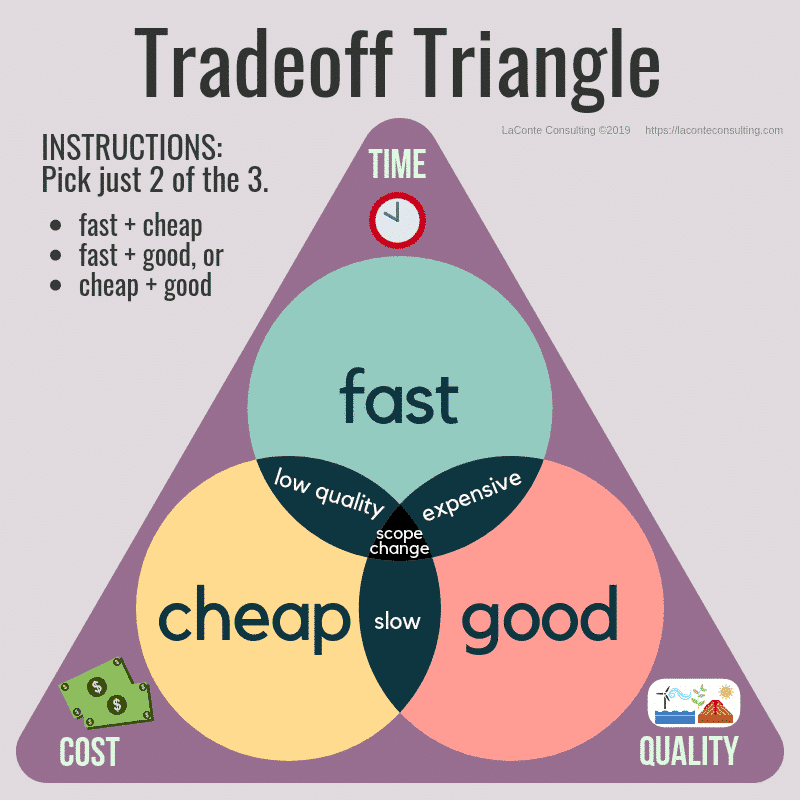
Let's re-frame this for an insurance product:
- Good: Comprehensive benefits, high guarantees, flexible options.
- Cheap: A low, competitive premium.
- Profitable (or "Fast to Issue"): A high profit margin for the insurer, often supported by simple, fast underwriting that may exclude fewer risks.
You can't have a product that is comprehensive, cheap, and highly profitable all at once.
- Good + Cheap = Unprofitable: The "Tesco" strategy of high value at a low price. This requires massive scale and razor-thin margins, risking losses if assumptions are slightly wrong.
- Good + Profitable = Expensive: The "luxury brand" strategy. A high-quality product with strong guarantees and a healthy profit margin will not be the cheapest on the market.
- Cheap + Profitable = Low Quality: A product with a low premium that is also profitable likely achieves this by having many exclusions, low benefit limits, or strict terms—it is not "Good."
3. Fairness: The Ethical Framework
The final objective, fairness, acts as an ethical boundary condition on the pricing process. From your perspective as a social researcher, this may be the most interesting dimension. In an actuarial context, fairness does not mean that everyone pays the same price. Instead, it means that the price should be commensurate with the risk. This principle is sometimes called fair discrimination.
The ethics of insurance pricing: Balancing profitability and fairness
This article from Markel provides a thoughtful perspective on the balance between profitability and fairness.
Please read the introduction, "Balancing profitability and fairness." Then, read the section "Setting an appropriate premium." Finally, pay close attention to the section on "Fair discrimination."
As the article explains, charging different premiums based on relevant, statistically supported risk factors (like age for life insurance or driving history for motor insurance) is considered fair. It ensures that low-risk individuals are not forced to subsidize high-risk individuals. From a statistician's viewpoint, this is simply risk segmentation.
Unfair discrimination would be using variables that have no logical or statistical relationship to the risk, or that are socially unacceptable (e.g., race). The principle of fairness ensures that the price transparently reflects the cost of the risk being transferred, creating value for both the policyholder and a sustainable, non-subsidized portfolio for the insurer.
Synthesizing the Objectives in Practice
In the real world, these objectives are not pursued sequentially but are balanced simultaneously. Actuarial judgment is essential to navigate the trade-offs. Let's return to the cancer product pricing video for a final example of this synthesis.
Pricing Models for Life and Health insurance products with a Fellow Actuary
These clips show the actuary grappling with the trade-offs we've discussed.
First, watch from 51:09 to 51:29. The speaker directly addresses the conflict between giving too large a discount (risking profitability) and being too conservative (risking competitiveness). Next, consider the discussion from 44:18 to 44:37. Here, the actuary suggests a strategy where profit targets might be lower for younger ages (to be more competitive and attract new customers) but higher for older ages. This is a perfect example of strategic pricing that balances all three objectives differently across customer segments.
This demonstrates that the "right" price is rarely a single number but a complex strategy that may vary by market segment, all while navigating the constant tension between profitability, competitiveness, and fairness.
Conclusion
Today we have moved from the what of product design to the why of pricing. We've established that setting a premium is not a simple cost-plus calculation but a strategic balancing act guided by three core objectives:
- Profitability: Ensuring the long-term financial survival of the company and a return for its owners by charging a price that covers costs and a margin for risk.
- Competitiveness: Positioning the product attractively in the marketplace to ensure it sells, which often requires tempering the pure profit motive.
- Fairness: Grounding the price in a sound statistical and ethical framework, where premiums are commensurate with the risk transferred.
Understanding these objectives is the critical first step in the pricing process. They inform every subsequent decision. In our next lesson, we will build directly on this by examining the specific "ingredients" used to construct a price. Knowing our goals are profit, competitiveness, and fairness, we will ask: what components do we need for our pricing basis to achieve them?
Key Takeaways & Cheatsheet
| Objective | Core Question | Key Considerations | Inherent Tension |
|---|---|---|---|
| Profitability | Is the price high enough to ensure the company remains solvent and generates a return on capital? | Covering claims, expenses, reinsurance. Target profit margin. Return on capital. | A price that is too high will not be competitive. |
| Competitiveness | Is the price low enough to be attractive to customers compared to rival products? | Market positioning. Competitor pricing. Customer price sensitivity (elasticity). Conversion & retention rates. | A price that is too low will not be profitable. |
| Fairness | Is the price equitable and reflective of the risk being transferred by the customer? | Risk classification ("fair discrimination"). Causal and statistical link between rating factors and risk. Avoiding unfair subsidies. Transparency. | The public perception of "fairness" (e.g., opposition to risk-based pricing) can conflict with the actuarial definition and the goal of profitability. |