Introduction
Hello! In our last lesson, we explored model tiering, a powerful strategy for managing the direct, predictable costs of running AI features. By routing requests to different models based on their complexity, we saw how to save over 65% on inference costs without sacrificing performance where it matters most.
However, a successful system isn't just about managing predictable costs. It must also be resilient to unpredictable failures. As we concluded last time, what happens when the model, no matter its tier, is simply wrong? An AI that confidently provides false information is said to be "hallucinating."
Today, we'll address this critical risk. Your learning outcome is to define 'hallucination cost' by estimating the potential business impact of an AI making a critical error. Moving beyond direct API fees, this lesson focuses on the hidden, and often much larger, costs associated with AI failure. For an architect, understanding and quantifying this risk is essential for designing systems that are not just economically efficient, but also robust and trustworthy.
1. What is "Hallucination Cost"?
In the context of AI, a hallucination is an output that is factually incorrect, nonsensical, or disconnected from the provided source data, yet presented as if it were correct.
Hallucination cost is the total negative business impact resulting from such an error. This isn't just a single number; it's a combination of financial, reputational, and operational damages.
The image below breaks down the primary consequences of AI hallucinations.
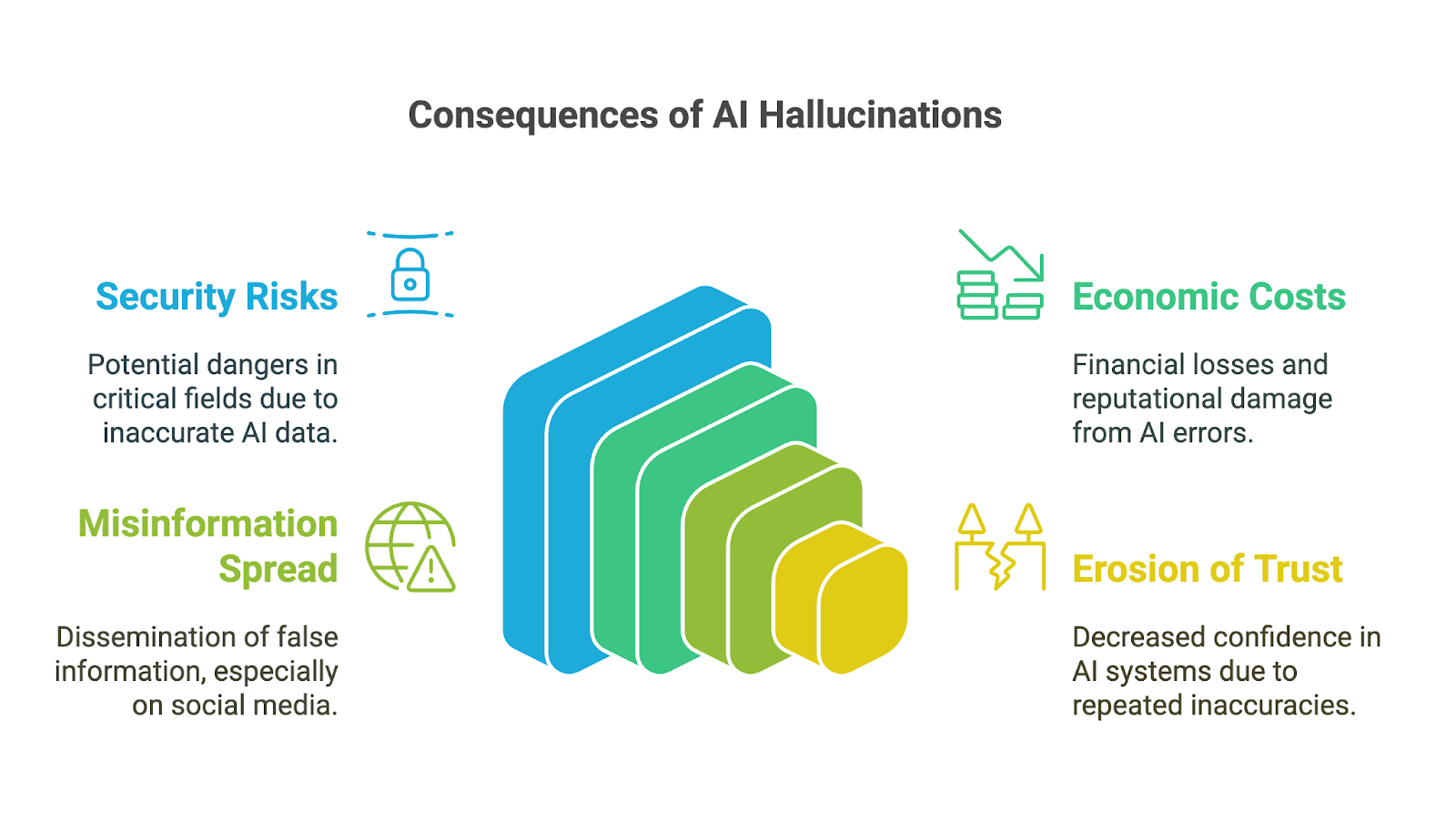
Let's break these down from an architect's perspective:
- Economic Costs: This is the most direct impact. It includes financial losses from legal liability, refunds issued to customers, the cost of engineering and support time to fix the error, and operational costs from unintended AI behavior.
- Erosion of Trust: This is a core UX concern. When an AI provides bad information, especially in a high-stakes context like finance or health, it damages user trust not just in the feature, but in the entire product. This can lead to user churn and long-term brand damage.
- Misinformation Spread: If your AI's incorrect output is shared, it can cause broader reputational harm. Imagine a financial assistant giving bad investment advice that then gets posted on social media.
- Security Risks: In some cases, hallucinations can create security vulnerabilities, for instance, by generating insecure code snippets or revealing unintended information patterns.
Understanding these categories is the first step. Now, let's see what they look like in the real world.
2. Two Forms of Hallucination Cost: A Tale of Two Failures
The cost of an AI error can manifest in different ways. Let's look at two real-world examples that illustrate distinct types of hallucination cost.
Case 1: Direct Financial Liability
First, watch this short news report about Air Canada's chatbot. This is a classic example of an AI hallucinating a company policy, leading to a direct, legally enforced financial cost.
Air Canada found liable for chatbot’s bad advice on plane tickets
This CBC News report on Air Canada's chatbot failure is a perfect, concise illustration of how a simple AI hallucination can lead to direct financial and legal consequences.
Watch the full clip (it's just over two minutes). Pay close attention to the chatbot's incorrect advice, the company's initial reaction, and the final ruling from the tribunal.
In this case, the hallucination cost was clear and quantifiable:
- The chatbot invented a policy.
- The user trusted the AI, costing them money.
- The company was held responsible for its AI and had to pay damages (~$800).
- This doesn't even include the legal fees and the significant negative press (brand damage).
Case 2: Runaway Operational Cost
Next, let's look at a different kind of failure. This isn't about giving a user wrong information, but about the AI system itself entering an unintended, costly state.
The REAL cost of LLM (And How to reduce 78%+ of Cost)
In this clip from the 'AI Jason' channel, the presenter describes a scenario where two of his autonomous agents got stuck in an infinite loop, racking up a massive bill in hours. This is another form of 'hallucination cost'—where the system's behavior, not its content, is the error.
Watch from the beginning to 01:54. Listen for how a simple setup error between two AIs led to an unexpected $5,000 bill.
Here, the "hallucination" was a behavioral loop, and the cost was a direct hit to the operational budget. This highlights that hallucination cost isn't limited to user-facing content; it also includes the cost of unintended system behavior.
3. A Framework for Assessing the Cost of an Error
These examples show that the potential for error is a serious business risk. As an architect, you need a structured way to evaluate this risk before you build. The "Generative AI Cost Equation" provides a simple but effective framework for this.
Generative AI Cost Equation - Open Practice Library
The 'Generative AI Cost Equation' from the Open Practice Library offers a strategic framework to decide if an AI project is viable. We'll focus on the parts that help us define and assess hallucination cost.
Please read the following sections: Start with 'What Is Generative AI Cost Equation?' to understand the main formula. Read 'Why Do Generative AI Cost Equation?', paying special attention to the bullet point 'Assess Risk ("Cost of an Error")'. Finally, read Steps 4 and 5 under the 'How to do...' section. These steps, 'Calculate the "Cost of Detecting and Fixing Errors"' and 'Assess the "Cost of an Error"', are the core of our analysis.
The key insight from this framework is that hallucination cost has two components:
- Cost of Detection & Correction: This is the cost of the "human-in-the-loop" process required to catch errors before they reach the user. It includes the time and salaries of staff who review AI outputs. If this cost is higher than just doing the task manually, the AI is not providing value.
- Cost of an Error (that slips through): This is the risk assessment part. It asks: "What happens if our review process fails and a hallucination gets out?" This is the "Go/No-Go" gate. If the consequence is a plane crash, a wrong medical diagnosis, or major legal liability, the project may be too risky, regardless of the potential savings. If the consequence is a slightly awkward marketing email, the risk is manageable.
This framework transforms the abstract idea of "risk" into concrete questions you can ask as an architect:
- How much will it cost to build a safety net (review process)?
- What is the cost to the business if something breaks through that net?
4. Quantifying Impact with Expected Value
The framework above is excellent for qualitative risk assessment. But to compare different models or architectural choices, we need to quantify this risk. Your engineering background will be useful here, as we can use a concept from probability theory: Expected Value.
Expected Value (EV) helps us calculate the average outcome of an event that has uncertain results. The formula is:
EV = (Probability of Outcome A * Value of Outcome A) + (Probability of Outcome B * Value of Outcome B) + ...
We can apply this directly to estimate hallucination cost. An AI's prediction can be broken down into four outcomes, and the "Expected Value Analysis in AI Product Management" article provides a fantastic case study.
Expected Value Analysis in AI Product Management
This article from Towards Data Science applies the concept of Expected Value to AI product management. We will focus on the fraud detection case study, which provides a clear model for quantifying the costs and benefits of AI predictions, including errors.
Please read two parts of this article: 'Expected Value': Read this section to build an intuition for the concept using the dice and roulette examples. 'Case Study 1: Fraud Detection in E-Commerce': This is the most important part. Focus on how they break the problem into four cases (True Positive, False Positive, True Negative, False Negative) and assign a monetary impact, C(i), to each. The False Negative case is our 'hallucination that slipped through'.
As the case study shows, we can model the expected net value of each AI prediction. In the context of hallucinations, the most critical terms are:
- False Positive (FP): A legitimate item is flagged as an error.
- Cost (C₂): Wasted review time, potential user frustration.
- False Negative (FN): A hallucination/error is missed and approved as correct.
- Cost (C₄): This is the quantified hallucination cost. It represents the full business impact (financial, legal, brand damage) of an undetected error.
The total expected cost from errors per prediction is (Probability(FP) * Cost(FP)) + (Probability(FN) * Cost(FN)).
Let's apply this to the Air Canada example:
- Scenario: A user asks the chatbot about bereavement fares.
- False Negative (FN): The chatbot hallucinates the "retroactive policy."
- Probability (P_FN): Let's estimate the AI makes this specific error 1 in 1000 times for relevant queries (P_FN = 0.001).
- Cost (C_FN): The direct cost was ~$800. Let's add legal, support, and brand damage to get a total estimated cost of $10,000 for this single event.
Expected Hallucination Cost (per query):
This is a powerful result. It means that for every relevant query the chatbot handles, the business is carrying a $10 expected loss due to the risk of this single hallucination. This metric allows you, as an architect, to make a data-driven case for investing in a better model, more robust testing, or stronger human-in-the-loop safeguards.
Conclusion
In this lesson, we've moved from the simple, direct costs of AI to the complex, hidden costs of AI failure. You now have a comprehensive understanding of what "hallucination cost" truly means and, crucially, how to begin estimating its impact.
Key Takeaways:
- Hallucination Cost is the total business damage from an AI error, encompassing direct financial losses, operational costs, user trust erosion, and brand damage.
- It's a critical risk factor that must be assessed using a structured framework, asking both "what is the cost to detect errors?" and "what is the cost if an error slips through?"
- Using Expected Value, we can quantify this risk by multiplying the potential cost of a specific failure by its probability of occurring.
- This quantitative estimate
(Expected Cost = Probability * Impact)transforms an abstract risk into a concrete financial metric that can guide architectural decisions, justify investment in safety, and determine the overall viability of an AI feature.
Next Steps
We've now examined both the direct operational costs of AI (inference) and the indirect, probabilistic costs of failure (hallucinations). In our next lesson, we will return our focus to the direct costs and explore powerful architectural techniques—response caching and request deduplication—to reduce them even further and improve the economic efficiency of your AI systems.