Introduction
Hello! In our previous lesson, we designed a conceptual AI Health Dashboard. We created a "control panel" to alert us when something goes wrong with an AI model by monitoring signals like model drift, prediction anomalies, and data freshness. That dashboard answers the question, "What is happening?"
An alert is just the first step. When a user—or an auditor—sees a problem, their immediate next questions are, "Why did this happen?" and "What information was used to make this decision?". Answering these questions is the foundation of trust and accountability.
This brings us to our final lesson in the "Engineering Trust in AI Systems" module. Today, we will address the learning outcome: Define an accountability chain for an AI-powered decision, from the model output back to the source data.
We will define what an accountability chain is and explore its core components. Most importantly for your work, we'll see how this chain, which is often a backend concept, can be made visible and understandable to users through thoughtful UI/UX design. This transforms accountability from an abstract policy into a tangible feature.
1. The Anatomy of an Accountability Chain
An accountability chain isn't just a simple log file. It's a structured, auditable trail of evidence that connects every AI-generated output back to its origins. It provides the "receipt" for an AI's decision.
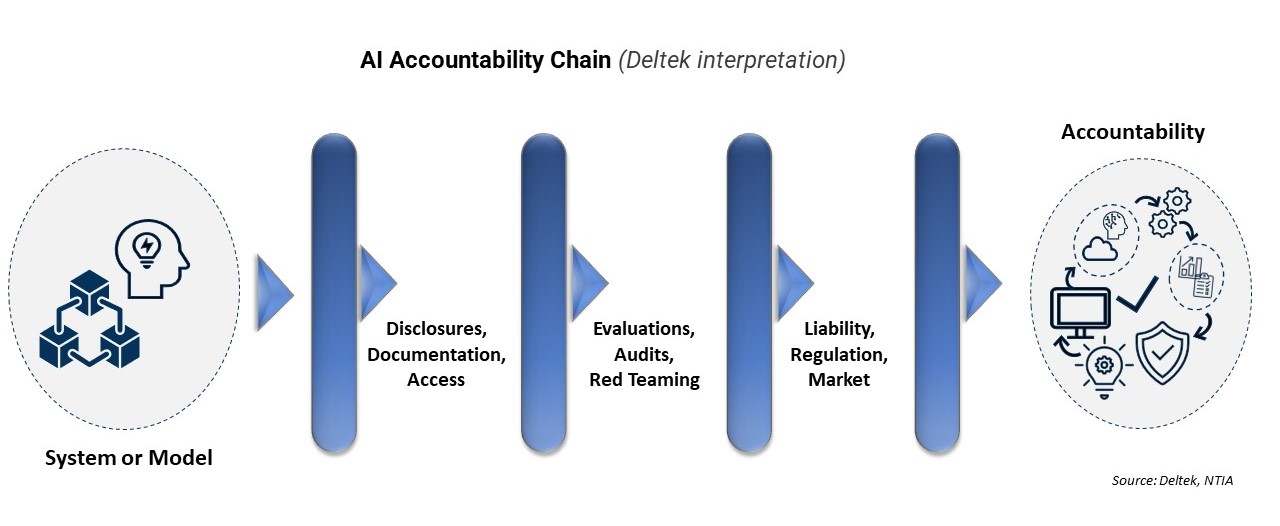
To build this trail, we need to track information across the entire AI lifecycle. The concept of AI Traceability provides a clear framework for this.
To understand the components of this chain, let's read an article from data.world that breaks AI traceability into three core principles. This will give us the vocabulary for our design discussions.
Please read the introduction 'What is AI traceability?' and the section 'Core principles of AI traceability'. Focus on understanding the distinction between Data Lineage, Model Lineage, and Decision Lineage.
As the article explains, a complete accountability chain is composed of three distinct "lineages":
- Data Lineage: Traces the data's entire journey. Where did it come from? How was it cleaned, transformed, and labeled? This is the "ingredient list" for the decision.
- Model Lineage: Documents the model itself. Which algorithm was used? What version of the model is this (e.g.,
v1.0orv2.1-beta)? When was it trained? This identifies the specific "tool" used. - Decision Lineage: Records the specific steps the model took to arrive at a particular output. What was the exact input data for this decision? What were the intermediate calculations or reasoning steps? This shows the "recipe" or process.
Here's a visual representation of Data Lineage, which helps to see how data moves through different systems and processes to create a final output.
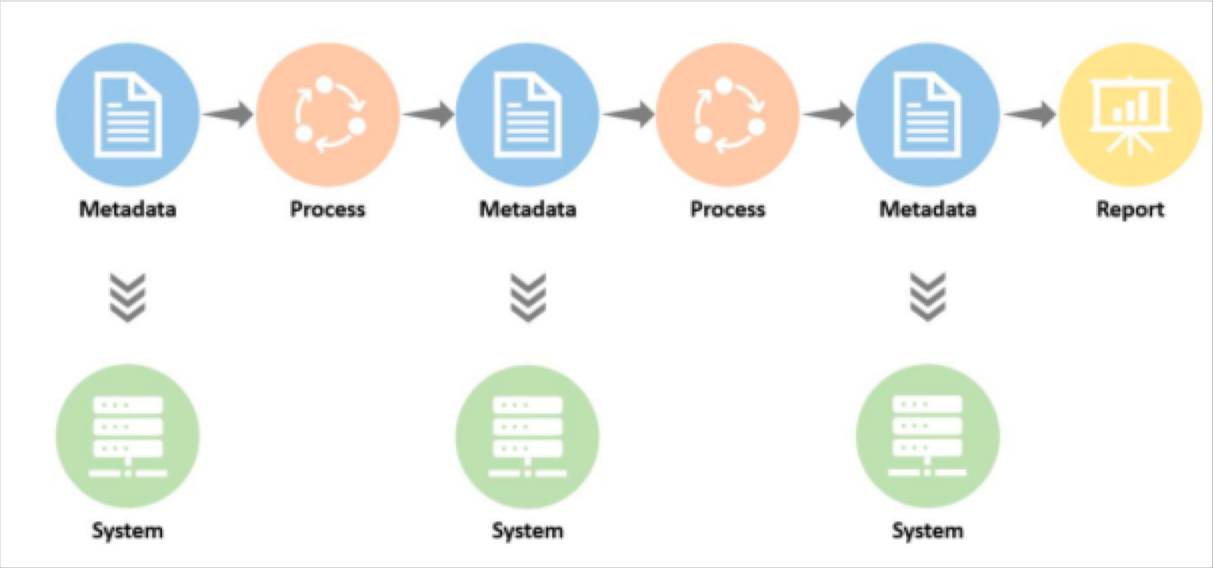
Together, these three lineages form an unbroken chain from the source data to the final output, making the AI's actions transparent and auditable.
2. Designing for Traceability: From Data to UI
Knowing the components of an accountability chain is one thing; making it useful is another. This is where your design skills are essential. A raw data log is only useful to an engineer. A user needs this information presented as clear, verifiable citations and explanations.
Let's explore how to design systems and interfaces that surface this accountability chain.
Providing Citations and Source Traceability for AI-Generated Information
The following guide from the Fintech Open Source Foundation (FINOS) provides an excellent framework for implementing source traceability, covering everything from system design principles to user interface patterns.
Please read the following sections from this guide: Purpose and Key Principles: Understand why we provide citations and the design goals (e.g., verifiability, transparency). Designing AI Systems for Citability: Briefly scan this section to understand the backend prerequisites. You don't need to know the implementation details, but it's useful to know that the system must be built to track sources and metadata. Presentation of Citations to Users: Pay close attention to this section. It details concrete UI/UX patterns for making traceability visible and usable.
Let's break down the key takeaways from that resource that are most relevant to your role as a designer:
- The Goal is Verifiability: The user must be able to check the AI's work. This means citations should be accurate, specific, and lead to the actual source.
- System and UI Must Cooperate: As the guide points out, the backend system must be designed to "maintain a robust and auditable link" between the information it retrieves and the output it generates. As a designer, you are creating the interface for that underlying capability.
- UI Patterns for Citations: The "Presentation of Citations to Users" section gives you a toolbox of patterns:
- Visual Indicators: Footnotes
[1], highlighted text, or small icons that signal a claim is backed by a source. - Accessible Information: Hover-over tooltips, clickable links, or expandable sections that reveal the source details (e.g., document title, author, date).
- Contextual Snippets: Showing the exact quote or data point from the source document that supports the AI's statement. This is highly effective for building immediate trust.
- Visual Indicators: Footnotes
3. Your Turn: Design a "Decision Card"
Let's put this into practice. Imagine you are designing a feature for a fintech application that uses an AI to provide investment advice. The AI has recommended that a user buy shares in a specific company.
Your Task (15 minutes):
Sketch or describe a UI component—a "decision card"—that presents this recommendation. Your design must clearly and intuitively expose the accountability chain to the user.
Your design should include elements that communicate:
- The Decision: The explicit recommendation (e.g., "AI Suggestion: Buy 10 shares of Company X").
- Model Lineage: A subtle indicator of which model version made the call (e.g., "Analysis by PortfolioBuilder v3.2"). This is important for tracking changes over time.
- Decision Lineage: A brief, human-readable summary of the AI's reasoning (e.g., "Based on strong Q3 earnings and alignment with your 'High Growth' risk profile.").
- Data Lineage (Citations): At least two specific, verifiable sources the AI used. Use the UI patterns we just discussed (e.g., footnotes, links, or an expandable "Sources" section). Examples could be:
- A link to "Company X's Q3 2024 Earnings Report".
- A reference to the user's own data: "Your stated risk profile (set on Oct 15)".
Think about the visual hierarchy. The recommendation should be prominent, but the evidence to support it should be easily accessible for a user who wants to dig deeper. This exercise connects the abstract principles of lineage to a concrete UI deliverable.
Conclusion
In this lesson, we demystified the concept of an accountability chain and established its critical role in building trustworthy AI systems. We've seen that true accountability isn't just a promise; it's a feature that must be designed.
Key Takeaways:
- An accountability chain provides an auditable trail for an AI decision and is built on three pillars: Data Lineage (the inputs), Model Lineage (the tool), and Decision Lineage (the process).
- For users, this chain is most effectively communicated through citations and explanations that are integrated directly into the UI.
- Good design for traceability makes AI outputs verifiable, empowering users to check the AI's work and building their confidence in the system.
- Traceability must be a core requirement of the entire system, as the user interface can only display the information that the backend is designed to track.
Next Steps
This lesson concludes our module on "Engineering Trust in AI Systems." You've learned to identify and monitor risks like model drift and data poisoning, design dashboards to make AI health visible, and now, create accountability chains to make AI decisions traceable.
You are now equipped with the core architectural concepts for designing robust, responsible, and human-centered AI systems. The next phase of your journey is the Capstone Architect Audit. In this final phase, you will select a real or hypothetical product and apply everything you have learned—from systems thinking and economic modeling to failure analysis and trust engineering—to conduct a comprehensive system audit. This will be your opportunity to synthesize your skills into a major portfolio piece.