Hello! Welcome to the fourth lesson in our module on structured thinking.
In our last lesson, you learned how to use an issue tree to systematically break down a complex problem, like a drop in a key metric. That analysis is the crucial first step. However, as a product manager, your analysis is only as good as your ability to communicate it persuasively to others—your team, stakeholders, and leadership. This is where we transition from analysis to advocacy.
Today, we'll focus on the Situation-Complication-Resolution (SCR) framework. This powerful storytelling structure, originally popularized by McKinsey, is the perfect tool for presenting your findings and recommendations in a clear, compelling, and memorable way. Mastering this directly addresses the feedback you've received and is a key step in shifting from an execution-focused role to one of strategic ownership.
By the end of this lesson, you will be able to structure a product recommendation using a situation-complication-resolution (SCR) framework.
1. What is the SCR Framework?
The SCR framework is a simple yet profound way to structure a narrative. It organizes your communication into three logical parts that guide your audience's thinking.
To start, let's get a crisp definition of the framework.
McKinsey's Presentation Framework Explained
This short clip from Communication Coach Alexander Lyon provides a clear and concise definition of each component of the SCR framework.
Watch from 00:21 to 01:02 to understand the core definition of Situation, Complication, and Resolution.
As the video explained, the framework consists of:
- Situation: This is the context or the current state of affairs. It should be a stable, non-controversial fact that your audience can easily agree with. It sets the stage.
- Complication: This is the event or problem that disrupts the situation. It's the reason you're talking. It creates tension and highlights what's at stake, grabbing the audience's attention.
- Resolution: This is your proposed solution or course of action. It directly addresses the complication and provides a clear path forward.
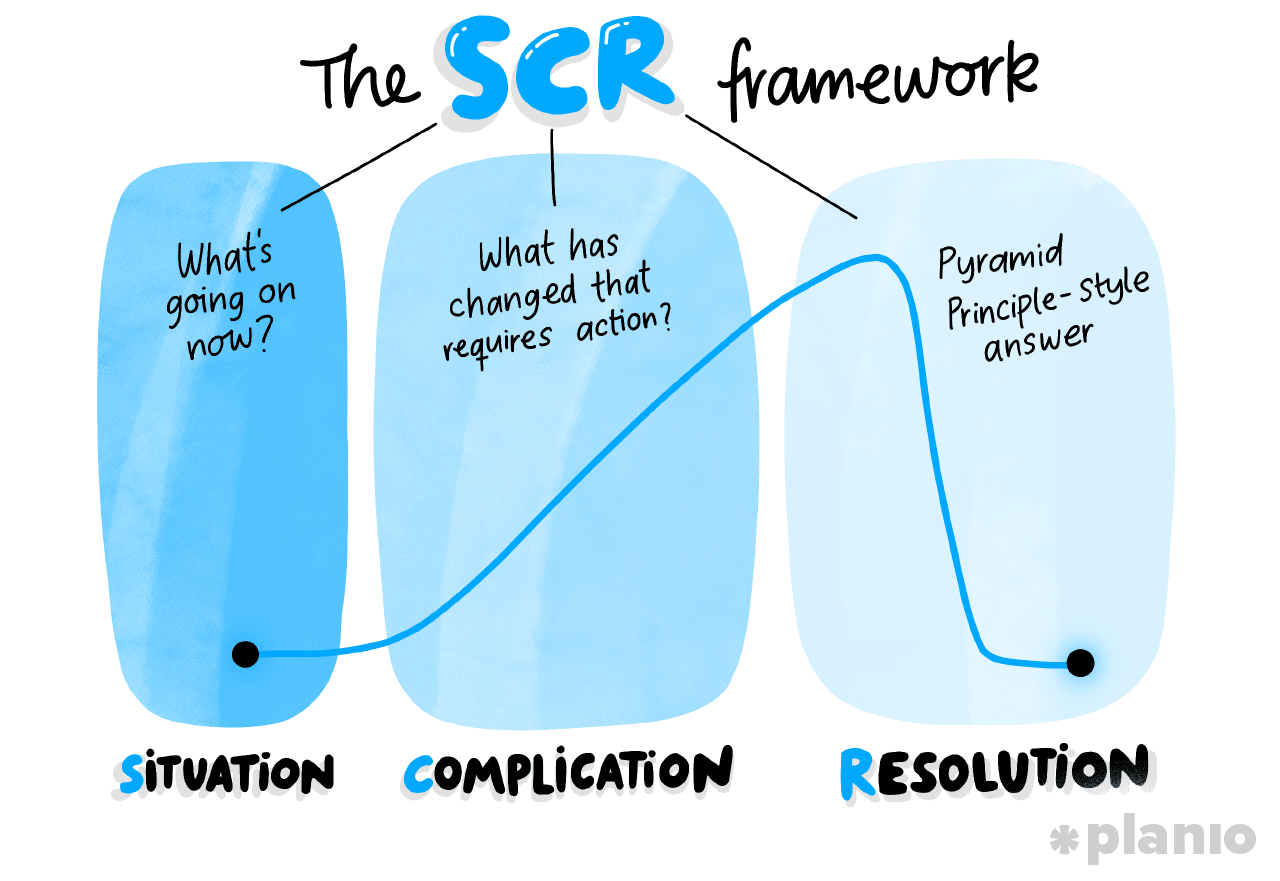
This structure works because it mirrors how we naturally process stories: a beginning, a middle with conflict, and an end that resolves the conflict. It makes your message easier to follow, understand, and remember.
2. Why the SCR Framework is so Effective
The SCR framework isn't just a communication trick; it's effective because it leverages fundamental principles of narrative and psychology to make your message more persuasive.
To understand the 'why' behind its effectiveness, please read the following brief article.
Situation Complication Resolution SCR Framework
The article 'Situation Complication Resolution - The SCR Framework' from Stratechi explains the psychological reasons why this structure is so persuasive. It also provides a helpful business scenario to see it in action.
Read the section titled 'WHY IS THE SCR FRAMEWORK EFFECTIVE & PERSUASIVE?'. Focus on the points about 'Structured Narrative Flow' and 'Emotional and Rational Engagement'.
As the article highlights, SCR is powerful because it:
- Creates a logical flow: It grounds the audience in a shared reality before introducing a problem, making them more receptive to your solution.
- Engages emotionally and rationally: The complication creates a sense of urgency and intrigue (the emotional hook), while the resolution provides a logical, data-driven answer (the rational payoff).
- Positions you as a problem-solver: By not just stating a problem but immediately offering a well-thought-out solution, you build credibility and demonstrate leadership.
For a product manager, this is invaluable when pitching a new feature, explaining a drop in metrics, or justifying a strategic pivot.
3. The SCR Framework in Product Management
Now let's move from theory to practice. How does this apply to the daily work of a product manager? The SCR framework is your go-to tool for everything from a quick update on Slack to a formal presentation to the C-suite.
The following resource provides excellent, PM-specific examples.
How to communicate clearly using the SCR framework
The article 'How to communicate clearly using the SCR framework' from the LogRocket blog is written specifically for product managers. It breaks down each component and provides two highly relevant examples.
First, read the section 'Using the SCR framework to communicate' to solidify your understanding of each component. Then, carefully study the two examples under 'Examples of the SCR framework in product management': 'Bug issue' and 'Pitch idea'. Notice how each example clearly lays out the context, the problem's impact, and the proposed actions.
The "Pitch idea" example is particularly relevant to your goals. It demonstrates how to advocate for a new initiative by framing it not as a list of features, but as a solution to a critical business problem.
Let's also look at another example, this time in a presentation format and on a topic you're passionate about: AI.
McKinsey's Presentation Framework Explained
In this part of the video from Alexander Lyon, he applies the SCR framework to structure an argument for a team to adopt AI. Notice how he quickly establishes the context, highlights the competitive risk, and then lays out a clear, three-part recommendation.
Watch from 03:46 to 04:58. Pay attention to how the speaker moves from the 'Situation' (everyone is using AI) to the 'Complication' (we are falling behind) and then to a structured 'Resolution' (three specific ways we can catch up).
This example shows how SCR can create a compelling opening for a presentation, immediately getting your audience aligned and focused on your proposed solution.
4. From Analysis to Recommendation: Tying it All Together
Let's connect this back to our previous lesson. You've used an issue tree to diagnose that Total Orders are down 10%. Your analysis pointed to a specific root cause. Now, you need to report this to your Head of Product.
Instead of just presenting a chart, you use SCR:
- Situation: "For the past two quarters, our primary goal has been to increase Total Orders, and we saw steady 5% growth quarter-over-quarter." (A stable, agreed-upon context).
- Complication: "However, this past quarter, Total Orders declined by 10%. My analysis using a metric tree shows this isn't due to a drop in traffic; in fact, traffic is up. The root cause is a 50% drop in our mobile checkout completion rate since we launched the mandatory sign-up wall last month." (The problem, its impact, and the data-driven cause).
- Resolution: "Therefore, I recommend we immediately form a squad to A/B test removing the hard sign-up wall and instead offer an optional 'create account' checkbox post-purchase. We hypothesize this will recover at least 80% of the lost checkout conversions within two sprints." (A clear, actionable, and hypothesis-driven recommendation).
See how this structure transforms a dry data report into a persuasive call to action?
5. Practice Exercise
Now it's your turn. Let's use the same e-commerce scenario from the previous lesson's practice exercise.
Scenario:
You are the Product Manager for an e-commerce fashion marketplace. Your North Star metric is Total Orders per Month, which has declined by 10%. Your metric tree analysis has confirmed the problem is not overall traffic or users adding items to the cart. The specific root cause is a 30% increase in cart abandonment on the payment details screen. Further digging reveals this spike correlates perfectly with the rollout of a new third-party payments provider that users are reporting as "slow and confusing."
Your Task:
Write a brief recommendation to your engineering lead and a senior stakeholder (e.g., Head of Product) using the SCR framework. Structure your response into three clear sections: Situation, Complication, and Resolution.
Take about 10 minutes to draft your response before looking at the solution.
Click here to see a sample solution
Here is one way you could structure your SCR recommendation. Your wording might be different, but the core logic should be similar.
To: Head of Product, Engineering Lead
Subject: Urgent: Recommendation to address 10% drop in Total Orders
Situation:
Our team's primary objective this quarter is to maintain or grow our 'Total Orders per Month'. Historically, our checkout funnel has been stable, with a cart abandonment rate on the payment screen of around 5%.
Complication:
Over the past month, our 'Total Orders per Month' have declined by 10%, representing a significant risk to our quarterly goals. Our analysis has isolated the problem to a 30% increase in cart abandonment specifically on the payment details screen. This spike began the day we rolled out the new 'PayEasy' third-party payment provider, and qualitative feedback from support tickets shows users find it slow and confusing, leading to a loss of trust at the final step.
Resolution:
I recommend we take immediate action. I propose we prioritize a "hotfix" to temporarily roll back to our previous payment provider for all users while we investigate the 'PayEasy' integration issues. Concurrently, we should allocate design and engineering resources to a two-week sprint focused on simplifying the 'PayEasy' UI and improving its performance, with a clear goal to relaunch it only when it outperforms our old provider in A/B testing. I need your approval to proceed with the rollback by EOD tomorrow.
Conclusion
You've now learned how to bridge the gap between rigorous analysis and persuasive communication. The SCR framework is a simple, repeatable structure that ensures your recommendations are heard, understood, and acted upon. It forces you to be clear about the context, crisp about the problem, and decisive about the solution.
Key Takeaways:
- The SCR framework structures a recommendation into Situation (context), Complication (problem), and Resolution (solution).
- It's effective because it follows a natural storytelling arc, making your message engaging and memorable.
- For product managers, SCR is a versatile tool for pitches, problem reports, and strategic updates.
- The best recommendations connect a clear Resolution directly to a specific Complication that is supported by data from your analysis (like an issue tree).
Preview of the Next Lesson:
Knowing the framework is one thing; using it effectively under pressure is another. In our next and final lesson of this module, we will focus on practicing how to articulate a structured product answer within a two-minute time constraint. This will simulate a real-world interview or a high-stakes meeting, helping you build the muscle memory to communicate with clarity and confidence when it matters most.