Hello! Welcome to your first lesson.
This course is designed to equip you with the core concepts of product management, with a special focus on AI products, to help you achieve your goal of landing a senior PM role. Based on your experience and the feedback you've received, we'll be concentrating on building a solid foundation in structured thinking and product strategy, moving beyond project execution to end-to-end product ownership.
This first module, "Foundations of Structured Thinking," is the bedrock for everything that follows. The frameworks we cover here will help you break down complex problems and communicate your thought process with the clarity and structure that interviewers and leadership teams expect.
Today's lesson focuses on a foundational principle from the world of consulting that has become essential for product managers: MECE. By the end of this 60-minute lesson, you will be able to explain the MECE principle and apply it to decompose a product problem into non-overlapping, comprehensive sub-problems.
Let's begin.
1. Why Structured Thinking is a PM Superpower
Before we dive into the "what" of MECE, let's establish the "why." In your past roles, you've managed complex projects and client relationships. As a Product Manager, you are the one expected to create clarity out of ambiguity. When faced with a vague problem like "user engagement is down," you can't just start brainstorming solutions. You need a systematic way to diagnose the problem first. This is what structured thinking enables.
To understand why this is so critical in a PM interview and on the job, please watch the beginning of the following video.
How to structure your answer in product management case interviews
This video from RocketBlocks, a PM interview prep resource, explains the fundamental reasons why structured thinking is non-negotiable for product managers. It directly addresses the kind of interview feedback you're aiming to overcome.
Watch from the start until 03:40. Pay close attention to the three key reasons provided for why structure matters: simplifying messy problems, demonstrating a repeatable process, and helping the interviewer follow your logic.
As the video highlights, a structured approach isn't just about sounding smart; it's a core competency that shows you can handle the complexity inherent in product management. It proves you have a reliable method for tackling any problem, not just the one you're asked about in an interview.
2. The MECE Principle: What Is It?
MECE (pronounced "mee-see") is a principle for organizing information that is central to structured problem-solving. It stands for Mutually Exclusive and Collectively Exhaustive.
- Mutually Exclusive (ME): Each item fits into only one category. There are no overlaps. This prevents you from double-counting and muddying your analysis.
- Collectively Exhaustive (CE): All items, taken together, fit into one of the categories. There are no gaps. This ensures you've considered all possibilities and have no blind spots.
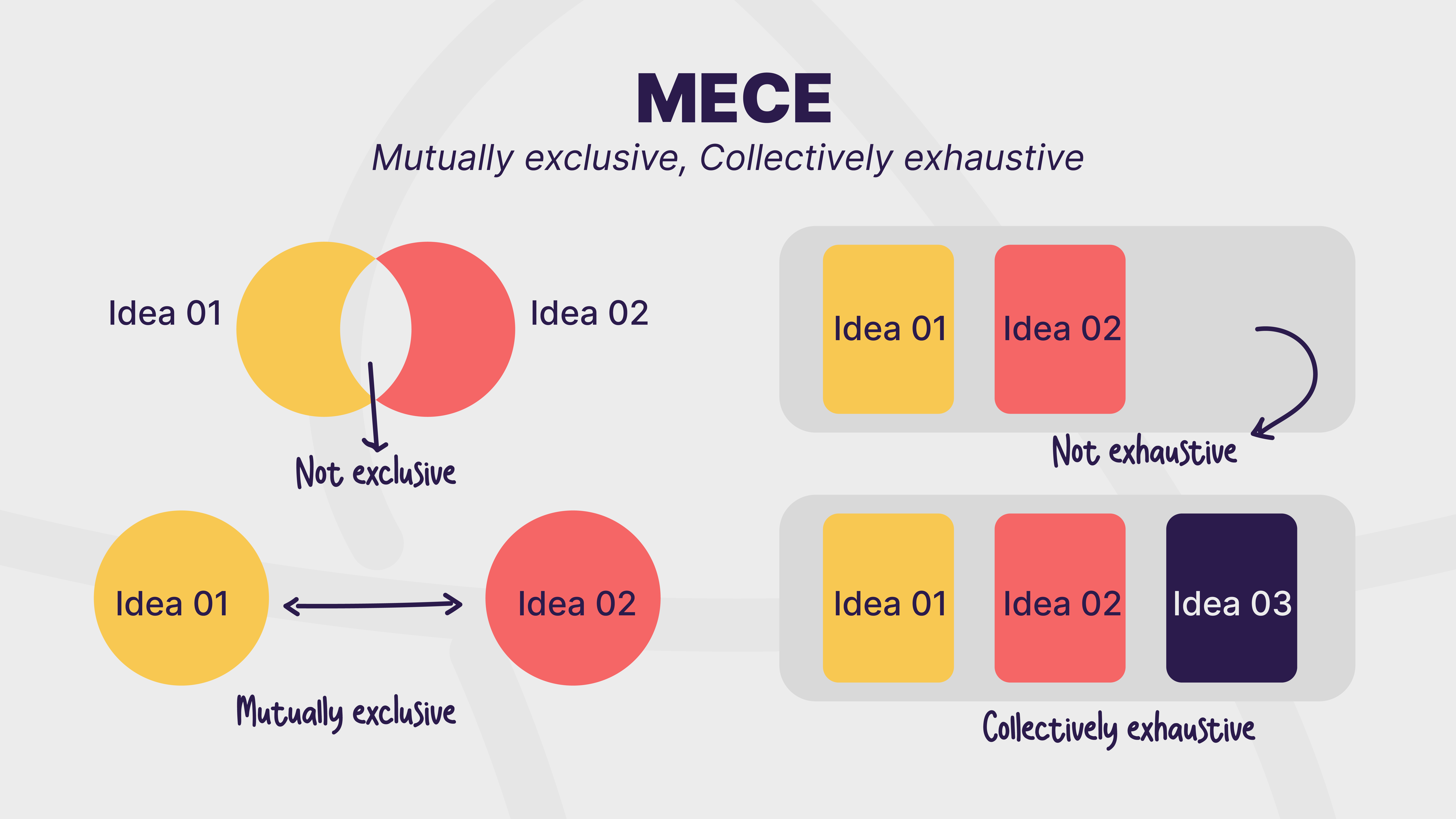
To get a clear, practical introduction to this concept, let's watch another short video.
What Is MECE Framework? (And How To Use It In Your Case Interviews!)
This video from 'My Consulting Offer' uses simple, effective examples to explain the two parts of MECE. The marble sorting analogy is a great way to grasp the core idea quickly.
Watch the segment from 00:16 to 03:21. Focus on how the narrator defines 'Mutually Exclusive' (avoiding double-counting) and 'Collectively Exhaustive' (avoiding gaps) using the marble and employee examples.
Now, for a more detailed breakdown and some common pitfalls to avoid, please read the following sections from the CaseStar guide on the MECE framework.
MECE Framework: What It Means and How to Apply It
This article provides a concise, text-based reference for the MECE principle. It includes clear definitions and useful examples that reinforce what you just saw in the video.
Read the sections 'What MECE stands for', 'Why consultants use MECE', 'Mutually Exclusive explained', 'Collectively Exhaustive explained', the table in 'MECE vs non-MECE examples', and 'Common MECE mistakes'. This should take about 10-15 minutes. Pay special attention to the table comparing non-MECE and MECE approaches.
These resources make it clear: MECE isn't an abstract theory. It’s a practical tool to ensure your thinking is both complete and logical.
3. Applying MECE to Product Problems
Now, let's connect MECE directly to the work of a Product Manager. You will use this principle constantly, whether you're diagnosing a metric drop, segmenting a market, or structuring a presentation.
Application 1: Decomposing a Metric
One of the most common scenarios you'll face is a "metric has changed" problem. The first step is to break the problem down into its component parts in a MECE way.
Let's return to the RocketBlocks video. The presenter applies this thinking to a classic product problem: a drop in Instagram's revenue.
How to structure your answer in product management case interviews
Here, you'll see a direct application of MECE thinking to a product execution interview question. Notice how the problem is broken down into clean, non-overlapping buckets that cover all possibilities.
Watch the section from 04:54 to 07:47. Observe how 'Instagram revenue' is first broken down into 'Ads revenue' and 'Non-ads revenue'—a perfect MECE split. Then, see how each of those buckets is broken down further (e.g., Ads revenue = Number of ads shown x Price per ad).
This is a powerful example of how a seemingly huge problem ("revenue is down") becomes a series of smaller, more manageable questions when you apply a MECE structure.
Application 2: Segmenting Your Users
Another critical PM task is defining your target audience. A vague user description leads to a weak product. MECE helps you create clear, distinct user segments so you can decide who you're building for (and who you're not).
The following article from Lenny's Newsletter is a masterclass in product sense. It explicitly calls out the need for mutually exclusive segments.
The definitive guide to mastering product sense interviews
This guide for PM interviews shows how top candidates structure their thinking. The section on segmentation is a direct application of the MECE principle to the problem of understanding users.
Read the section titled 'Step 2: Segmentation'. Focus on the paragraph that begins 'A crucial test for effective segmentation is mutual exclusivity...'. Also, review the examples of creating segments for different products (e.g., a gardening app). Notice how they are based on motivations or behaviors, which creates clearer, more mutually exclusive groups than simple demographics.
Creating segments like "Functional gardeners" vs. "Aesthetic gardeners" is a MECE approach. A user's primary motivation is either one or the other (mutually exclusive), and by defining several such motivation-based segments, you can cover the landscape of potential users (collectively exhaustive). This is far more insightful than using overlapping demographic labels like "young gardeners" and "urban gardeners," as a user could be both.
4. Practice Exercise
Let's put this into practice.
Scenario: You are the Product Manager for a music streaming service like Spotify or Apple Music. Your key engagement metric, "average daily listening time per user," has been flat for the past six months. Your goal is to understand why.
Task: Using the MECE principle, outline two different ways you could break down this problem to investigate potential causes. For each breakdown, list the categories you would investigate.
Take 5-7 minutes to write down your answer before revealing the solution below.
Click here to see a sample solution
Here are two possible MECE breakdowns for the problem:
Breakdown 1: By User Segment
This approach segments the entire user base into non-overlapping groups based on their tenure. Listening time behavior often differs dramatically between new and long-time users.
- New Users (first 30 days): Is the issue that we are failing to convert new users into habitual listeners?
- Core Users (1-12 months): Are our established users listening less over time?
- Power Users (>12 months): Are our most loyal users hitting a ceiling or reducing their usage?
This is MECE because every user falls into exactly one time-based category, and all users are accounted for.
Breakdown 2: By Content Type
This approach segments all listening time into the distinct types of content available on the platform. A drop could be isolated to a specific content category.
- Music: Is listening time for songs and albums declining?
- Podcasts: Is engagement with spoken-word content flat or decreasing?
- Other Audio (e.g., audiobooks, live radio): Is a smaller content category dragging down the average?
This is MECE because every minute of listening time is spent on one of these content types, and there are no overlaps between them.
Either of these breakdowns would provide a structured, comprehensive starting point for your investigation.
Conclusion
In this lesson, we introduced MECE as your first core tool for structured thinking. It's a simple but powerful principle that forces you to be logical and thorough when you break down a problem.
Key Takeaways:
- Structured thinking is a critical PM skill that demonstrates your ability to create clarity from ambiguity.
- MECE stands for Mutually Exclusive (no overlaps) and Collectively Exhaustive (no gaps).
- Applying MECE helps you avoid double-counting efforts and leaving blind spots in your analysis.
- You can apply MECE to many product management tasks, including diagnosing metric changes and segmenting user bases.
This principle is the first building block. As you can see in the diagram below, MECE arguments are the foundation that supports larger recommendations, a concept known as the Minto Pyramid Principle, which we'll touch on later in this module.

Preview of the Next Lesson:
Now that you know how to break a problem down into its constituent parts, what's next? You need to figure out which part is the actual source of the problem. In our next lesson, we will cover how to use a hypothesis-driven approach to form educated guesses about which branch of your MECE tree to investigate first.