Introduction
In our previous lesson, we explored the core teachings and social appeal of Buddhism, understanding it as a "Middle Path" that arose in response to the socio-religious conditions of the 6th century BCE. We saw how its practical, accessible doctrines and inclusive Sangha provided a compelling alternative to Brahmanical ritualism.
This lesson examines another major philosophical and religious movement that emerged from the same crucible of change: Jainism. Our learning objective is to explain the core teachings and ethical framework of Jainism, focusing on Ahimsa, the Triratnas, and the Mahavratas. While Buddhism offered a 'Middle Path', Jainism prescribed a more rigorous and ascetic route to liberation. We will dissect its fundamental beliefs about the soul and karma, its demanding ethical code, and the philosophical principles that guide a Jain's life.
1. The Philosophical Foundations of Jainism
Like Buddhism, Jainism is a non-theistic tradition, meaning it does not posit a creator God. However, its core metaphysics are unique. Jains believe the universe is eternal and uncreated, functioning according to universal laws. The central struggle of existence revolves around the soul, or Jiva.
Key Concepts:
- Jiva (Soul): Every living being, from humans to animals, insects, and even plants or microbes, possesses a pure, eternal, and conscious soul. The soul's intrinsic nature is one of infinite knowledge, perception, bliss, and energy.
- Karma: Unlike in many other philosophies, in Jainism, karma is conceptualized as a physical, albeit subtle, form of matter. These karmic particles are attracted to the soul by our actions, thoughts, and words. They stick to the soul, obscuring its pure nature and trapping it in the cycle of birth, death, and rebirth (samsara).
- Tirthankaras: These are the 'ford-makers' or enlightened teachers who have conquered their own karma, attained omniscience (Kevala Jnana), and teach the path to liberation (Moksha). There have been 24 Tirthankaras in the current time cycle. The 24th and last was Vardhamana Mahavira, who consolidated and propagated the Jain faith in the 6th century BCE.
To understand these foundational ideas and the life of Mahavira, please watch the following video.
L21: Jainism | Ancient India History | NCERT | UPSC | IAS | Religion | Philosophy
The video 'L21: Jainism' provides a clear introduction to Jainism's fundamental beliefs, the concept of Karma, and the life of Mahavira. This will establish the philosophical context for its ethical framework.
Please watch the video from 00:59 to 27:40. The first part (00:59 - 05:27) explains the non-theistic nature of Jainism and the role of Tirthankaras. The second part (11:21 - 16:35) details the life of Mahavira, from his birth to attaining Kevalya (omniscience) and Nirvana. The third part (16:35 - 27:40) offers a detailed explanation of the Jain concept of Karma as a force that binds the soul (Jiva) and the passions (attachment and aversion) that fuel this cycle. This is crucial for understanding why the ethical vows are so important.
2. The Ethical Framework: The Five Vows
The entire ethical structure of Jainism is designed to prevent the influx of new karma and shed existing karma. This is achieved through a disciplined life guided by a set of vows. For ascetics (monks and nuns), these are the five Mahavratas or 'Great Vows', which must be followed strictly and absolutely.

The five Mahavratas are:
- Ahimsa (Non-violence): This is the cornerstone of Jain ethics. It is a principle of absolute non-injury to any living being, in thought, word, or deed. This extends to all life forms, which is why Jain monks take extreme precautions like sweeping their path and wearing masks to avoid harming even insects.
- Satya (Truthfulness): One must not speak falsehood. However, even a truth that causes harm to a living being should be avoided.
- Asteya (Non-stealing): One must not take anything that is not willingly given.
- Brahmacharya (Chastity/Celibacy): For ascetics, this means complete abstinence from all sensual pleasures.
- Aparigraha (Non-possession/Non-attachment): This involves detaching from people, places, and material things. Ascetics renounce all property and worldly possessions.
The first four vows were taught by the 23rd Tirthankara, Parshvanatha. Mahavira is credited with adding the fifth vow, Brahmacharya.
The following resource provides a deep dive into Ahimsa, explaining how it is the philosophical root from which the other vows grow.
To appreciate the unique depth of Jain ethics, it's essential to understand their radical interpretation of non-violence. The Wikipedia article 'Ahimsa in Jainism' is an excellent resource for this.
Please read the introduction and the section titled 'The Vow of Ahimsa: Ascetic and Lay Practice'. Focus on how Jainism defines violence primarily as injury to one's own soul. Note how the text frames the other four vows (Truth, Non-stealing, Chastity, Non-possession) as subdivisions of Ahimsa, arguing that indulgence in falsehood, theft, etc., inevitably causes injury (himsa).
Anuvratas: The Vows for Householders
Recognizing that the absolute observance of the Mahavratas is impossible for laypeople, Jainism provides a more moderate code of conduct for householders known as the Anuvratas or 'Lesser Vows'. These are the same five vows, but followed with less severity. For example, Ahimsa for a layperson means being vegetarian and avoiding intentional harm, while Aparigraha means limiting one's possessions and wealth, not renouncing them entirely. The concept of trusteeship you may have encountered in business ethics, where surplus wealth is used for community welfare, has strong parallels with the Jain lay principle of non-possession.
This distinction between the paths for ascetics and householders is a key feature of Jainism's social structure.
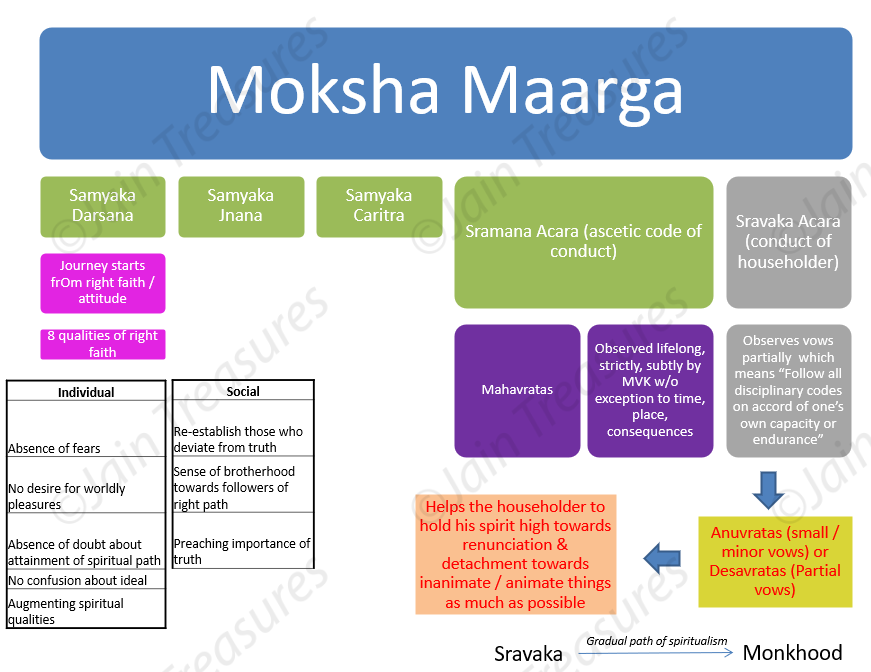
The videos below explain the Mahavratas and the practical application of Anuvratas in daily life.
L21: Jainism | Ancient India History | NCERT | UPSC | IAS | Religion | Philosophy
First, let's revisit the 'Kaarwan-e-upsc' video for a detailed breakdown of the five Mahavratas and their practical implications, followed by an explanation of the Anuvratas.
Watch the segment from 30:01 to 44:03. This part details each of the five Mahavratas, explaining their strictness (e.g., why monks carry brooms). It then contrasts this with the more relaxed Anuvratas for lay followers and explores the profound influence of these principles on figures like Mahatma Gandhi.
The Central Philosophy of Jainism
For another perspective in English, the following video from CEC elaborates on the ethical code for both householders and monks.
Please watch the segments from 02:30 to 08:58 and 12:54 to 16:00. The first part (02:30 - 08:58) explains the five Anuvratas for householders, providing practical examples and a useful classification of four types of violence (accidental, occupational, protective, and intentional). The second part (12:54 - 16:00) describes how ascetics observe the same five vows in a much stricter, absolute manner as Mahavratas.
3. The Path to Liberation: Triratna (The Three Jewels)
Living by the five vows constitutes 'Right Conduct'. However, according to Jainism, this conduct must be based on Right Faith and Right Knowledge. Together, these three form the Triratna, or the 'Three Jewels', which are the definitive path to liberation (Moksha).
- Samyak Darshana (Right Faith/Belief): This is belief in the substance of reality as taught by the Tirthankaras. It is about seeing things as they truly are, free from delusion.
- Samyak Jnana (Right Knowledge): This is the correct and detailed understanding of Jain doctrine, especially the nature of the soul, karma, and the universe.
- Samyak Charitra (Right Conduct): This is the ethical behavior that puts Right Faith and Right Knowledge into practice, primarily through the observance of the five vows.
These three are not sequential steps but an integrated whole. One cannot exist without the others; all are required to stop the influx of karma and purify the soul.
For a concise definition of the Triratna, please review the following text.
Jainism: Doctrines, Philosophy & Relevance in Contemporary Times
The PMF IAS article on Jainism clearly and succinctly defines the Three Jewels.
Read the short section titled 'Three Jewels or Triratna in Jainism'. It crisply explains the interdependent nature of Right Faith, Right Knowledge, and Right Action.
Conclusion
In this lesson, we have explored the intricate ethical and philosophical system of Jainism. We learned that its ultimate goal is the liberation (Moksha) of the soul (Jiva) from the bondage of karmic matter. This goal is pursued through the integrated path of the Triratna (Three Jewels): Right Faith, Right Knowledge, and Right Conduct.
The practical expression of this path is the adherence to the five vows (Pancha Mahavratas), with Ahimsa (non-violence) serving as the absolute foundation for all Jain ethics. We also noted the crucial distinction between the strict vows for ascetics (Mahavratas) and the more moderate vows for householders (Anuvratas), a structure that allowed the faith to function both as an ascetic order and a community of lay followers.
Key Takeaways:
- Jainism's core philosophy centers on the pure, eternal soul (Jiva) and its entanglement with physical karmic particles.
- The ethical framework is designed to stop and shed karma through disciplined conduct.
- The Five Great Vows (Mahavratas)—Ahimsa, Satya, Asteya, Brahmacharya, and Aparigraha—form the code of conduct for ascetics.
- Ahimsa is the paramount principle, with an extremely broad application to all life forms.
- The Triratna (Right Faith, Knowledge, and Conduct) is the integrated, three-fold path to liberation.
Preview of the Next Lesson:
Now that we have examined the core teachings of both Buddhism and Jainism, we are well-equipped to analyze their place in society. In the next lesson, we will compare the social base and patronage of Buddhism and Jainism. We will investigate which segments of society were drawn to each religion, who the key patrons were, and how these factors influenced their respective growth, geographical spread, and long-term legacy.