Introduction
In our last lesson, we mapped the economic geography of the 6th century BCE, tracing the great trade routes and the flourishing urban centers they sustained. We concluded that this dynamic environment of commerce, travel, and new wealth created a fertile ground for new ideas, as the old Vedic traditions didn't fully resonate with the evolving concerns of an urbanizing society.
This lesson addresses that intellectual shift by focusing on the most influential new philosophy to emerge from this period. Our learning outcome is to explain the core teachings, monastic organization (Sangha), and social appeal of Buddhism. We will dissect Buddhism not just as a religion, but as a system of thought and a social movement that offered a compelling alternative to the established order. For someone with your background in finance and economics, you might see parallels between Buddhism's rise and the success of a disruptive innovation that effectively targets the unmet needs of a changing market.
1. The Context for Emergence
The 6th century BCE was a time of profound social and intellectual ferment in the Gangetic plains. The rigid, hierarchical Varna system, the escalating cost and complexity of Brahmanical rituals (yajnas), and the priestly monopoly on religious knowledge created widespread dissatisfaction. Simultaneously, the rise of a wealthy merchant class (Vaishyas) and a robust agricultural economy created new power centers and social aspirations that the old system did not accommodate.
Into this environment came a number of thinkers who sought new answers to life's fundamental questions. The most successful of these was Siddhartha Gautama.
To understand the origins of his ideas, it's helpful to first review the story of his life and the societal conditions that shaped his quest.
History of Buddhism | Origin of Buddhism | Gautam Buddha | Ancient Indian History | UPSC GS
The video 'History of Buddhism' from StudyIQ IAS provides an excellent overview of the socio-economic context and the life of the Buddha. Watching these initial sections will set the stage for our deeper analysis.
Please watch the first two segments of the video (from the beginning to 05:44). The first part (00:00 - 02:04) quickly recaps the social and economic causes for the rise of new religions, which will be familiar from our previous discussions. The second part (02:04 - 05:44) details the life of Siddhartha Gautama. Pay close attention to the 'Four Sights' and how they framed his core problem: the universality of suffering (dukkha).
As the video illustrates, the Buddha's personal journey from a sheltered prince to a wandering ascetic was driven by a direct confrontation with the realities of old age, sickness, and death. His enlightenment was not a divine revelation in the traditional sense, but a discovery of what he considered to be the fundamental nature of reality and a path to escape its inherent suffering.
2. The Core Teachings: The Dharma
The Buddha was a practical reformer who focused on a central problem—human suffering—and a clear, actionable solution. His teachings, known as the Dharma, can be understood through a few foundational concepts.
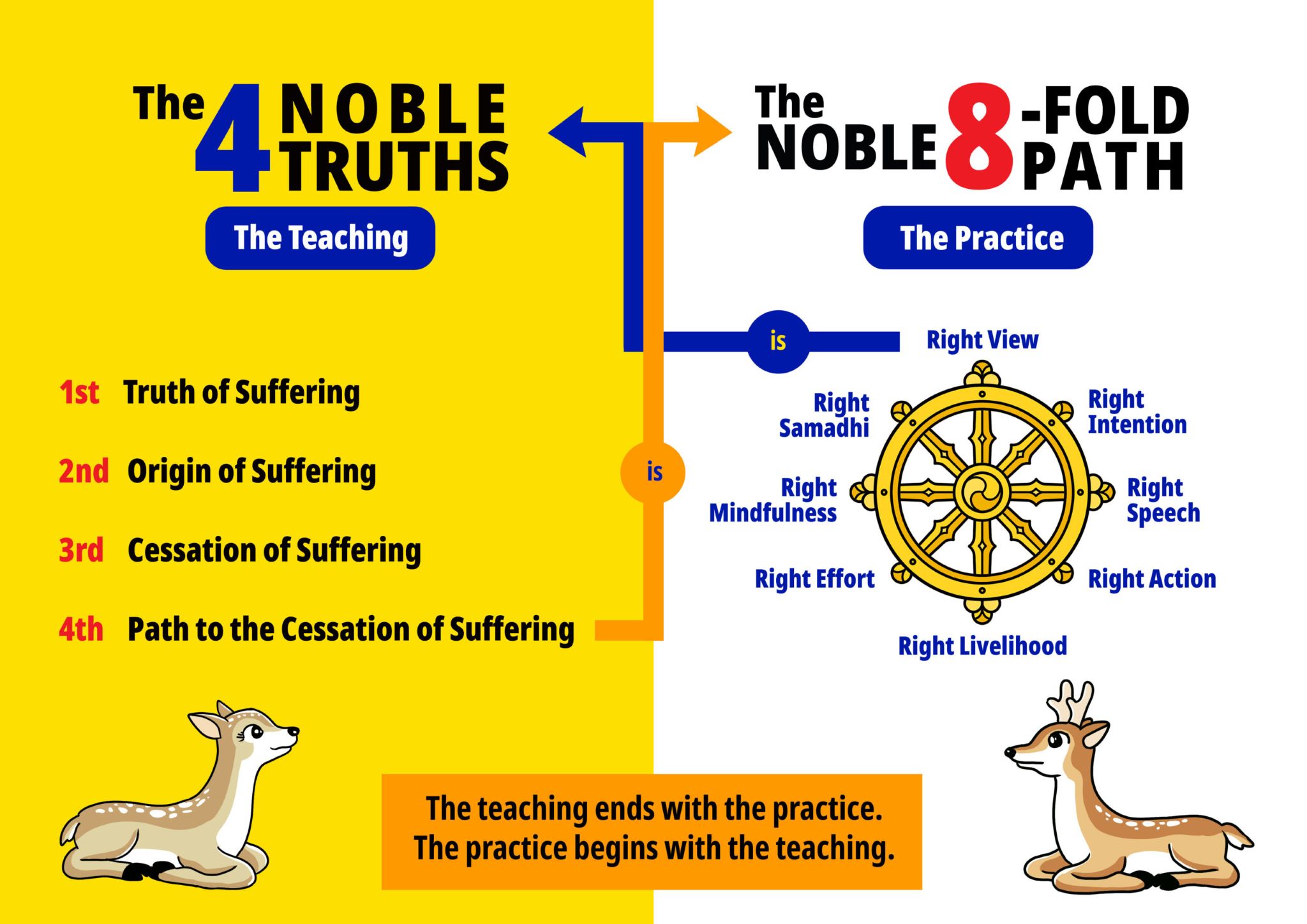
The essence of the Dharma is contained in the Four Noble Truths:
- The Truth of Suffering (Dukkha): Life is inherently characterized by suffering, dissatisfaction, and stress.
- The Truth of the Origin of Suffering (Samudāya): The cause of suffering is craving, desire, and attachment (tanhā).
- The Truth of the Cessation of Suffering (Nirodha): Suffering can be eliminated by completely extinguishing craving. This state of cessation is Nirvana.
- The Truth of the Path to the Cessation of Suffering (Magga): The way to end suffering is to follow the Noble Eightfold Path.
The Noble Eightfold Path is the practical, step-by-step guide to achieving Nirvana. It consists of: Right View, Right Intention, Right Speech, Right Action, Right Livelihood, Right Effort, Right Mindfulness, and Right Concentration.
To explore these concepts further, let's return to the video.
History of Buddhism | Origin of Buddhism | Gautam Buddha | Ancient Indian History | UPSC GS
This segment of the video explains the core doctrines of Buddhism in a straightforward manner.
Please watch the segment from 05:44 to 09:11. It covers the Four Noble Truths, the Eightfold Path, and the concept of the 'Middle Path,' which you should note as a key differentiator from the extreme asceticism of other contemporary movements.
Two philosophical ideas underpin these teachings and represent a radical break from the Vedic tradition:
- Anatta (No-Self/No-Soul): Unlike the Brahmanical belief in an eternal, unchanging soul (Atman), Buddhism posits that there is no permanent, independent self. What we perceive as "I" is just a temporary combination of physical and mental components.
- Paticcasamuppāda (Dependent Origination): This doctrine states that all phenomena arise in dependence on other phenomena. Nothing exists in isolation; everything is part of a web of cause and effect.
For a more rigorous understanding of how these ideas contrasted with the prevailing Brahmanical thought, the following reading is highly valuable.
[PDF] Aspects of Buddhism in Indian History - Sariputta
The paper 'Aspects of Buddhism in Indian History' by L. M. Joshi offers a scholarly comparison between early Buddhism and Brahmanism. This will give you the deeper, analytical perspective you prefer.
Please read Part III, 'Early Buddhism and Early Brāhmaṇism' (pages 19-29). As you read, focus on identifying the fundamental differences: Theology: Buddhism as non-theistic vs. Brahmanism as theistic. Philosophy: Buddhist anātmavāda (no-soul) vs. Brahmanical ātmavāda (eternal soul). Central Problem: Buddhist focus on dukkha (suffering) vs. the Vedic quest for prosperity and happiness. Core Doctrine: The uniqueness of Buddhist concepts like the three marks of existence (anicca, dukkha, anattā) and Dependent Origination (paṭiccasamuppāda).
3. The Sangha: The Organizational Vehicle
A brilliant idea needs an effective organization to spread. For Buddhism, this vehicle was the Sangha, the community of monks (bhikkhus) and nuns (bhikkhunis). It was a revolutionary social institution for its time.
Key Features of the Sangha:
- Egalitarian Structure: Membership was open to people from all castes. Once admitted, one's previous social identity was erased. This stood in stark contrast to the rigid Varna hierarchy.
- Democratic Governance: The Sangha was governed by rules and procedures (Vinaya) rather than the whim of a single leader. Decisions were often made through communal consensus.
- Inclusion of Women: The Buddha established a parallel order for nuns, granting women an institutionalized role in religious life that was absent in Brahmanism.
- Symbiotic Relationship with Laity: The monks and nuns were dependent on the lay community (upasakas and upasikas) for food, clothing, and shelter. In return, they provided spiritual guidance and teaching, creating a mutually supportive ecosystem.
This section of the StudyIQ video provides a good summary of the Sangha's organization and role.
History of Buddhism | Origin of Buddhism | Gautam Buddha | Ancient Indian History | UPSC GS
Let's now look at the Sangha, the organizational 'steel frame' of Buddhism.
Watch the clip from 09:51 to 12:06. Focus on how the Sangha was organized and why its liberal, democratic, and inclusive nature was a key factor in Buddhism's rapid spread.
The scholar L.M. Joshi adds an important nuance, arguing that the Sangha should be understood not just as a monastic order, but as the entire community of believers.
[PDF] Aspects of Buddhism in Indian History - Sariputta
For a deeper perspective on the social dimensions of the Sangha, let's revisit Joshi's paper.
Please read the section titled 'Social Life' (pages 52-61). Focus on the argument that Buddhism was a social movement, not just a monastic one. Note the distinction between the monastic Sangha and the broader community, and how Buddhism championed social emancipation for lower castes and women.
4. The Social and Economic Appeal
Why did Buddhism find such a receptive audience? The reasons are a mix of its philosophical message and its alignment with the socio-economic realities of the time.
- Simplicity and Accessibility: It rejected expensive and complicated rituals and used Pali, the language of the common people, instead of the elite Sanskrit.
- Egalitarianism: Its critique of the caste system resonated deeply with the Kshatriyas (who were in a power struggle with the Brahmins), the Vaishyas (who were wealthy but socially subordinate), and the Shudras.
- Economic Pragmatism: Buddhism's doctrine of non-violence (ahimsa) opposed the large-scale animal sacrifices of Vedic rituals. This was economically rational, as it preserved cattle, which were vital for the expanding agricultural economy. Furthermore, unlike Brahmanical law which sometimes condemned usury, Buddhism was not hostile to trade and the accumulation of wealth, making it attractive to the burgeoning merchant class.
The following resource explicitly details these economic connections.
[PDF] The Economic Impact of Buddhism in the Ganga Valley Region from ...
The article 'The Economic Impact of Buddhism' directly addresses how Buddhist principles aligned with the economic interests of the era, a perspective that should resonate with your background.
Please read the sections 'Buddhism and Contemporary Economy' and 'Mahajanpad Period'. Focus on how the religion's tenets—such as non-violence and a favorable attitude towards maritime trade and lending—directly benefited the agricultural and merchant classes.
The combination of a simple, ethical message, an inclusive social organization, and principles that supported economic growth created a powerful synergy. This allowed Buddhism to spread rapidly from its heartland in the Gangetic plains, as shown on the map below.

Conclusion
In this lesson, we have dissected the rise of Buddhism as a comprehensive system. We began by understanding its core teachings—the Four Noble Truths and the Eightfold Path—as a pragmatic response to the universal problem of suffering, built on the radical philosophical foundations of no-self (anatta) and dependent origination.
We then analyzed the Sangha not merely as a group of monks, but as a revolutionary organizational structure that was egalitarian, democratic, and inclusive, serving as the engine for the Dharma's propagation. Finally, we evaluated the reasons for its widespread social and economic appeal, noting its simple and accessible message, its critique of the caste system, and its alignment with the interests of the rising agricultural and merchant classes.
Key Takeaways:
- Buddhism's core teachings provide a diagnosis of suffering (Dukkha) caused by craving (tanhā) and a prescription for its cure (the Eightfold Path).
- Its philosophy of anatta (no-soul) was a direct challenge to the Brahmanical concept of atman.
- The Sangha was a key innovation, creating an open, egalitarian community that effectively disseminated Buddhist teachings.
- Buddhism's success was driven by its appeal to groups marginalized by the Vedic system and its compatibility with the new economic realities of the second urbanization.
Preview of the Next Lesson:
Buddhism was not the only heterodox movement to challenge the old order. In our next lesson, we will turn our attention to its contemporary, Jainism. We will explore its core teachings, including its more extreme form of asceticism and its radical interpretation of non-violence (ahimsa), and compare its social base and patronage with that of Buddhism. This will allow us to see how two different "solutions" emerged from the same set of societal problems.