Introduction
Welcome back. In our last lesson, we analyzed the strategic factors—geographic, economic, and military—that allowed Magadha to outcompete its rival Mahajanapadas and begin its imperial ascent. We concluded that its political success was built upon a powerful and dynamic economic base.
Today, we will delve into that economic base. This lesson addresses the learning outcome: Describe the socio-economic conditions—urbanization, trade guilds (shrenis), and punch-marked coins—that characterize the second urbanization. We will explore the three pillars of a complex new economy that emerged around the 6th century BCE: the growth of cities, the sophisticated institutions that organized commerce, and the introduction of money. For someone with your background in finance and economics, this is an opportunity to see the ancient origins of concepts like corporate governance, banking, and monetization.
1. The Second Urbanization: A New Landscape
The term "Second Urbanization" is used by historians to describe the re-emergence of cities in the Indian subcontinent nearly a millennium after the decline of the Indus Valley (or Harappan) Civilization. While the Harappan cities were centered in the Indus basin, this new wave of urbanism was concentrated in the Gangetic plains.
The engine of this transformation was the agricultural revolution we touched upon previously. To understand how this process unfolded, let's explore the causal chain linking technology, agriculture, and urban growth.
Economic transformation in 6th century BCE
The following paper, 'Economic transformation in 6th century BCE', provides an excellent overview of the material foundations of this period. We'll start by focusing on how agricultural changes made cities possible.
Please read the section titled 'Agrarian expansion in the ganga valley'. As you read, focus on the sequence of events: widespread use of iron technology -> clearance of dense forests -> spread of wet-rice cultivation -> generation of a substantial food surplus. Consider how this surplus is the essential prerequisite for a society to support non-farming specialists like artisans, traders, and administrators.
As the reading highlights, this agricultural surplus was the bedrock of the new economy. It sustained a growing population and, crucially, freed a significant portion of it from the necessity of producing food. These people could now specialize in other professions, congregating in newly emerging towns and cities that served as centers for administration, craft production, and trade. Prominent urban centers of this era included Rajagriha and later Pataliputra (Magadha), Kashi (Varanasi), Ujjayini (Avanti), and Taxila in the northwest.
2. Organizing Commerce: The Shreni (Trade Guild)
With the growth of cities and specialized crafts—such as textiles, pottery, metallurgy, and ivory carving—a new institutional framework was needed to manage the increasing complexity of production and trade. This need was met by the shreni, or guild.
These were far more than simple associations; they were sophisticated, self-regulating corporate bodies that formed the backbone of the urban economy. Their structure and function bear a striking resemblance to a mix of modern trade associations, corporations, and even financial institutions.
The Grokipedia entry on 'Shreni' offers a clear, structured explanation of these vital institutions. It details their organizational structure, economic functions, and financial activities.
Please read the initial summary section and the section titled 'Role in trade, production, and finance'. Pay close attention to the multifaceted roles of the shrenis, particularly: Regulatory Functions: How they standardized prices and quality. Productive Organization: How they organized workshops and apprenticeship. Financial Operations: Their functions as proto-banks, accepting deposits, issuing loans, and using early credit instruments.
The financial activities of the shrenis are particularly noteworthy. By accepting deposits (often as religious endowments) and lending money at interest, they performed core banking functions. There are inscriptions, for example, recording perpetual endowments to weaver's guilds, with the instruction that only the interest from the principal sum be used for a specific charitable purpose. This demonstrates a clear understanding of capital and returns. Their use of instruments similar to a hundi (a bill of exchange) also points to a sophisticated system for facilitating credit and long-distance trade, mitigating the risk of carrying large amounts of currency.
These guilds became powerful entities, possessing their own property, laws (shreni-dharma), and even militias in some cases. They provided social security for their members and gave the burgeoning merchant and artisan classes a collective voice and significant economic power.
To appreciate the full scope of their activities, the following video further details their social and even judicial roles.
Guild or Shreni and It's Role in Ancient India | Prelims & History optional | UPSC CSE | Gallant IAS
This short video from GALLANT IAS elaborates on the diverse functions of the shrenis, emphasizing their role in justice, welfare, and their autonomy from the state.
Watch the segments from 03:25 to 05:00 and 09:23 to 11:32. Note how the speaker describes the shreni as not just an economic entity, but also a court of justice, a charitable body, and a powerful institution that could even challenge the king.
3. Monetizing the Economy: Punch-Marked Coins
The final pillar of this new economic system was the move from a barter-based economy to a monetized one. The large-scale, impersonal trade taking place in urban centers and across long distances required a standardized medium of exchange. This led to the introduction of India’s first coinage: punch-marked coins.
These were not like modern milled coins. They were typically irregular pieces of silver (and sometimes copper) on which various symbols were punched.
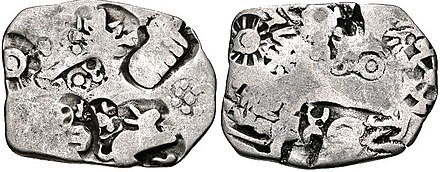
The introduction of coinage was a revolutionary development. Let's look at the specifics of their manufacture and use.
The First coins of Ancient India | Punch-Marked Coins
The channel Jay Vardhan Singh offers a concise look at the specifics of these first coins, from their weight standard to their denominations.
Please watch from 04:23 to 05:05, and then from 07:46 to 10:55. Focus on: The timeline for the introduction of coinage. The manufacturing process that gives them their name. The different denominations, such as the standard 'karshapana'.
The adoption of a metallic currency had profound implications:
- Efficiency: It dramatically simplified transactions, eliminating the "double coincidence of wants" required in a barter system.
- Taxation: It allowed states like Magadha to collect revenue in a storable, quantifiable, and easily transportable form, which was essential for paying soldiers and officials.
- Accumulation: It facilitated the accumulation of wealth by merchants and the state, further fueling investment and state-building.
Conclusion
In this lesson, we have dissected the socio-economic engine of the 6th century BCE. We saw how a surplus in agriculture laid the groundwork for the Second Urbanization, creating a new landscape of cities and towns. Within these urban centers, commerce and craft were organized by sophisticated guilds, or shrenis, which acted as proto-corporations and banks. This entire system was lubricated and accelerated by the introduction of punch-marked coins, which monetized the economy and enabled a new scale of trade and state finance. These were not isolated developments; they were interlocking parts of a dynamic system that created the wealth and complexity that underpinned the rise of great kingdoms and new religious philosophies.
Key Takeaways:
- The Second Urbanization was driven by an agricultural surplus generated by iron technology and wet-rice cultivation in the Gangetic plains.
- Trade and craft production were managed by shrenis (guilds), which were powerful, self-regulating bodies that set standards, organized labor, and performed crucial financial functions like banking and credit provision.
- The introduction of punch-marked coins, primarily silver, marked the beginning of a monetary economy, which streamlined trade, taxation, and wealth accumulation.
Preview of the Next Lesson:
Now that we understand the key mechanisms of commerce—guilds and coinage—we will turn our attention to the networks they operated on. In the next lesson, we will map out the major trade routes, such as the famous Uttarapatha and Dakshinapatha, and examine the key urban centers that served as the critical nodes in this subcontinental and international commercial web.