Introduction
Welcome back. In our last lesson, we charted the emergence of the first territorial states, or janapadas, in the Later Vedic period. We saw how the shift to settled agriculture in the Gangetic plains transformed society and led to the rise of kings whose power was based on land and legitimized by elaborate rituals.
Today, we will witness the dramatic scaling up of this process. This lesson addresses the learning outcome: Identify the 16 Mahajanapadas and explain the political, economic, and military factors behind Magadha's dominance. We will explore the vibrant and competitive political landscape of the 6th century BCE, an era marked by the consolidation of these janapadas into "great kingdoms," or Mahajanapadas. We will then conduct what amounts to a strategic analysis of why one of these kingdoms, Magadha, outmaneuvered and ultimately absorbed its rivals to lay the foundation for India's first great empire. Your background in M&A and strategic analysis will be particularly relevant here as we deconstruct the "business model" of an ancient empire.
1. The Stage is Set: The Age of the Mahajanapadas
Around the 6th century BCE, the socio-economic trends we've been studying—agricultural surplus from iron ploughs and wet rice cultivation, population growth, and increasing trade—reached a critical point. This allowed for the support of larger political entities with more complex administrative and military structures. The age of the Mahajanapadas had begun.
To understand the material basis for this political transformation, let's watch a segment that connects the dots from the Later Vedic economy to the rise of these large states.
Territorial States and The First Magadhan Empire FULL CHAPTER | RS Sharma Chapter 11
This video from OnlyIAS UPSC provides an excellent overview of the economic prerequisites for the formation of the Mahajanapadas, such as agricultural surplus, the rise of artisans and trade, and the development of taxation and standing armies.
Please watch the segment from 01:46 to 28:04. As you watch, focus on the causal chain: how does iron technology lead to agricultural surplus, and how does that surplus enable the existence of non-agricultural specialists like kings, soldiers, and artisans, which are the building blocks of a complex state?
The political landscape that resulted from these developments was a patchwork of sixteen major states, as documented in Buddhist texts like the Anguttara Nikaya.
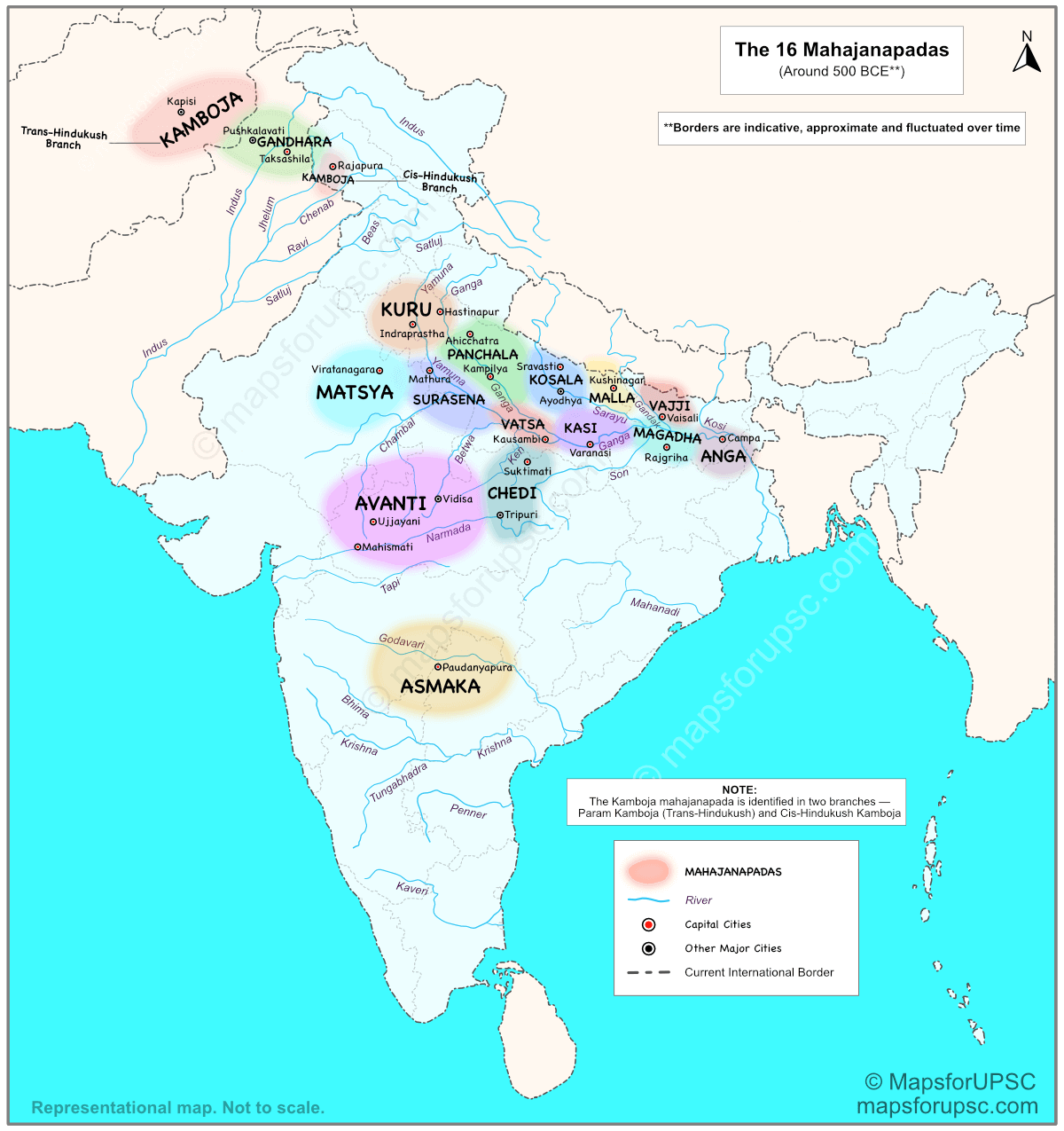
These states were not all alike. They primarily fell into two categories:
- Monarchies: Ruled by a hereditary king (e.g., Magadha, Kosala, Avanti, Vatsa).
- Gana-sanghas (Republics/Oligarchies): Governed by an assembly of clan chiefs or nobles rather than a single king (e.g., the Vrijjis of Vaishali, the Mallas of Kusinara).
To get a clearer picture of these key players, please consult the following reading.
Mahajanapadas- Rise of Magadha – Nandas – Invasion of Alexander
The following document from INFLIBNET provides concise descriptions of all 16 Mahajanapadas and includes a handy reference table.
First, skim through the descriptions of a few key Mahajanapadas under the heading 'Sixteen Mahajanapadas'. I suggest focusing on Kasi, Kosala, Avanti, and the Vrijji confederacy to get a feel for their individual characteristics. Then, review the table 'The List of sixteen Mahajanapadas and their Capitals' at the end for a complete overview.
2. The Rise of Magadha: Strategy and Conquest
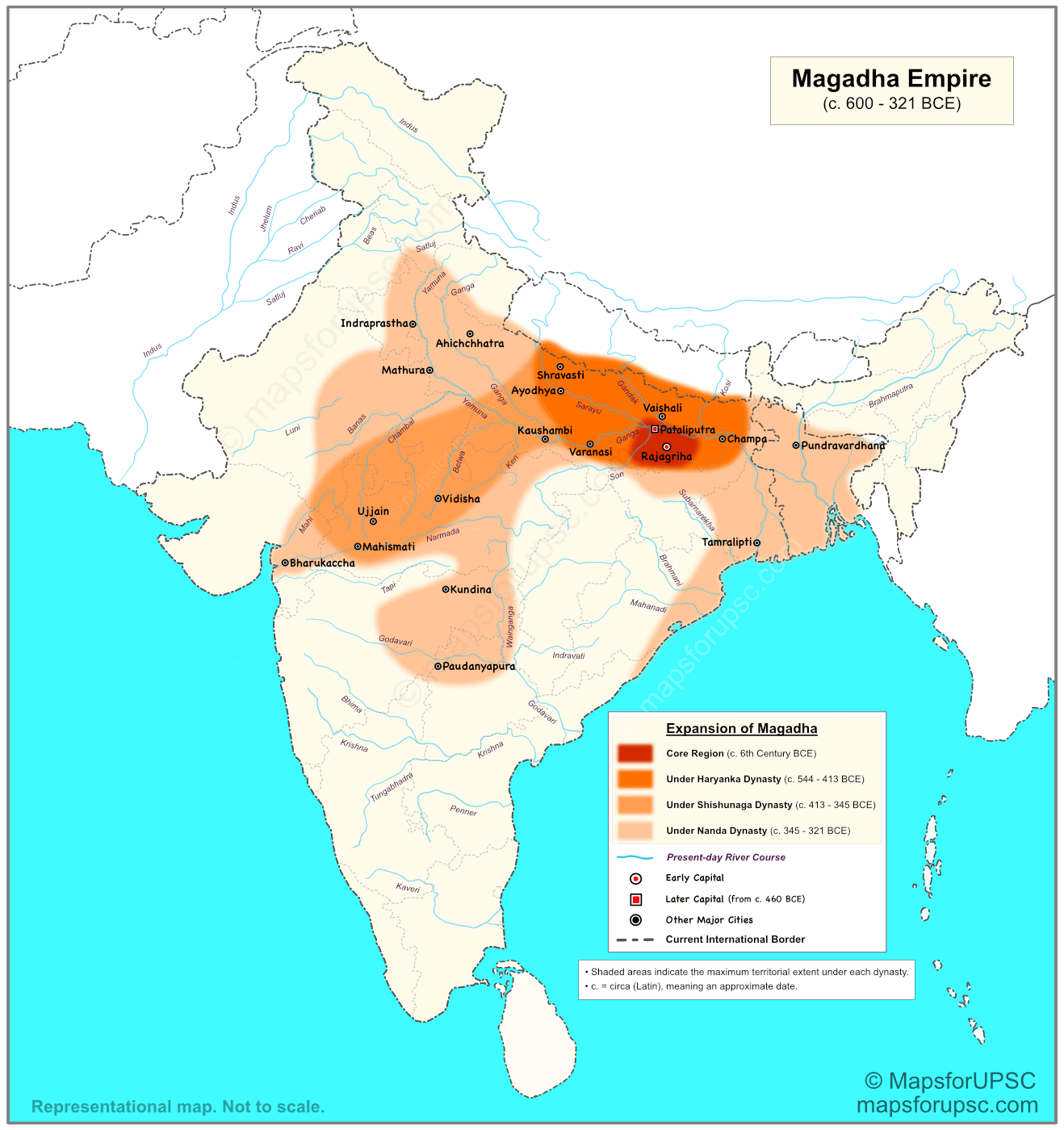
In this competitive environment, four monarchies emerged as the main contenders for supremacy: Kosala, Vatsa, Avanti, and Magadha. Over the course of about a century, through a combination of ruthless ambition, strategic diplomacy, and military might, Magadha systematically eliminated its rivals.
This ascent began with the Haryanka dynasty.
- Bimbisara (c. 544-492 BCE): He employed a three-pronged strategy.
- Matrimonial Alliances: He secured his western and northern flanks by marrying princesses from Kosala and the Vrijji confederacy (Lichchhavi clan), turning potential rivals into allies.
- Conquest: He conquered the eastern kingdom of Anga, gaining control of its river ports and trade.
- Diplomacy: He maintained friendly relations with the powerful western kingdom of Avanti.
- Ajatashatru (c. 492-460 BCE): More aggressive than his father, Ajatashatru engaged in protracted wars. He fought and eventually subdued a hostile Kosala. His most significant and lengthy campaign was against the powerful Vrijji confederacy to the north, which he weakened through internal dissent before conquering it. He also fortified his capital, Rajagriha, in anticipation of a conflict with Avanti.
The subsequent Shishunaga dynasty delivered a decisive blow by defeating and annexing Avanti, Magadha's last great rival. Finally, the Nanda dynasty, under the powerful Mahapadma Nanda, inherited this consolidated kingdom and expanded it into the first true empire of northern India, creating a massive, centrally administered state with a formidable army.
3. The Factors of Dominance: An Analysis of Magadha's Success
Why Magadha? Its ultimate victory was not a matter of chance. It was the result of a powerful confluence of geographic, economic, and political factors that gave it a decisive edge. We can analyze these as a series of strategic advantages.
A. Geographic and Economic Advantages
Magadha's location was its greatest asset.
Strategic Location and Importance of Magadha in Ancient India
This article from BA Notes clearly outlines the strategic importance of Magadha's geography. Please read the following sections to understand how its location translated into economic and military power.
Please read the sections 'The geographical advantage of Magadha’s location' and 'Command over vital trade routes and resources'. Focus on how control over rivers, fertile land, and mineral deposits created a self-reinforcing cycle of wealth and power.
To summarize and build on the reading:
- Fertile Land: Situated in the lower Gangetic plains, which received ample rainfall, the land was exceptionally fertile. This produced a massive agricultural surplus, which was the primary source of state revenue.
- Riverine Control: Its later capital, Pataliputra (modern Patna), was located at the confluence of the Ganga, Gandak, and Son rivers. This acted as a "water fort" (jaladurga), providing natural defense. More importantly, it gave Magadha control over the riverine trade routes, the highways of ancient India. It effectively became a choke point for commerce, allowing it to levy tolls and taxes.
- Mineral Resources: The region, especially after the conquest of Anga, had rich deposits of iron ore (in present-day Jharkhand). This gave Magadha a near-monopoly on the key resource for manufacturing superior weapons and agricultural tools.
- Timber and Elephants: The surrounding forests provided ample timber for building cities and chariots, and, crucially, elephants. Magadha was the first kingdom to use elephants in warfare on a large scale, which acted as the ancient equivalent of tanks, terrifying opponents and breaking through enemy lines.
B. Political and Military Factors
Resources alone are not sufficient; they must be effectively mobilized by political will.
NCERT Class 12 | Ancient History | Why Magadha was able to transform from Mahajanapada to Empire
This video from Let's Crack UPSC CSE excellently explains the political dimension of Magadha's rise, focusing on its ambitious rulers and military innovations.
Please watch the segment from 41:17 to 59:35. The speaker discusses the 'enterprising' and 'ruthless' nature of Magadhan kings like Ajatashatru and how they used their resources to build a powerful and innovative military machine.
The key political and military factors were:
- Ambitious Rulers: Magadha was blessed with a succession of capable and ruthless kings like Bimbisara, Ajatashatru, and Mahapadma Nanda who were masters of both diplomacy and warfare. They were unburdened by sentiment and singularly focused on imperial expansion.
- Strategic Capitals: The choice of capitals was strategic. The first, Rajagriha, was surrounded by five hills, making it a naturally impregnable fortress. The later shift to Pataliputra was a masterstroke, moving from a defensive posture to an offensive one, better suited for controlling the vast river network and administering a growing empire.
- A Heterodox Society: Being on the eastern periphery of the core Vedic cultural area, Magadhan society was less orthodox and more syncretic. This social dynamism may have allowed for greater social mobility and a more pragmatic, materialistic outlook, which favored political consolidation and economic expansion over rigid adherence to tradition.
Conclusion
In this lesson, we surveyed the political landscape of 6th century BCE India, identifying the 16 Mahajanapadas that competed for dominance. We then conducted a deep-dive analysis into the rise of Magadha, concluding that its success was a direct result of leveraging a superior strategic position.
Key Takeaways:
- The 6th century BCE was the age of the 16 Mahajanapadas, a mix of monarchies and republics that arose from the earlier janapadas.
- Magadha's dominance was not accidental. It stemmed from a powerful combination of factors:
- Economic Strength: Based on agricultural surplus, control of river trade, and access to crucial resources like iron and elephants.
- Political Acumen: Driven by a series of ambitious and ruthless rulers who used strategic alliances, warfare, and shrewd administrative decisions (like the capital shift to Pataliputra).
- Military Superiority: Enabled by iron weapons and the large-scale use of war elephants.
Preview of the Next Lesson:
The rise of large, centralized states like Magadha was both a cause and a consequence of profound economic changes. In our next lesson, we will focus on these developments, which historians call the "Second Urbanization." We will examine the growth of cities, the organization of craft and trade through guilds (shrenis), and the introduction of India's first monetary system: punch-marked coins. This will provide a more granular look at the economic engine that powered the political transformations we discussed today.