Introduction
Welcome to the final module of our course. In our last lesson, we concluded our study of the freedom struggle by examining the complex and painful series of events—the rise of communal politics, the failure of negotiations like the Cabinet Mission, and the escalating violence—that led to the British Parliament passing the Indian Independence Act and accepting the partition of the subcontinent. The decision, finalized in the June 3rd Plan, set the stage for the birth of two new nations: India and Pakistan.
This lesson addresses the learning outcome: Describe the immediate challenges of post-independence nation-building: Partition's aftermath and the integration of princely states.
As the tricolor was hoisted on August 15, 1947, the euphoria of freedom was profoundly overshadowed by two immediate and existential challenges. The first was a humanitarian crisis of unimaginable scale triggered by Partition. The second was a political crisis that threatened to tear the new nation apart before it could even find its footing: the integration of over 500 princely states into the Indian Union. We will explore how the nascent Indian state grappled with this dual trial by fire.
Part 1: The Aftermath of Partition - A Nation in Crisis
The drawing of the Radcliffe Line, which partitioned Punjab and Bengal, unleashed a storm of violence and one of the largest and most traumatic mass migrations in human history. The "aftermath" of Partition was not a post-script; it was the violent birth of the new state.
The Human and Economic Catastrophe
Beyond the political act of division, Partition was a profound human tragedy and a severe economic shock. For a clear, data-driven understanding of its impact, it is helpful to consult academic analyses of the event.
Catastrophic impact of 1947 partition of India - People’s health
The research paper 'Catastrophic impact of 1947 partition of India' published in the Journal of Family Medicine and Primary Care provides a comprehensive, albeit grim, overview of the consequences. It moves beyond narrative to quantify the impact, which will be useful for our analysis.
Please read the following sections of the paper: 'Catastrophic consequence of the partition': Focus on the scale of death and migration. 'Impact on population': Note the demographic shifts and the creation of a refugee crisis. The next four sections on the impact on land, food, industries/trade, and the economy: Pay attention to how the division of assets and resources created systemic problems for India. For instance, note the imbalance where India retained most jute mills but the raw jute-growing areas went to East Pakistan, or how the 'granaries' of Punjab and Sindh were lost, leading to a food crisis.
From this reading, we can distill the consequences into three critical areas:
-
Mass Migration and Violence: An estimated 14 million people were displaced, fleeing their ancestral homes to cross newly formed borders. The journey was marked by horrific communal violence, with death tolls estimated between one and two million. Around 75,000 women were abducted and subjected to brutal violence, treated as symbols of community honor to be defiled.
-
The Refugee Crisis: The newly formed government was immediately confronted with the task of rehabilitating millions of refugees. Refugee camps were established, and new townships like Faridabad and Lajpat Nagar (in Delhi) were built from scratch. This was an immense administrative and financial burden, requiring the establishment of a dedicated ministry to manage relief and rehabilitation.
-
Economic Disruption: As you saw in the paper, the partition was an economic disaster.
- Agriculture: India lost its prime wheat and cotton-producing regions in Punjab and Sindh to Pakistan, immediately creating a food deficit and requiring costly imports.
- Industry: The integrated economies of regions like Bengal and Punjab were severed. The jute industry in Bengal is a classic example: India had the mills around Calcutta, while the jute-growing areas went to East Pakistan. The same applied to the cotton industry.
- Infrastructure: Key road and rail links were cut, disrupting trade and communication.
- Macro-economy: This shock, combined with the costs of rehabilitation, placed immense strain on the new nation's finances, contributing to a decline in India's GDP per capita in the immediate post-partition years.
Part 2: The Integration of the Princely States
Simultaneously with the Partition crisis, a second, equally grave threat to India's existence was unfolding. The Indian Independence Act of 1947 ended the "paramountcy" of the British Crown over the princely states. This meant that the roughly 565 states, varying wildly in size and importance, were legally independent.
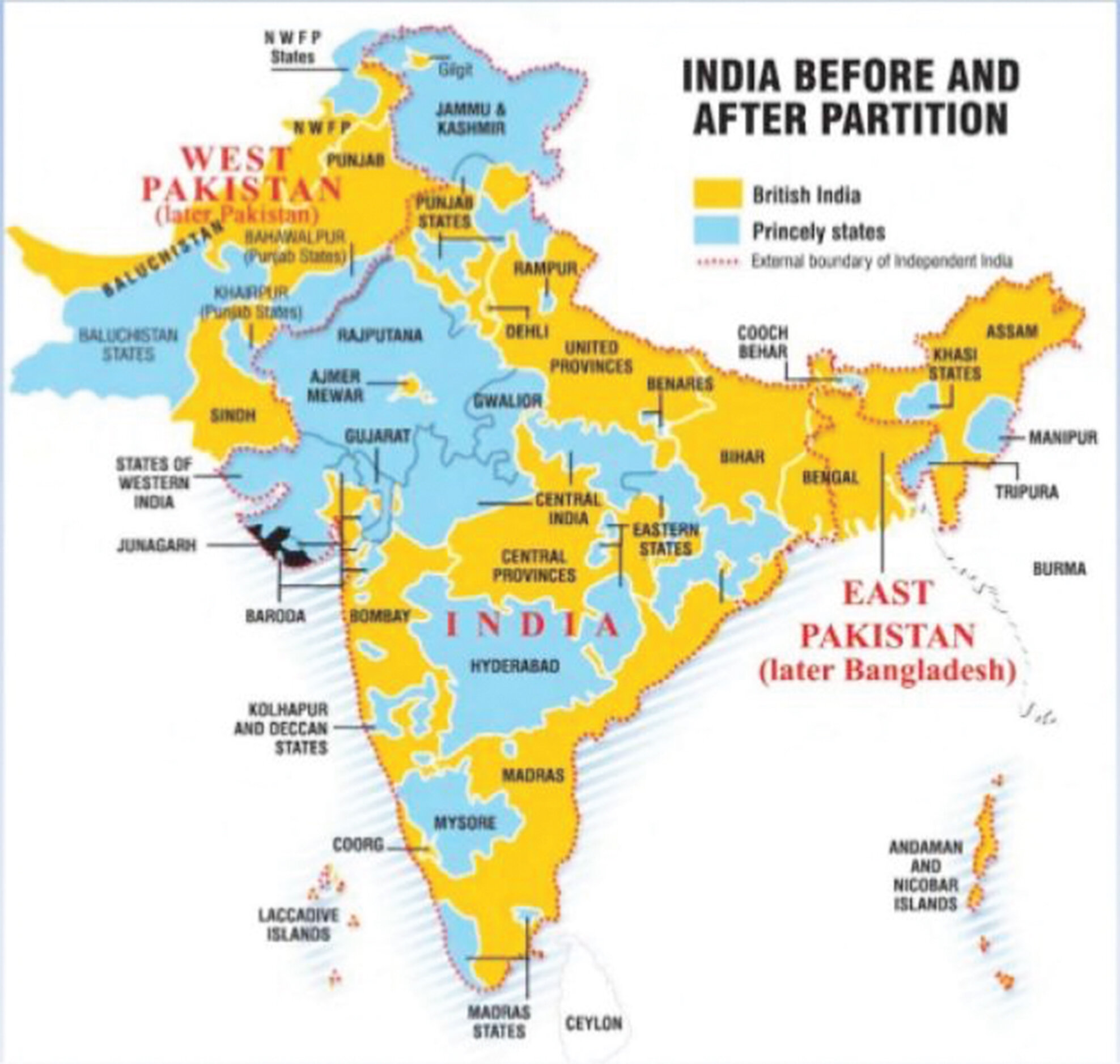
The task of preventing this and forging a unified nation fell to the newly created States Department, headed by Sardar Vallabhbhai Patel, with his exceptionally able secretary, V.P. Menon.
The 'Carrot and Stick' Strategy
Patel and Menon employed a masterful strategy of diplomacy, persuasion, and, when necessary, coercion. Their approach can be summarized as follows:
- The Instrument of Accession: This was the primary legal tool. Rulers were asked to sign this document, ceding control over just three subjects: Defence, Foreign Affairs, and Communications. In return, they were promised that they would retain autonomy in all other internal matters.
- Appeals to Patriotism: Patel tirelessly met with rulers, appealing to their sense of duty to a larger Indian nation.
- The 'Carrot' - Privy Purses: To sweeten the deal, rulers who signed the Instrument of Accession were offered a privy purse—a generous, tax-free annual payment from the government of India, guaranteed for them and their successors. This was a pragmatic financial incentive to compensate for their loss of sovereignty.
- The 'Stick' - Popular Pressure and Coercion: Where diplomacy failed, Patel's ministry was not afraid to use pressure. This included encouraging popular movements (Praja Mandals) within the states to demand integration with India, and in some cases, hinting at or using military force.
The documentary below provides an excellent overview of this complex process, including the key tools and case studies.
The Integration Of India's Princely States | Full Documentary
The documentary 'The Integration Of India's Princely States' provides a detailed analysis of the strategies and challenges involved. We'll focus on the initial setup and the most difficult cases.
Watch the segment from the beginning to 07:53. This covers: The Problem: The lapse of paramountcy and the threat of balkanization (00:00 - 01:58). The Strategy: An introduction to Patel and Menon's pragmatic approach (01:58 - 02:52). The Tools: A clear explanation of the Standstill Agreement and the crucial Instrument of Accession (02:52 - 03:50). The 'Carrot and Stick' in Action: How incentives like privy purses and the threat of popular revolt were used to persuade the majority of states (03:50 - 07:53).
By August 15, 1947, this strategy had succeeded in securing the accession of almost all states geographically contiguous with India. However, a few crucial and defiant states remained.
The Three Problematic States
The real test of Patel's resolve came from three states that resisted integration. Their cases demonstrate the full range of tactics used by the States Department.
The Man Who United 565 Princely States: Sardar Patel’s Untold Story
Let's turn to another video for a concise summary of how these three critical holdouts—Junagadh, Hyderabad, and Kashmir—were integrated.
Watch the segment from 05:39 to 07:37. It provides a quick and clear overview of the events in each of the three states.
Let's break down these cases in more detail:
-
Junagadh:
- The Problem: A state on the coast of Gujarat with a majority-Hindu population but a Muslim ruler (the Nawab) who decided to accede to Pakistan, despite having no land border with it.
- The Response: India argued the accession was invalid. It imposed an economic blockade and supported a provisional government formed by Junagadhi citizens. When the Nawab fled to Pakistan, Indian forces moved in. A plebiscite (public vote) was held in February 1948, which resulted in an overwhelming vote (99%) in favor of joining India. This was a case of combining economic, popular, and military pressure, legitimized by a democratic vote.
-
Hyderabad:
- The Problem: The largest and wealthiest princely state, located in the heart of India. Its Muslim ruler, the Nizam, wanted to remain an independent sovereign state. His position was backed by a radical militia, the Razakars, who terrorized the local population and attacked pro-India sympathizers.
- The Response: After months of failed negotiations, and with the Razakars' violence spiraling out of control, India's patience ran out. In September 1948, the Indian Army launched "Operation Polo." The military action was swift, lasting only five days, after which the Hyderabad army surrendered and the Nizam acceded to India. This was the clearest example of the use of decisive military force when all other options were exhausted.
-
Kashmir:
- The Problem: A large state with a majority-Muslim population but a Hindu ruler, Maharaja Hari Singh. He, like the Nizam of Hyderabad, dreamed of independence and delayed his decision to accede to either India or Pakistan.
- The Response: In October 1947, tribal invaders backed by the Pakistan army crossed the border and advanced towards the capital, Srinagar. Facing the complete collapse of his state, the Maharaja urgently appealed to India for military assistance. India agreed, on the condition that he first sign the Instrument of Accession. He did so on October 26, 1947, making Kashmir legally a part of India. Indian troops were airlifted to Srinagar just in time to save the city. This accession, however, led to the first India-Pakistan war and became a long-standing dispute.
The integration of the princely states was a monumental achievement, described by Patel as a "bloodless revolution" that created a unified Indian state out of a fragmented political landscape.
Conclusion
The period immediately following August 1947 was arguably the most perilous in India's modern history. The new nation was born amidst the chaos of Partition and faced an immediate threat of disintegration.
Key Takeaways:
- Partition's Aftermath: The independence of India was accompanied by a humanitarian catastrophe involving mass migration, unprecedented violence, and a severe refugee crisis. It also dealt a crippling blow to the nation's economy, creating food shortages and disrupting key industries.
- Integration of Princely States: The lapse of British paramountcy left India politically fragmented. The visionary and firm leadership of Sardar Patel, through a strategic mix of diplomacy (Instrument of Accession), financial incentives (privy purses), and decisive force (as in Hyderabad), successfully integrated over 500 states, thereby preventing the balkanization of the country and forging a unified Indian union.
These two challenges—coping with the trauma of Partition and building a cohesive political entity—were the foundational tasks that had to be accomplished before any other work of nation-building could begin.
Preview of the Next Lesson:
Having secured its territory, the next monumental task for India's leaders was to define the nation's political soul. In our next lesson, we will delve into the making of the Indian Constitution, examining the guiding principles, the key debates in the Constituent Assembly, and the framework they created for the world's largest democracy.