Introduction
Welcome back. In our previous lesson, we examined the Mansabdari system, the sophisticated human resources framework that organized the Mughal elite. We saw that this system, particularly the payment of salaries through jagirs, depended entirely on the state's ability to generate revenue from the land. This raises a critical question: How did the empire assess and collect this wealth to fund its vast administrative and military machinery?
Today, we will answer that question by exploring the other great pillar of Mughal administration. Our learning outcome is to explain Todar Mal's land revenue settlement (Zabti/Dahsala) and its role in the Mughal economy. This system was a landmark achievement in fiscal policy, designed by Emperor Akbar and his brilliant finance minister, Raja Todar Mal.
From your perspective in finance, you can think of this as the Mughals moving away from an erratic, ad-hoc system of revenue collection to a standardized, data-driven model designed to create predictable cash flows for the imperial treasury while providing stability to the agricultural sector.
Part 1: The Pre-Akbar Context and the Need for Reform
Before Akbar and Todar Mal's interventions, the land revenue system was fraught with problems. It often relied on old, inaccurate records, and the assessment methods were inconsistent. The state's demand would often fluctuate wildly from year to year, creating uncertainty for both the peasants and the imperial treasury.
This annual process of fixing prices and settling revenues was cumbersome and a major source of corruption for local officials. Sher Shah Suri had made important preliminary reforms by introducing systematic land measurement, but his reign was too short to create a lasting, empire-wide structure. Akbar inherited this foundation but recognized the need for a more robust and permanent solution.
To understand the improvements Todar Mal made, it's helpful to first review the system he inherited and refined.
[PDF] Akbar's Land Revenue System
This PDF, 'Akbar's Land Revenue System,' provides a good overview of the situation before Todar Mal's final reforms, especially highlighting the foundational work of Sher Shah Suri.
Please read the section titled 'Land Revenue System' on pages 8-9. It begins with 'There was no Mughal land revenue system before Akbar...' and ends just before 'Akbar established a proper land revenue system.' Focus on the methods used by Sher Shah, as they form the direct precursor to Todar Mal's system.
As you've read, the key elements of Sher Shah's system—land measurement and fixing the state's share at one-third of the average produce—were crucial starting points. However, the assessment was still largely an annual affair, which Akbar and Todar Mal sought to change.
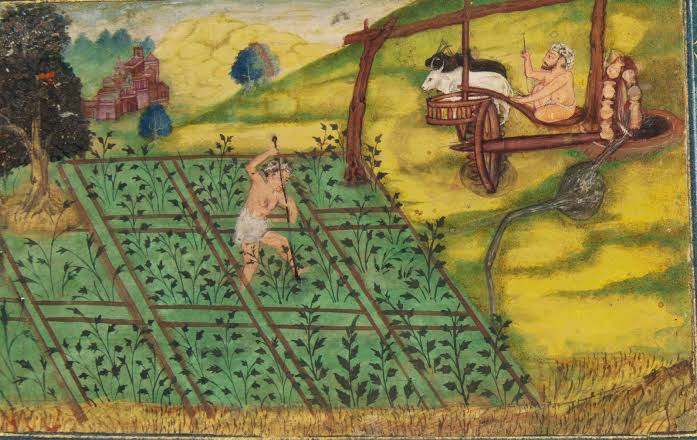
Part 2: The Architecture of the Zabti/Dahsala System
Introduced formally around 1580, the new system was a combination of two interconnected concepts: Zabt (measurement) and Dahsala (ten-year). It was a scientific framework built on four key pillars: measurement, classification, averaging, and monetization.
1. Standardized Measurement
The foundation of any accurate assessment is reliable measurement. Todar Mal replaced the easily manipulated hempen rope with the jarib, a chain of bamboo rods linked with iron rings. This ensured a consistent unit of length regardless of weather conditions. The standard unit of area was the bigha.
2. Classification of Land
The system recognized that not all land is equally productive. To ensure a fair assessment, land was classified into four categories based on the continuity of cultivation:
Polaj: Land that was cultivated annually and never left fallow. This was the most fertile and taxed at the full rate every year.Parauti: Land left fallow for a year or two to recover its fertility. It was taxed at the full rate when cultivated.Chachar: Land that had lain fallow for three to four years. It was taxed at a progressive, concessional rate to encourage its reuse.Banjar: Wasteland left uncultivated for five years or more. It was subject to very lenient tax rates over several years to incentivize bringing it under cultivation.
The following video provides a clear explanation of this classification and the overall mechanics of the system.
Dahsala or Zabti System also known as Todarmal Bandobast Explained
Let's watch a section of the video 'Dahsala or Zabti System' by HD Education. It breaks down the land classification and explains how the ten-year average was calculated.
Please watch from 05:34 to 09:44. Pay close attention to the definitions of the four land types and how they were taxed differently. This demonstrates the system's built-in flexibility and fairness.
3. The Dahsala (Ten-Year) Assessment
This was the system's most revolutionary feature. Instead of fixing revenue demands annually, Todar Mal's team compiled agricultural data for the preceding ten years (1570-1579). They calculated two key averages for each locality (pargana):
- The average produce/yield for each crop.
- The average market price for each crop.
The state's share was then fixed at one-third of this ten-year average produce, converted into a cash value based on the ten-year average price. This established a fixed and predictable revenue demand for the medium term, eliminating the uncertainty of the old annual system.
4. The Zabti System and Dasturs
The term Zabti refers to this overall system of assessment based on measurement. The fixed cash revenue rate for each crop in a given region was known as the dastur. The empire was divided into revenue circles, each with a uniform set of dasturs, accounting for local variations in productivity and prices.
To formalize this, each cultivator was issued a patta (a deed specifying their landholdings and tax liability) and in turn signed a qabuliyat (an agreement to pay the assessed revenue). This introduced a level of contractual clarity to the state-peasant relationship.
Part 3: Role and Impact on the Mughal Economy
The Zabti/Dahsala system was more than an administrative reform; it was a powerful economic engine that shaped the Mughal state's destiny.
The following resource provides a superb evaluation of the system's effectiveness and limitations, which directly addresses its role in the economy.
Todar Mal's Revenue System Evaluation
The article 'Todar Mal's Revenue System Evaluation' from Dalvoy offers a concise yet comprehensive analysis of the system's structure and its economic impact.
Please read the sections 'Structural Features of Todar Mal's Revenue System' and 'Evaluation of Effectiveness in Standardized Land Revenue Assessment.' Focus on how the system contributed to fiscal stability, monetization, and agricultural promotion, as well as its limitations.
Drawing from the reading and our discussion, we can analyze the system's impact:
Positive Economic Impacts:
- Fiscal Stability and Predictability: By establishing a fixed revenue demand, the system guaranteed a stable and predictable income for the state. This fiscal stability was essential for funding the Mansabdari system, the army, and large-scale architectural projects. It allowed for long-term financial planning, a concept very familiar to modern finance.
- Monetization of the Economy: The strong preference for revenue payment in cash compelled peasants to sell their surplus produce in the market. This accelerated the transition from a barter economy to a money economy, stimulating trade and the growth of urban centers.
- Promotion of Agriculture: The system incentivized agricultural expansion. By providing clear tenure (
patta) and a predictable tax burden, it gave peasants the security to invest in their land. The concessional rates forchacharandbanjarlands actively encouraged the cultivation of wastelands, increasing the overall agricultural output of the empire. - Reduced Corruption and Exploitation: While not eliminating it, the system reduced the arbitrary power of local officials and intermediaries. With a fixed, officially recorded demand, it was harder for them to make illegal exactions from the peasantry.
Limitations and Drawbacks:
- Rigidity in the Face of Calamity: The ten-year average, while providing stability, was inflexible. It couldn't account for sudden, severe crop failures due to drought, floods, or pests. In such years, the fixed demand became an unbearable burden on the peasants.
- High Cost and Complexity: Implementing the system was a massive undertaking. It required a large, trained, and honest bureaucracy to conduct accurate surveys. This was expensive, and a special cess called
jabitanawas sometimes levied on peasants to cover the measurement costs. - Limited Geographical Reach: The Zabti system was most effective in the core, flat, and fertile provinces of the empire, from Lahore to Allahabad. In other regions like Bengal, Gujarat, or the Deccan, where measurement was difficult, other systems like
batai(crop-sharing) continued to be used. - Heavy Tax Burden: Even with its fairness, a one-third share of the produce was a heavy tax. It left the average peasant with little surplus, keeping subsistence levels low.
Conclusion
Todar Mal's land revenue settlement was a masterpiece of medieval fiscal administration. It was the crucial economic counterpart to the Mansabdari system, providing the financial lifeblood that sustained the Mughal empire at its zenith.
Key Takeaways:
- The Zabti/Dahsala system replaced arbitrary annual assessments with a scientific, data-driven framework based on a ten-year average of yields and prices.
- It involved meticulous land measurement (
jarib) and classification (polaj,parauti,chachar,banjar) to ensure fairness. - Its primary role in the economy was to provide fiscal stability for the state, promote the monetization of the rural economy, and incentivize agricultural expansion.
- The system formalized the peasant-state relationship through legal documents (
pattaandqabuliyat), reducing the scope for local corruption. - Despite its sophistication, it had limitations, including its rigidity during natural calamities and its limited geographical application.
Preview of the Next Lesson:
Having secured the administrative (Mansabdari) and fiscal (Zabti/Dahsala) foundations of his empire, Akbar turned his attention to its ideological and cultural cohesion. How could he rule a vast subcontinent populated overwhelmingly by non-Muslims? In our next lesson, we will analyze Akbar's unique approach to this challenge by exploring his religious policy of 'sulh-i-kul' (universal peace) and its evolution through the Ibadat Khana debates.