Introduction
Welcome to our next lesson on the Mughal Empire. In our previous sessions, we explored the 'hard power' of the empire: the Mansabdari system, which organized its military and nobility, and the Zabti/Dahsala system, which provided its financial lifeblood. These were the structural steel and concrete of the imperial edifice. Today, we turn to the 'soft power'—the ideological mortar that was needed to hold this vast, diverse structure together.
Your background in finance and economics gives you a keen appreciation for systems that create stability and manage risk. Akbar, as a master statesman, understood that military and fiscal strength alone were insufficient to rule a subcontinent where his own ruling class was a small minority. He faced the classic challenge of governance: how to foster unity and loyalty among people of vastly different beliefs.
Our focus for this lesson directly addresses this challenge. The learning outcome is to analyze Akbar's religious policy of 'sulh-i-kul' (universal peace) and its evolution through the Ibadat Khana debates. We will trace the journey of Akbar's personal beliefs and how they translated into a sophisticated state policy that became a hallmark of his reign.
Part 1: The Foundations of a Liberal Outlook (Pre-1575)
Akbar's religious policy didn't emerge in a vacuum. It was the product of his personal temperament, his political necessities, and the rich intellectual currents of his time. Before he initiated the famous debates, several factors were already pushing him towards a more liberal and inclusive approach.
Akbar: Evolution of religious and social outlook, theory of Sulh-i-kul ...
To understand the origins of Akbar's unique perspective, let's examine the key influences on his early life and reign. This article from Self Study History, titled 'Akbar: Evolution of religious and social outlook,' provides an excellent overview of these formative factors.
Please read the introduction (under 'Following factors determined Akbar’s state religious policy...') and the section titled '(1) The First Phase (1556-73)'. Focus on the three main influences—Turko-Mughal traditions, Bhakti-Sufi movements, and his tutors—and note the early policy decisions like abolishing the jizya and pilgrimage tax.
As you've read, we can identify several key streams of influence:
- Ancestral Legacy: The Turko-Mughal tradition, inherited from figures like Chingiz Khan and Timur, was often pragmatic and less dogmatic than that of other Islamic empires, prioritizing political stability over strict religious uniformity.
- Intellectual Milieu: Akbar's India was alive with the syncretic ideas of the Bhakti and Sufi movements, which emphasized a personal connection to the divine over rigid rituals and sought common ground between Hinduism and Islam. His tutor, Abdul Latif, was also known for his liberal views.
- Political Pragmatism: To consolidate an empire in a Hindu-majority land, alienating the vast populace was not a viable strategy. His matrimonial alliances with Rajput princesses—whom he allowed to practice their faith within the imperial household—were a clear sign of this accommodative policy.
These factors culminated in two landmark decisions that predated his deeper philosophical explorations:
- Abolition of the Pilgrimage Tax (1563): This tax was levied on Hindus visiting their holy sites.
- Abolition of the Jizya (1564): This was the per-capita tax on non-Muslim subjects.
By removing these discriminatory taxes, Akbar signaled a fundamental shift: non-Muslims were to be treated as equal subjects of the empire, not merely as a source of revenue. However, this was just the beginning of his intellectual journey.
Part 2: The Ibadat Khana – An Imperial 'Think Tank'
By 1575, with the empire's borders secured and its administration taking shape, Akbar's deep spiritual curiosity led him to create a unique institution: the Ibadat Khana (House of Worship) at his new capital, Fatehpur Sikri. You can think of this as an imperial 'think tank' or a formal forum for debating theology and philosophy.
Initially, these debates were an internal affair within Islam. However, Akbar's experience here fundamentally altered his perspective and the course of his policy.
Akbar: The Muslim Monarch Who Championed Religious Harmony
This video, 'Akbar: The Muslim Monarch Who Championed Religious Harmony,' offers a compelling narrative of Akbar's spiritual journey. The first segment we'll watch sets the scene, describing Akbar's personal piety and his decision to establish the Ibadat Khana.
Please watch from 07:26 to 13:34, and then from 17:27 to 19:47. The first part covers his devotion to Sufism, particularly the tolerant Chishti order. The second part details the creation of the Ibadat Khana and his motivation for inviting scholars from different faiths.
The evolution of the Ibadat Khana debates occurred in two distinct phases:
Phase 1: The Intra-Faith Debates (1575–1578)
Akbar initially invited only Sunni Muslim scholars, jurists, and mystics. He was quickly dismayed. The debates were characterized by bitter arguments, intellectual arrogance, and dogmatism, with different scholars trying to prove their superiority rather than seeking truth. Disappointed by the orthodox ulama, he expanded the circle to include Shia scholars, which only intensified the sectarian squabbling.
Phase 2: The Inter-Faith Debates (1578–1582)
Realizing that truth was not the exclusive property of any single sect, Akbar threw the doors of the Ibadat Khana wide open. He invited Hindu pandits, Jain monks, Zoroastrian priests, and even Christian Jesuit fathers from Goa to debate with each other and with the Muslim scholars.
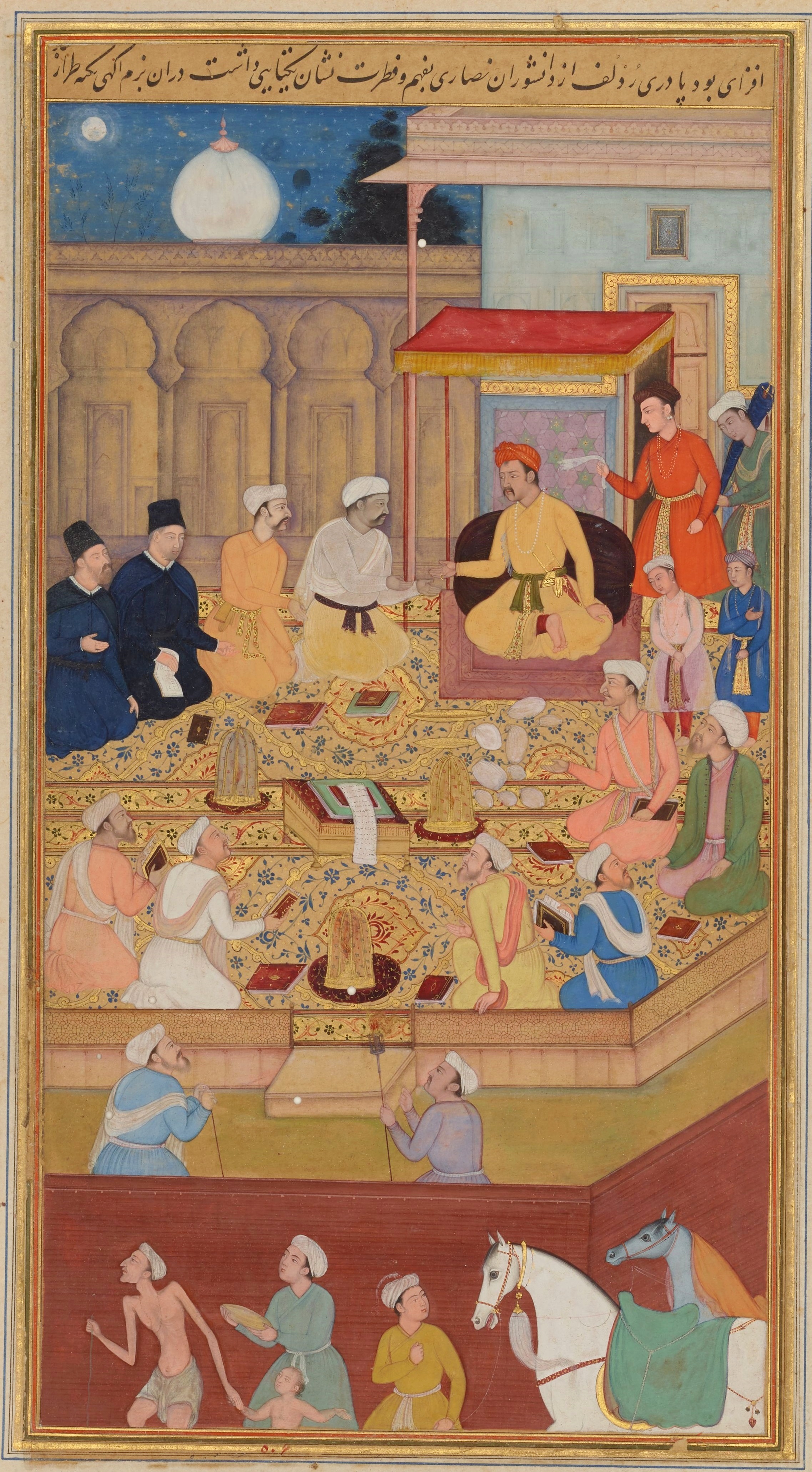
These intense, all-night discussions convinced Akbar of two things:
- The orthodox clergy (ulama) were often more concerned with power and dogma than with spiritual truth.
- All religions, despite their differences, contained elements of truth and shared a common quest for a single, divine reality.
This realization was the crucible in which his mature religious policy would be forged.
Part 3: Consolidating Power and Philosophy
The Ibadat Khana was more than a philosophical exercise; its outcomes had direct political consequences. The debates provided Akbar with the intellectual justification to challenge the authority of the orthodox ulama and formulate his own vision for the empire. This led to two significant and controversial developments.
1. The Mahzar (The 'Infallibility' Decree) of 1579
Having witnessed the endless and often self-serving disputes of the clerics, Akbar, guided by advisors like Shaikh Mubarak and his son Abul Fazl, issued the Mahzar (attested statement).
This document, signed (some say coerced) by leading ulama, declared that if there were conflicting interpretations of Islamic law, Akbar, as a just ruler (Imam-i-Adil), had the authority to choose the interpretation that served the best interest of the state and the public good. He could also issue new decrees provided they did not contradict the Quran.
From a governance perspective, this was a masterstroke. It was not a claim to prophethood, but a political move to subordinate the religious establishment to the authority of the state. It effectively made the emperor the ultimate arbiter in religious matters, cutting the ulama's power down to size.
2. Tauhid-i-Ilahi (Divine Monotheism)
The most debated outcome of Akbar's religious explorations is what is often mislabeled Din-i-Ilahi (Divine Faith). A more accurate name is Tauhid-i-Ilahi (Divine Monotheism). The central question is: Was this a new religion designed to replace Islam and Hinduism, or something else entirely?
The following resource explores this controversy in detail, presenting the conflicting historical accounts.
Akbar: The Muslim Monarch Who Championed Religious Harmony
Let's return to the video 'Akbar: The Muslim Monarch Who Championed Religious Harmony' to analyze the nature and purpose of Tauhid-i-Ilahi. This segment carefully weighs the evidence from both Akbar's supporters and his critics.
Please watch from 19:47 to 28:37. Pay close attention to the two main interpretations: one portraying it as a new, syncretic religion (the view of critics like Badauni), and the other seeing it as a Sufi-inspired order for Akbar's closest disciples.
As the video explains, the evidence suggests that Tauhid-i-Ilahi was not a new religion for the masses. Instead, it was an elite order or a discipleship centered on the emperor. Its members were high-ranking nobles, who swore personal loyalty to Akbar. It combined elements from Sufism, Zoroastrianism, and Jainism and aimed to create an ideologically unified ruling class that was bound by loyalty to the throne, transcending their diverse ethnic and religious origins. With only a handful of members, it was a political tool for the inner circle, not a new faith for the empire.
Part 4: Sulh-i-Kul – The Cornerstone of State Policy
The culmination of Akbar's entire intellectual and spiritual journey was the policy of Sulh-i-Kul. This became the philosophical foundation of the Mughal state under his rule.
Religious Conflict in Early Modern India - UMN Libraries Publishing
The concept of 'Sulh-i-Kul' is more nuanced than its usual translation of 'universal peace.' This scholarly article, 'Religious Conflict in Early Modern India,' provides a precise definition and explains how Akbar applied this policy to both non-Muslims and Muslims within his empire.
Please read the three short sections starting with the heading that begins 'After the fractious but enlightening discussions...'. Note the more accurate translation of 'sulh-i kull' as 'lasting reconciliation' and focus on the specific actions Akbar took to implement this policy towards different communities.
As you have read, Sulh-i-Kul, or "lasting reconciliation," was not about creating a single religion. It was a state policy of active tolerance and non-discrimination, ensuring that all subjects could live and worship freely without fear of persecution. It was a framework for managing a pluralistic society.
The principles of Sulh-i-Kul were:
- Freedom of Religion: The state would not interfere in the religious beliefs and practices of its subjects.
- Abolition of Discrimination: Policies like the jizya that discriminated based on religion were eliminated.
- Equal Opportunity: State patronage and offices were open to talented individuals from all communities. The high positions held by Rajputs like Raja Todar Mal and Raja Man Singh are prime examples.
- Rational Discourse: The state would promote rational debate and discussion over religious bigotry.
In essence, Sulh-i-Kul was Akbar's solution to the fundamental problem of governing a multi-religious empire. It was a pragmatic and enlightened policy that fostered an environment of stability and cooperation, allowing the Mughal Empire to flourish.
Conclusion
Today, we have analyzed the remarkable evolution of Akbar's religious policy. We saw how his personal curiosity and the intellectual currents of his time led him away from orthodoxy and towards a more inclusive and rational worldview.
Key Takeaways:
- Akbar's religious policy evolved over time, influenced by his personal inclinations, the syncretic Bhakti-Sufi environment, and the political need to govern a diverse empire.
- The Ibadat Khana debates were the catalyst for this change. They began as an intra-Muslim dialogue but expanded to include all major faiths, convincing Akbar that truth was not the monopoly of any single religion.
- The Mahzar of 1579 was a political decree that established the emperor's authority over the orthodox clergy in interpreting religious law.
- Tauhid-i-Ilahi was not a new mass religion but an elite, Sufi-like order designed to foster personal loyalty to the emperor among his highest-ranking nobles.
- The ultimate expression of his policy was Sulh-i-Kul ("lasting reconciliation"), a framework for governance based on non-discrimination, tolerance, and justice for all subjects, which provided the ideological stability for the empire's golden age.
Preview of the Next Lesson:
Akbar's policy of Sulh-i-Kul was not universally accepted and was significantly altered by his successors. In our next lesson, we will jump forward to the reign of his great-grandson, Aurangzeb. We will compare the religious policies of Akbar and Aurangzeb and analyze the profound political consequences of Aurangzeb's reversal of Sulh-i-Kul. This contrast will highlight the critical link between religious policy and imperial stability.