Introduction
Welcome back. In our previous lesson, we examined the Iqta system as the administrative and military backbone of the Delhi Sultanate. We concluded by noting that Alauddin Khalji began to dismantle parts of this system, particularly in the fertile Doab region, by bringing land under direct state control (khalisa). This was not an arbitrary decision but the first step in a radical economic overhaul.
Today's lesson addresses a central question: How did Alauddin fund a massive, permanent standing army—a necessity to counter the relentless Mongol invasions—without bankrupting the state? His solution was a two-pronged economic strategy of unprecedented scale and severity. We will analyze both pillars of this strategy:
- Aggressive revenue policies to maximize state income.
- Systematic market control regulations to suppress the cost of maintaining the army and the state apparatus.
For someone with your background in finance and economics, this case study offers a fascinating medieval parallel to modern state-led economic interventions, involving principles of taxation, price controls, supply chain management, and regulatory enforcement.
The Problem: A Military-Financial Crisis
Before diving into the policies, it's crucial to understand the existential threat Alauddin faced. The late 13th and early 14th centuries saw some of the most severe Mongol invasions of India. To defend the Sultanate, Alauddin needed a huge, professional, and permanently stationed army. The financial challenge was immense: paying this army with cash from the treasury would have drained it within years.
Alauddin's answer was audacious. Instead of drastically increasing soldiers' salaries, he decided to drastically decrease their cost of living by engineering a low-price environment. This required absolute control over the two sides of the economic ledger: state revenue and market prices.
Part 1: Revenue Reforms – Maximizing State Income
Alauddin's first step was to ensure the state's coffers were overflowing. This involved a complete restructuring of the land revenue system, aimed at maximizing extraction and eliminating leakages.
To begin, let's watch a segment that outlines the foundational changes he introduced.
L10: Alauddin Khilji - Market and Military Reforms | Medieval History | UPSC CSE | Vishal Chauhan
This video from U IAS by Unacademy explains Alauddin's primary revenue reforms. The speaker, Vishal Chauhan, details the shift in land administration in the fertile Ganga-Yamuna Doab and the introduction of a heavy new tax rate.
Please watch from 00:10:26 to 00:19:19. Focus on understanding the concept of converting land into 'Khalisa' in the Doab region and the rationale and rate of the 'Kharaj' tax. The video also touches on the Hanafi school of Islamic law to contextualize this tax rate.
The video introduces the core components of his revenue policy. Now, let's delve deeper into the specific mechanisms of this aggressive taxation system.
Alauddin Khalji's Market Reforms: A Comprehensive Exploration
The article 'Alauddin Khalji's Market Reforms' on History Marg provides a detailed breakdown of his agrarian policies. This section will clarify the different types of taxes and, importantly, the measures taken against the powerful rural intermediaries.
Please read the section that begins 'Some scholars on the basis of Nasiruddin Mahmud’s writings...' and ends just before 'Alauddin was more or less the first ruler...'. Pay close attention to the three main taxes levied and the specific actions taken against the 'chaudharis, muqaddams, and zamindars'.
Based on these resources, we can identify four key pillars of Alauddin's revenue policy:
-
Land Measurement (Paimash): He was one of the first Delhi Sultans to mandate a systematic survey of land. The state's demand was not based on a simple estimate but was calculated based on the area of cultivation, with the biswa (one-twentieth of a bigha) as the standard unit. This shift towards a data-driven assessment allowed for more precise and higher revenue extraction.
-
High Tax Rate: The land tax, Kharaj, was fixed at 50% of the agricultural produce. This was the maximum rate sanctioned by the Hanafi school of Islamic jurisprudence, which was prevalent in India, and was a significant increase from the rates under previous rulers.
-
Additional Taxes: On top of the Kharaj, Alauddin imposed a grazing tax (Charai) on milch cattle and a house tax (Ghari). These taxes were broad-based and left very few sources of rural wealth untouched.
-
Elimination of Intermediaries: This was perhaps his most revolutionary step. He attacked the privileges of the rural elite—the traditional village headmen (Khuts), local chiefs (Muqaddams), and landholders (Chaudharis). They were stripped of their traditional rights to collect revenue, forced to pay taxes on their own lands, and their authority was effectively broken. In modern business terms, this was a process of disintermediation, removing the middlemen to allow the state to capture the full value from the producer (the peasant).
The following video segment elaborates on the social impact of removing these intermediaries and the harsh methods used to enforce the new system.
L10: Alauddin Khilji - Market and Military Reforms | Medieval History | UPSC CSE | Vishal Chauhan
Let's return to the video by Vishal Chauhan. This part details the ruthless efficiency of the new revenue administration and the severe consequences for corruption or non-compliance.
Watch from 00:19:19 to 00:34:58. This covers the targeting of Hindu intermediaries, the logic of direct collection from peasants, and the establishment of an audited, efficient revenue administration with severe punishments for any discrepancies.
Part 2: Market Control Regulations – Suppressing State Expenditure
With revenue maximized, the second part of Alauddin's plan was to control expenditure by fixing the prices of all essential goods. This would allow him to pay his soldiers a modest salary while ensuring they could maintain a comfortable standard of living. This was, in essence, a centrally planned command economy.
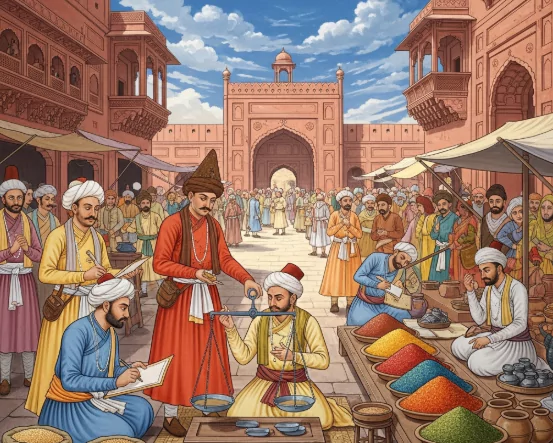
Alauddin established three distinct, regulated markets in Delhi:
- The Grain Market (Mandi).
- The market for cloth, sugar, dry fruits, and ghee, known as the Sarai-i-Adl.
- The market for horses, cattle, and slaves.
To understand the enforcement structure, let's watch a short segment on the officials and spies responsible for policing these markets.
L10: Alauddin Khilji - Market and Military Reforms | Medieval History | UPSC CSE | Vishal Chauhan
In this clip, Vishal Chauhan explains the administrative machinery created to enforce the market regulations. Focus on the roles of the market supervisors and the intelligence network.
Watch from 00:44:50 to 00:51:02. Note the functions of the 'Shahna-i-Mandi' (market superintendent) and the 'Barids' (spies) in preventing hoarding and ensuring compliance with fixed prices.
Now, let's examine the specific regulations for each market in more detail through our reading.
Alauddin Khalji's Market Reforms: A Comprehensive Exploration
The History Marg article provides an excellent in-depth look at the regulations governing each of the three main markets.
Please read the sections titled 'Alauddin was more or less the first ruler...' and 'The second market was called sarai-i-adl', ending just before 'The general markets...'. Focus on the specific mechanisms used to control supply and price in each of the three markets.
The system was a masterclass in authoritarian control, built on several key mechanisms:
| Mechanism | Description | Financial/Economic Analogy |
|---|---|---|
| Price Fixation | The Sultan personally fixed the price of every commodity, from grain and cloth to horses and even needles. These rates were non-negotiable. | State-mandated price ceilings on all consumer goods. |
| Supply Chain Control | The state managed the entire supply chain. It forced peasants to sell grain to registered transporters (banjaras), established state granaries (shahanas) to act as buffer stocks, and gave capital advances to merchants to import goods. | A vertically integrated, state-owned supply chain with strategic reserves and state-financed procurement. |
| Rationing | During famines or shortages, grain was rationed from government stores, with households being allowed to buy only a fixed amount. | A Public Distribution System (PDS) for crisis management. |
| Permit System | To prevent black-marketeering, high-value items like expensive silk could only be purchased by nobles who obtained a permit from an officer (parwana-rais). | Licensing requirements for the purchase of luxury or controlled goods. |
| Strict Enforcement | A special officer, the Shahna-i-Mandi, aided by a network of spies (barids and munhiyans), monitored all transactions. Punishments were severe, most famously the rule that a merchant who cheated on weight would have an equivalent amount of flesh carved from his body. | A highly stringent regulatory body with absolute authority and a zero-tolerance policy for non-compliance, backed by corporate espionage. |
Critical Analysis: A Brutal Success, A Temporary System
Historians debate Alauddin's primary motive. Was it military necessity, as the historian Ziauddin Barani suggests, or a genuine concern for public welfare, as the court poet Amir Khusrau claimed? The evidence overwhelmingly points to the former. The entire system was designed to support a low-cost, effective military.
The impact was profound and varied across social classes:
- The Peasantry was impoverished by the crushing 50% tax rate and forced sale of their produce.
- The Rural Elite (Khuts, Muqaddams) were ruined, their economic and political power broken.
- Merchants and Shopkeepers lost their ability to profit, operating in a climate of fear.
- Soldiers, Nobles, and the Urban Population of Delhi were the primary beneficiaries, enjoying stable, low prices for all goods.
Ultimately, Alauddin's command economy was a temporary and unsustainable construct. It was built on coercion and fear, creating enormous resentment. The complex bureaucratic machinery was prone to corruption, held in check only by the Sultan's personal vigilance and terror. Consequently, the entire system collapsed almost immediately after his death in 1316.
Conclusion
Alauddin Khalji's economic reforms represent one of the most radical and comprehensive attempts at state intervention in the economy in pre-modern Indian history. His policies were a direct, calculated response to a military-financial crisis.
Key Takeaways:
- Revenue Policy: Alauddin maximized state income through land measurement (paimash), a 50% Kharaj tax, additional taxes (Ghari, Charai), and the violent suppression of rural intermediaries.
- Market Controls: He suppressed state expenditure by creating a command economy with fixed prices, total supply chain control, rationing, and a permit system for luxury goods.
- Enforcement: The entire system was held together by a dedicated bureaucracy (Diwan-i-Riyasat, Shahna-i-Mandi) and an extensive network of spies, all backed by brutal punishments.
- Legacy: While brutally effective in the short-term, allowing Alauddin to successfully defend India from the Mongols, the system was economically oppressive and politically unsustainable, collapsing immediately after his death.
Preview of the Next Lesson:
Alauddin Khalji's successor dynasty, the Tughlaqs, also saw a ruler with grand, ambitious economic ideas. In our next lesson, we will "Evaluate Muhammad bin Tughlaq's major administrative experiments," including his infamous token currency and the disastrous shift of the capital. We will compare his visionary but failed projects with Alauddin's brutal but temporarily successful ones.