Introduction
In our previous lesson, we examined the Shunga and Kanva dynasties, who consolidated their rule in the Gangetic heartland after the fall of the Mauryan Empire. We noted their conflicts with the Yavanas, the Indian term for Greeks, who were making incursions from the northwest. Today, we turn our focus to these very Yavanas—the Indo-Greeks—to explore their profound and lasting influence on the subcontinent.
This lesson will address the learning outcome: Analyze the impact of the Indo-Greeks on Indian polity, coinage, and art. We will investigate the successors to Alexander the Great's eastern legacy, who established kingdoms that became remarkable crucibles of cultural fusion. You will see how their administrative systems, economic tools, and artistic sensibilities interacted with Indian traditions to create a unique and influential synthesis.
Let's begin by orienting ourselves geographically.
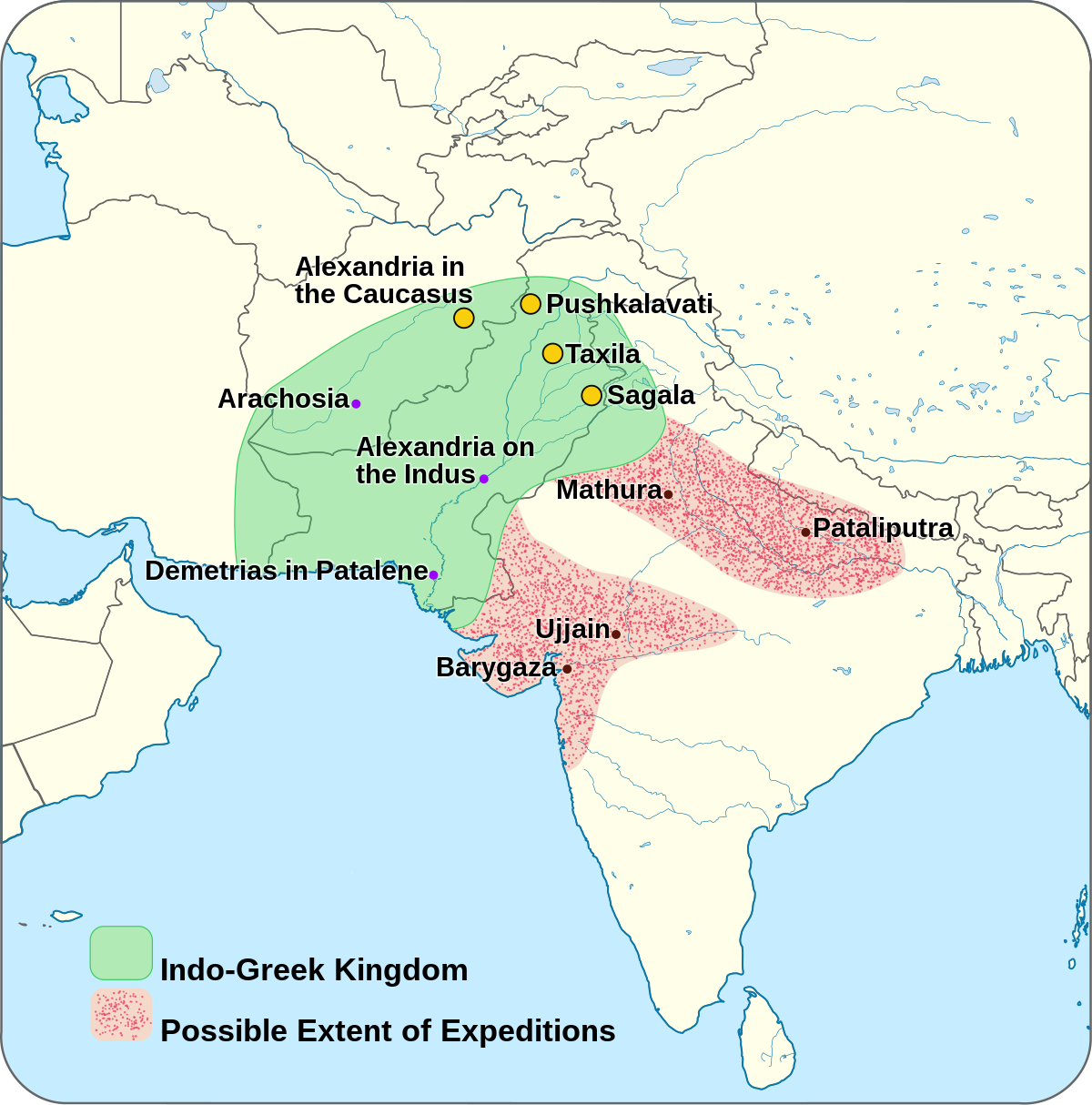
The Indo-Greek Political System: A Hellenistic Framework in an Indian Context
The Indo-Greeks were not invaders who came and left; they were rulers who established a political presence in northwestern India that lasted for nearly two centuries. Their origins and political structure represent a fascinating blend of Hellenistic legacy and adaptation to local Indian realities.
To understand their story, from their origins in the breakaway Greco-Bactrian kingdom to their eventual assimilation into the Indian cultural landscape, watch the following video.
TN Board | Post Mauryan India From Indo Greeks to Kushans | Gandhara Art | Pratik Nayak
This lecture by Pratik Nayak provides an excellent narrative of the post-Mauryan political situation. It explains who the Indo-Greeks were, their deep-rooted connections to the subcontinent since the time of Alexander, and the context for their invasions and rule.
Watch the segment from 10:51 to 31:02. Pay attention to: The connection between the Indo-Greeks and Alexander's earlier campaigns. The long history of Greco-Indian diplomatic relations during the Mauryan period (Megasthenes, Ashoka's edicts). The reasons for their invasion during the decline of the Mauryan Empire. The use of the term 'Yavana' in Indian sources.
As the video explains, the ground for Hellenistic presence was laid long before the Indo-Greek kingdoms. However, these new rulers had to establish a durable administrative system. For a deeper, systemic look at their governance, we will turn to a more specialized academic source.
[PDF] 9 Tools of Economic Activity from the Greek ... - Semantic Scholar
The paper 'Tools of Economic Activity from the Greek Kingdoms...' offers a scholarly analysis of the administrative and fiscal structures of this period. It provides precisely the kind of systemic detail on governance that moves beyond a simple narrative of kings and battles.
Please read the subsection titled 'Facilitating Extraction: Administrative Apparatuses' (starting on page 451). Focus on the discussion of the administrative roles under the Greek Kingdoms, specifically the terms 'strategos' and 'meridarch'. You don't need to get bogged down in the Kushan parts; concentrate on the structure left by the Greeks.
Drawing from these resources, we can summarize the Indo-Greek impact on polity:
- A Hellenistic Administrative Hierarchy: The Indo-Greeks implemented a system of governance inherited from the Seleucids. The kingdom was divided into provinces governed by a
strategos(plural:strategoi), a title that originally meant 'general' but evolved to signify a civic-military governor. These provinces were further subdivided intomeridarchies, governed by ameridarch. This structured, hierarchical system was a hallmark of Hellenistic statecraft. - A Hybrid State: While the top administrative posts were held by Greeks, their rule relied on collaboration with local elites. Their most visible political statement was their coinage, which used both Greek and local languages (Gāndhārī, written in Kharosthi script), signaling a state that governed a multicultural population.
- Political Fragmentation and Interaction: The Indo-Greeks were not a single unified empire but a collection of smaller, often competing, kingdoms. Their most famous ruler, Menander I, pushed deep into India, clashing with Pushyamitra Shunga, but also engaged in profound cultural and religious dialogue, as we will see.
The Coinage Revolution: A New Language for Power and Commerce
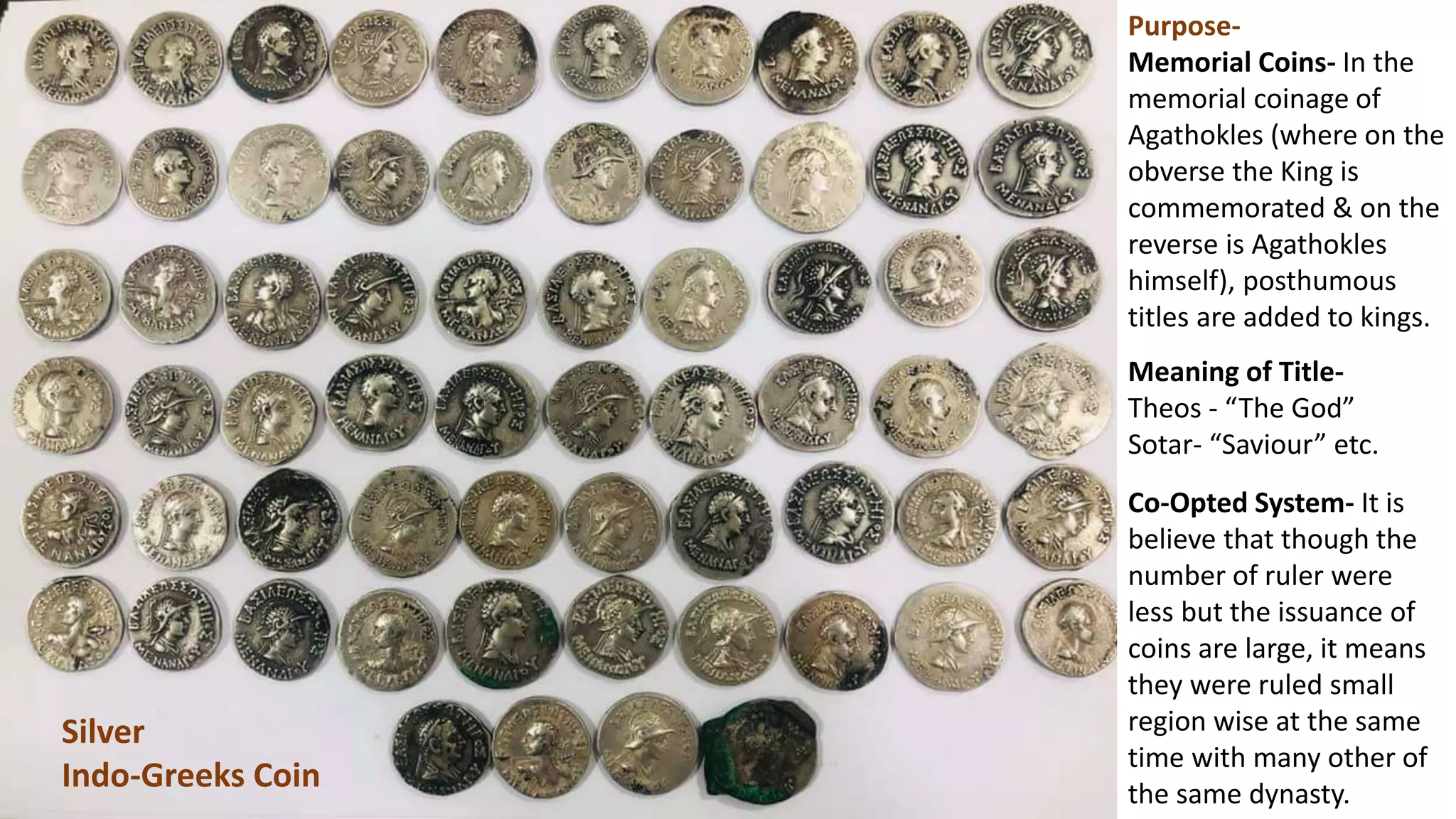
For someone with your background in finance, the numismatic legacy of the Indo-Greeks will be particularly interesting. Their coins were not merely currency; they were sophisticated instruments of state finance, political messaging, and economic policy, representing a dramatic leap from the earlier abstract punch-marked coins.
To understand the economic logic behind their coinage, let's return to the academic paper.
[PDF] 9 Tools of Economic Activity from the Greek ... - Semantic Scholar
This section of the paper discusses monetization and the function of coinage. It touches upon how the Indo-Greeks adapted their currency to the local economic environment, a fascinating parallel to modern economic strategies.
Read the section 'Monetization' (starting on page 458), focusing on the paragraphs that discuss the Graeco-Bactrian and Indo-Greek coinages (roughly pages 461-462). Pay close attention to: The initial use of the Attic standard. The strategic shift to a new, lighter 'Indian standard' to improve local acceptance and integrate with the existing monetary economy. This can be seen as a way to lower transaction costs. The use of bilingual legends.
The key innovations and impacts of Indo-Greek coinage were:
- Realistic Portraiture: They were the first rulers in India to issue coins with realistic portraits of the reigning king. This established a new model of asserting royal sovereignty and identity.
- Bilingual and Bi-scriptual Legends: Coins typically featured Greek script on the obverse and Kharosthi script (for the local Gāndhārī language) on the reverse. This was a clear political and economic tool to ensure the coins were legible and acceptable to both Greek and Indian subjects.
- Systemic Integration: Their decision to create a unique "Indian standard" for their silver coins, rather than imposing the Hellenistic Attic standard, was a masterful economic move. It allowed their currency to circulate alongside and be easily exchangeable with existing local coins, effectively lowering transaction costs and integrating their economy with the broader Indian marketplace.
- Artistic and Religious Iconography: The coins depicted a pantheon of Greek deities (Zeus, Athena, Heracles, Apollo) and Indian symbols (the Buddhist Wheel of Law), serving as a medium of cultural transmission.
Cultural Syncretism: Philosophy, Religion, and the Birth of Gandhara Art
The most enduring impact of the Indo-Greeks was cultural. Their kingdoms in the northwest became a melting pot where Greek rationalism, art, and religion met and mingled with Indian traditions, particularly Buddhism.
Philosophical and Religious Exchange
The interaction went beyond superficial contact, leading to genuine intellectual and spiritual exchange.
078: The Indo Greeks - Heracles, Menander, and the Buddha
The Hellenistic Age History Podcast offers a scholarly perspective on this cultural fusion. This first segment explores the legendary dialogue between King Menander and the Buddhist sage Nagasena.
Watch the video from 09:06 to 24:36. It provides a deep dive into: The Milinda Panha ('The Questions of Milinda'), a text that stages a philosophical debate between the Greek king and a Buddhist monk. The comparison of this text's structure to Plato's Socratic dialogues. The numismatic and literary evidence (like Plutarch's account of his funeral) for Menander's connection to Buddhism.
The Milinda Panha is a testament to an era where a Greek king could seriously engage with Buddhist doctrines of non-self (anattā) and impermanence through a process of rational inquiry. This wasn't a one-off event. We have other powerful examples of this assimilation:
- Heliodorus Pillar (c. 113 BCE): An even more striking example comes from Vidisha (near modern Bhopal). Here, an Indo-Greek ambassador named Heliodorus, sent by King Antialcidas to the court of the Shunga king Bhagabhadra, erected a pillar dedicated to Vasudeva (a form of Vishnu). The inscription states that Heliodorus was a Bhagavata, a devotee of the Vaishnava tradition. This shows that the cultural influence was not limited to Buddhism and that Greeks were embracing various streams of Indian spirituality.
The Gandhara School of Art
This cultural synthesis found its most vivid expression in art. The patronage and aesthetic sensibilities of the Indo-Greeks, combined with the rich narrative tradition of Buddhism, gave birth to the Gandhara school of art.
078: The Indo Greeks - Heracles, Menander, and the Buddha
Let's continue with the Hellenistic Age History Podcast to explore the artistic legacy of this encounter. This part details how Greek artistic conventions were used to create a new visual language for Buddhism.
Watch from 36:04 to 44:20 and then from 47:14 to 54:25. Focus on: The key characteristics of Gandharan art and its 'Greco-Buddhist' style. The revolutionary creation of the anthropomorphic Buddha image and its Hellenistic features (drapery, realistic form, contrapposto stance, halo). The syncretic adaptation of Greek mythological figures, specifically the transformation of Heracles into Vajrapani, the powerful protector of the Buddha.
The key contributions to art can be summarized as:
- The First Human Buddha: Before the Gandhara school, the Buddha was represented only through symbols (a footprint, an empty throne, the Bodhi tree). Influenced by the Greek tradition of depicting gods in idealized human form, Gandharan artists created the first anthropomorphic images of the Buddha. These images feature classical elements: a figure clad in a toga-like robe, with wavy hair reminiscent of Apollo, a serene expression, and naturalistic anatomy.
- Narrative Reliefs: The practice of carving stone panels depicting scenes from the Buddha's life (the Jatakas) borrowed from the Hellenistic tradition of using friezes for narrative storytelling.
- Syncretic Iconography: Greek mythological figures were repurposed to serve Buddhist narratives. The most famous example is the muscular hero Heracles, with his club and lion skin, being reimagined as Vajrapani, the fierce and loyal guardian of the Buddha.
Conclusion
The Indo-Greeks, though their political power eventually faded, left an indelible mark on the Indian subcontinent. Their impact was not one of simple conquest but of complex interaction and synthesis.
Key Takeaways:
- Polity: They introduced a Hellenistic administrative structure of
strategoiandmeridarchs, creating a hybrid Greco-Indian state in the northwest. - Coinage: They revolutionized Indian numismatics by introducing realistic portraiture, bilingual legends, and sophisticated weight standards designed for economic integration, demonstrating an acute understanding of state finance and local markets.
- Art and Culture: Their interaction with Indian thought produced profound philosophical dialogues like the Milinda Panha and fostered a climate of religious assimilation. This culminated in the Gandhara school of art, which gave the world the first human image of the Buddha and created a powerful syncretic style that would influence Buddhist art across all of Asia.
Preview of the Next Lesson:
The Indo-Greeks were the first in a series of foreign powers to rule the northwest after the Mauryas. They were eventually supplanted by other groups from Central Asia. In our next lesson, we will analyze the administrative system of satrapies under their successors, the Shakas and Pahlavas, and see how they built upon the political and cultural foundations laid by the Indo-Greeks.