Hello. The previous lesson examined Lenin’s proposed route to revolution and distinguished a party’s claim to represent workers from workers’ actual exercise of power. This lesson looks at a government that claimed that revolutionary inheritance. Under Stalin, who controlled productive assets, how were economic decisions made, what hierarchies existed, and where did political power rest? Those four questions let us describe the Soviet system without treating either its official ideals or the word communist as a complete answer.
Allow about 40 minutes, including the video and readings.
From an image of collective farming to the institutions behind it
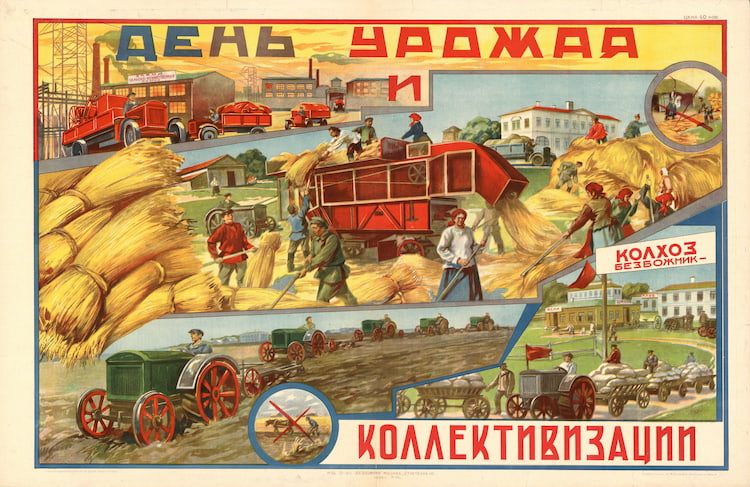
This Soviet-era poster presents collectivization as a scene of shared work and agricultural modernization. Tractors, harvest machinery, and groups of workers fill the image. It is useful evidence of how collective farming was promoted, but it cannot establish whether joining a farm was voluntary, who set its production targets, or how much of its harvest farmers could keep.
Stalin’s government launched a drive for rapid industrialization and forced collectivization at the end of the 1920s. Watch this short account for the broad connection between those policies: the state sought agricultural output and resources while directing investment toward industry.
The Soviet Economy from Revolution to Khrushchev
“The Soviet Economy from Revolution to Khrushchev,” from The Cold War, introduces Stalin’s Five-Year Plans and collectivization without requiring you to study the entire earlier history covered by the video.
Watch plans and farms for the establishment of central planning, the collectivization drive, and its coercive consequences. Continue with industrial priorities to see why heavy industry and defense received priority over consumer goods. Keep the distinction between what the authorities aimed to produce and what the policies cost in view.
Industrial expansion was real, but it does not answer the ownership or political questions by itself. A government can build factories while leaving open the question of who owns them, who issues orders to them, and who can contest those orders.
Ownership and coordination: related, but not identical
Soviet law recognized state property and collective or cooperative property as forms of “socialist property.” Major industrial enterprises were predominantly state enterprises. Collective farms had a different formal property status from state farms, yet both operated under powerful state direction. People could still own personal goods, and limited private farming remained. Thus, “no private property” is too broad a description; private ownership of major productive assets was largely displaced, not every form of individual possession.
The following reading pairs those legal categories with the way production was coordinated.
Soviet law - Property, Ownership, Collectivization | Britannica
Britannica’s “Soviet law — Property” distinguishes state, collective, and individual property, then describes what central planning required of enterprises and farms. Read it to connect legal ownership with practical control.
In the “Property” section, start with the paragraph beginning “Public ownership of the means of production was a key feature.” Read the property account, focusing on the distinction between state and collective property. Then read the planning account in the next paragraph; finish its sentence about farm deliveries at prices below local market prices. Stop before the “Labour and social benefits” heading.
A Five-Year Plan set priorities and targets that were translated into orders for state enterprises. Farms were required to deliver much of their output to the state. The state, rather than competition among independently owned firms, made the principal decisions about investment and production. In particular, it favored heavy industry and military capacity over many consumer goods. Plans did not make every local choice for every person: money continued to be used, consumers made some spending choices, and limited private plots and markets persisted.
The ownership distinction matters especially in agriculture. Calling a farm collective identifies its formal category; it does not mean farmers freely controlled its output. Required deliveries and centrally set targets sharply limited that control. Conversely, calling a factory state-owned says who held legal title, but not whether its workers directed it. State ownership, worker control, and common ownership are different claims.
Class hierarchy without a large private capitalist class
Earlier in the course, economic class was distinguished from income alone: ownership of productive assets and the need to work for wages matter. Stalin’s system removed private capitalists as the dominant owners of large-scale industry, but that did not make everyone equal in authority or living conditions. Industrial workers were generally employees of state enterprises, not owners with independent control over those enterprises. Collective farmers occupied a different position, and forced-labour camp inmates had almost no enforceable rights.
Britannica’s account of Soviet law makes those differences concrete. It discusses practices extending beyond Stalin’s lifetime, so use it to identify the hierarchy while taking care not to assume that every detail applied unchanged in every Soviet decade.
Soviet law - Property, Ownership, Collectivization | Britannica
Return to Britannica’s “Soviet law” for the difference between workers’ formal status and their effective power. The passages on benefits and government also help explain why inequality was not simply a matter of private wealth.
Under “Labour and social benefits,” read labour categories in the first paragraph. In the next, read allocated privileges. Then continue to the discussion beginning “Under the constitution adopted in the 1930s”; read political institutions through the end of that paragraph. Focus on the contrast between formally elected councils and the Communist Party’s role in choosing candidates and shaping decisions.
Access to housing, scarce goods, and services could depend heavily on position within the party and state apparatus. Managers and technical specialists could receive preferential rewards, while senior officials enjoyed privileges unavailable to ordinary workers. This was a stratified society. Whether its ruling officials constituted a class in exactly the same sense as private owners under capitalism is a further argument: their privileges and control came largely through political office, not ordinary private title to factories that they could sell. The narrower conclusion is secure without settling that debate: abolishing dominant private ownership did not abolish hierarchy.
Political power and the limits of the official ideal
Formal Soviet institutions included councils, but effective political power was concentrated in the Communist Party leadership and, under Stalin, increasingly in Stalin himself. Restricted political competition, purges of perceived opponents, and forced-labour camps made independent challenges exceptionally dangerous. This is why a description of ownership alone cannot tell us whether workers governed.
Read this final account with two levels of analysis in mind: the stated justification for a strong state and the observed concentration of power.
Stalinism | Definition, Facts, & Legacy
Britannica’s “Stalinism” explains both the argument for strengthening the state and the hierarchy that developed during rapid industrialization. It provides a direct point of comparison with Marx’s expectation of an eventual classless, stateless society.
In the main account, read the paragraph beginning “While socialist ideology foresaw a ‘withering away’ of the state.” Follow state and repression to the paragraph’s end. Then read the paragraph beginning “Basic to Stalinism was the doctrine of” through industrial hierarchy. Attend to the difference between the promised future classless society and the immediate policies used in its name.
The Soviet leadership described a powerful state as necessary to defend and build socialism. That justification should not be confused with Marx’s envisioned end point of a classless, stateless society. Nor should Stalin’s institutions be inferred directly from Lenin’s earlier proposal for a revolutionary party. To characterize the government, we need evidence about what its leaders and institutions actually did.
Taken together, the four dimensions give a precise description: predominantly state ownership of major industry, collective and state forms in agriculture, central planning with limited market activity, substantial inequalities of status and control, and highly concentrated party-state power. The poster’s promise of collective effort belongs to the history of the period, but it cannot substitute for this institutional account.
Conclusion
Under Stalin, the Soviet Union substantially replaced private ownership of major productive assets with state and collective forms, and coordinated much production through plans rather than markets. Yet “collective” did not necessarily mean farmer control, and “state-owned” did not mean worker self-government. Differences among workers, farmers, specialists, and officials remained consequential, while Stalin and the Communist Party leadership held concentrated political power.
The next lesson examines China after 1978. Its combination of markets, multiple ownership forms, and Communist Party rule will provide another reason to classify a system by its institutions rather than its ruling party’s name.