Welcome back. The previous lesson described Stalin’s Soviet Union through its institutions rather than its official label: state ownership and planning were extensive, while political power was concentrated in the party leadership. China after 1978 offers a different test of the same method. The Communist Party remained in power, but farming, firms, prices, and trade changed substantially.
This lesson traces those changes and uses ownership, economic coordination, class, and political power to explain why the ruling party’s name cannot classify the whole system. Allow about 40 minutes, including the readings and video.
What changed after 1978?
Before the reforms, Chinese farming was collectivized, and urban industry was largely state-owned and subject to planning. Reform did not replace that arrangement with a single new blueprint overnight. It began with changes to incentives and decision-making: households gained greater control over farming, enterprises gained room to make commercial choices, and markets and international trade became more important.
Read the opening account for the contrast between the starting point and the first agricultural reform.
China's Economic Reform and Opening at Forty
In this Brookings chapter, Jacques deLisle and Avery Goldstein explain what “reform and opening” changed. Read it to establish the pre-reform baseline and to distinguish household use of land from ownership of land.
In the chapter’s opening discussion (printed pp. 3–4), begin where the authors describe the rural economy as collectivized. Read the baseline and first reform, ending with the explanation of household land-use rights. Focus on what families gained the authority to do—and what the passage says remained collectively owned.
The land distinction is central. Under the household responsibility system, families could manage allocated land and benefit more directly from what they produced, while the land itself remained collectively owned. “Farm families gained control over production” is therefore more accurate than either “nothing changed” or “all farmland became private property.”
Reforms also unfolded over decades rather than at one moment. This graphic places selected policy changes beside annual GDP growth rates:
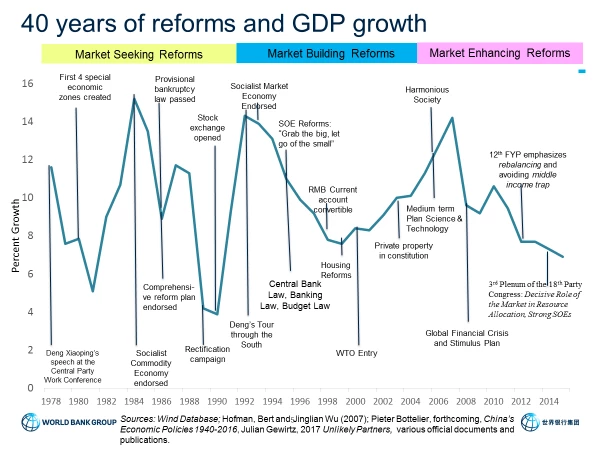
Notice the distinction between a growth rate and the size of the economy. A lower positive growth rate means output grew more slowly, not that output necessarily fell. Likewise, the proximity of a reform label to a peak on the line is not, by itself, evidence of cause and effect. The graphic is most useful here for seeing the long sequence of reforms.
Markets and ownership changed together—but not in the same way
An economy can use market prices without making every enterprise privately owned. Conversely, a state-owned enterprise can be required to compete for customers and account for profits and losses. These distinctions, introduced earlier in the course, are especially important in China’s reform era.
Read how the authors describe changes inside enterprises and the widening range of firm types.
China's Economic Reform and Opening at Forty
Return to deLisle and Goldstein’s chapter to see how changes in enterprise decisions differed from changes in legal ownership.
On printed p. 4, start with the paragraph beginning “Early in the reform era,” which discusses private entrepreneurs and new freedoms for enterprises. Read the enterprise reforms through the list of newer ownership forms. Track separately the changes to prices, contracts, and managerial autonomy, and the changes to who could own firms.
The result was not one uniform ownership arrangement. State-owned and collectively owned enterprises continued to operate; private and foreign-invested firms expanded; and some existing enterprises were privatized or reorganized as corporations. A corporation’s legal form does not, on its own, settle who controls it: the state might retain an ownership stake, while a different firm might be privately controlled.
A World Bank account makes the 1990s turning point more precise. It describes both the official commitment to a “socialist market economy” and the decision to accept public and private ownership side by side.
[PDF] The World Bank in China's State-Owned Enterprise Reform Since ...
This World Bank account helps separate an official description of the economy from the concrete restructuring of state-owned enterprises.
Find the discussion of the 1992 “Southern Speeches” and the “second generation” of state-owned enterprise reform, immediately before the printed page numbered 6. Begin with the sentence about reform being relaunched in 1992, then read the restructuring account through the sentence on job losses. Pay particular attention to the 1997 acceptance of private ownership and to the social costs of restructuring.
The 1997 policy is telling: the ruling party explicitly accepted the coexistence of public and private ownership as part of the economic system it continued to call socialist. That official usage matters historically, but the label does not erase the differences between a state enterprise, a privately owned firm, and collectively owned land. Nor were reforms costless: restructuring state firms led to substantial job losses.
Markets also became more important as a method of coordination. Firms could choose suppliers and customers, prices became more responsive to exchange, and foreign trade expanded. Yet market activity did not mean that the state stopped owning enterprises or shaping economic priorities.
Class relations and political power did not follow a party name
Changes in ownership changed class relations. A privately owned firm employing wage workers has an owner–employee relationship that a largely state-owned planned economy did not have in the same form. Farmers with land-use rights, employees of state firms, private business owners, and state or party officials occupy different positions. Those differences cannot be captured by calling everyone simply “communist” or “capitalist.” Nor does state ownership alone establish that a firm’s workers control its decisions or receive its returns directly.
The next video adds an institutional detail that a simple “state versus market” contrast misses: local governments played substantial economic roles. Their competition to meet growth targets was competition among officials, not the same thing as firms competing for customers.
How China's Economy Actually Works
Watch “How China’s Economy Actually Works” from New Economic Thinking for its account of local government roles and early reforms. Use it to add detail to the ownership and market distinctions in the readings.
Watch local government roles for the contrast with a uniformly centralized planning model. Continue through officials’ competition, noting what was being measured, then early rural reforms for household land-use rights and rural enterprises. Keep legal land ownership distinct from the authority households gained to use land.
Economic decentralization did not amount to multiparty political competition. The Communist Party retained ruling authority as the economy incorporated markets and private firms. The chapter’s later discussion shows that party leaders also set limits on reform when they judged their political control to be at risk.
China's Economic Reform and Opening at Forty
Return to deLisle and Goldstein for the political boundary of market reform, particularly in their discussion of the 2010s.
On printed p. 14, find the discussion beginning with the tension between prosperity, international influence, and continued party control. Read the political limits, ending in the next paragraph with the authors’ description of renewed intervention and party presence in firms. Focus on why economic liberalization need not imply political liberalization.
This gives a more exact account than either “the party controls everything directly” or “markets replaced the state.” Firms and households gained important economic choices, while the party-state retained political authority and continued to intervene in markets. The balance has also changed across periods and sectors.
A classification that states what it means
China’s post-1978 system can be described across four dimensions without forcing it into a single, all-purpose label:
| Dimension | What the reform-era evidence shows |
|---|---|
| Ownership | State, collective, private, and foreign-invested forms coexist; household land-use rights are not the same as private ownership of farmland. |
| Class | Wage workers, private owners, farmers, and officials have different relationships to productive assets and decision-making. |
| Coordination | Markets and commercial incentives expanded, alongside continuing state ownership and intervention. |
| Political power | The Communist Party retained ruling authority through economic reform. |
China’s official term socialist market economy describes its own combination of commitments. Analysts may emphasize different features when choosing other labels. A useful comparison therefore states which feature a label is meant to identify—public ownership, private investment, market allocation, or party rule—rather than assuming one feature proves all the others.
This approach also makes the contrast with the previous lesson clearer. Stalin’s Soviet system and reform-era China both had Communist Party rule, but their ownership patterns and ways of coordinating production differed markedly. The same kind of party name does not guarantee the same economic institutions.
Conclusion
After 1978, China expanded household decision-making, markets, private enterprise, and international economic activity while retaining state and collective ownership in important areas and Communist Party rule. Land-use rights were not identical to private land ownership; market competition did not require every firm to be private; and economic reform did not itself establish political competition.
The next lesson turns to democratic socialism. It will distinguish a commitment to democratic institutions and social ownership from both one-party rule and the provision of welfare within a privately owned economy.