Hello! Welcome to your fourth lesson.
In our last session, we explored how nouns are classified by type (Common, Proper, etc.) and how they change from singular to plural. We saw that while most nouns have a plural form, some, like sheep, do not, and others, like mathematics, look plural but are actually singular.
Today, we'll build directly on that knowledge. Our goal is to distinguish between countable and uncountable nouns and apply the correct usage rules. Understanding this distinction is one of the most important foundations in English grammar. It decides whether you can use "a/an", whether a noun can be plural, and which quantity words (like many or much) are correct. This skill is constantly tested in SSC CGL error-spotting questions.
This lesson will cover:
- Defining Countable and Uncountable Nouns: What's the core difference?
- Rules for Quantifiers: When to use
many,much,few,little, anda lot of. - Commonly Tested Uncountable Nouns: A look at the tricky words that frequently appear in exams.
Let's get started.
1. What are Countable and Uncountable Nouns?
At its simplest, the difference is exactly what the names suggest:
- Countable Nouns are things we can count with numbers. They have both a singular and a plural form.
- One
book, twobooks - One
chair, fivechairs
- One
- Uncountable Nouns (also called non-count nouns) are things we cannot count with numbers. They are often substances, concepts, or categories. They usually only have a singular form.
water(we can't say "one water, two waters")information(we can't say "one information, two informations")
To get a clear, foundational understanding, let's watch a video that explains this concept from the very beginning.
English for Beginners: Countable & Uncountable Nouns
The video 'English for Beginners: Countable & Uncountable Nouns' by English with Emma provides an excellent step-by-step introduction. We'll start with the core definitions and rules.
Please watch the video from 03:08 to 13:13. The video is divided into two parts: Countable Nouns (03:08 - 06:55): Pay attention to the use of 'a/an' and how plurals are formed by adding '-s'. Uncountable Nouns (06:55 - 13:13): Focus on why you cannot use 'a/an' or add '-s'. Notice the examples of abstract ideas (happiness), categories (furniture, money), and substances (milk).
Key Rules from the Video
To summarize and organize the key points, here is a helpful chart.
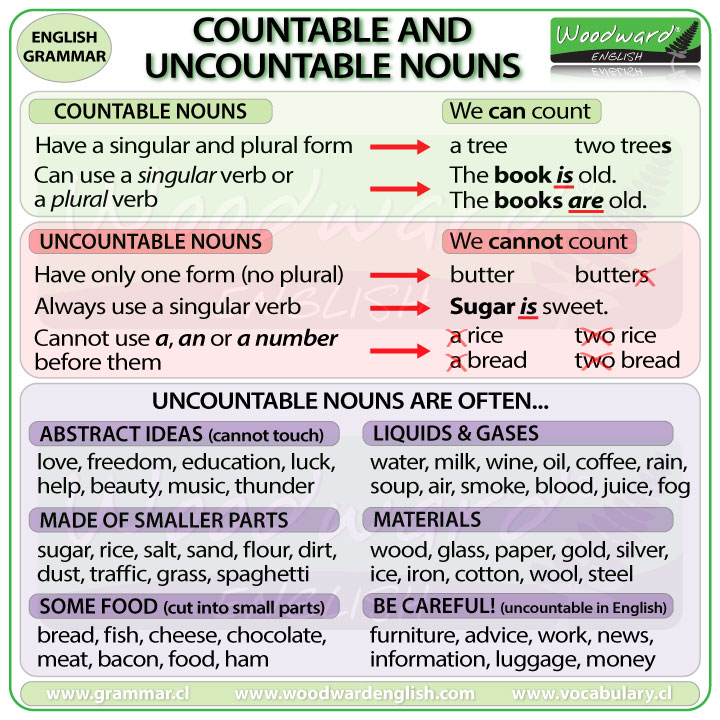
As you can see from the video and the chart, the primary rules are:
- Countable nouns can be singular (
a dog) or plural (dogs). - Uncountable nouns do not have a plural form. We cannot say
furnituresoradvices. - Uncountable nouns always take a singular verb. For example, "The furniture is old," not "The furniture are old."
A very important concept from the video is that we can often make an uncountable noun countable by using a "unit" or "container" word:
water(uncountable) ->a glass of water(countable)advice(uncountable) ->a piece of advice(countable)bread(uncountable) ->a loaf of bread(countable)
Test your understanding!
For each noun below, decide if it is Countable (C) or Uncountable (U).
- Car
- Rice
- Knowledge
- Student
- Music
- Bottle
Show answer
- Car: C (You can count cars: one car, two cars.)
- Rice: U (You count grains of rice, or bags of rice, but not 'rice' itself.)
- Knowledge: U (This is an abstract concept.)
- Student: C (You can count students.)
- Music: U (This is an abstract concept. You can count songs or albums, but not 'music'.)
- Bottle: C (You can count bottles.)
2. Using Quantifiers: many, much, few, little
The choice between words like many and much depends entirely on whether the noun is countable or uncountable. This is a very common source of errors in the SSC exam.
- Use
manyandfewwith countable nouns. - Use
muchandlittlewith uncountable nouns.
There are also "safe" words that can be used with both, which is a useful trick for exams if you are unsure.
English Grammar Tricks - Countable & Uncountable Nouns
The video 'English Grammar Tricks - Countable & Uncountable Nouns' by Learn English with Rebecca offers a very clear and practical way to remember these rules.
Please watch from 02:06 to 05:18. Focus on: Which words go with which noun type (02:06 - 03:32): many/few for countable, much/little for uncountable. The 'safe' list (03:32 - 05:18): Words like some, any, and a lot of that can be used with both.
A Deeper Look at few/little
There's a subtle but important difference between a few/a little and few/little. This is a higher-level point that can definitely appear in sentence improvement questions.
This chart explains it perfectly:

From the chart, we can learn:
a little/a fewhave a positive meaning: a small amount, but it's enough.- I have a little money, so we can buy a coffee. (uncountable)
- I have a few friends, so I'm not lonely. (countable)
little/fewhave a negative meaning: almost none, not enough.- I have little money, so I can't afford a coffee. (uncountable)
- He has few friends, so he is often lonely. (countable)
This structured text from the British Council provides a great summary of all these rules for quantifiers in different types of sentences (positive, negative, questions).
Nouns: countable and uncountable
The article 'Nouns: countable and uncountable' from the British Council is an excellent written reference. It neatly organizes all the rules we've discussed so far.
Read the 'Grammar explanation' section. Focus on how words like 'some', 'any', 'much', 'many', and 'a lot of' are used with countable and uncountable nouns in positive sentences, negative sentences, and questions.
Test your understanding!
Choose the correct word to complete each sentence.
- How (much / many)
sugardo you need? - There aren't (much / many)
chairsin the room. - I have very (little / few)
timebefore the exam. - She told me a (little / few)
secretsabout her plan.
Show answer
- much:
sugaris uncountable. - many:
chairsis countable. - little:
timeis uncountable. - few:
secretsis countable.a fewis used because it means "some secrets," not "almost no secrets."
3. Common Uncountable Nouns in SSC Exams
Some nouns are frequently used in error-spotting questions because they are uncountable in English, even though they might seem countable. Memorizing this list is highly beneficial.
Common Uncountable Nouns:advice, information, news, luggage, baggage, furniture, scenery, poetry, machinery, work, evidence, bread, equipment.
Let's look at a resource specifically for SSC preparation to see how this rule is applied.
This PDF is a study material for the SSC CGL exam. It highlights a key rule and provides a direct example of an error related to uncountable nouns.
Please find and read two specific parts in this document: Rule 1 under the section 'Important Rules'. It states: "We always use singular verb with uncountable nouns. Plural of these words does not exist." Question 11 in the practice exercise. The error is "I like the poetries of Byron and Shelley." The correction explains that 'poetry' is an uncountable noun and does not have a plural form.
As you saw, the error in "poetries" is a classic example. The correct sentence must use the singular form: "I like the poetry of Byron and Shelley."
Here are more examples of common errors and corrections:
- Incorrect: The
sceneriesof Kashmir are beautiful.- Correct: The
sceneryof Kashmir is beautiful. (Scenery is uncountable, takes a singular verb)
- Correct: The
- Incorrect: He gave me many
advices.- Correct: He gave me
much advice/a lot of advice/a piece of advice. (Advice is uncountable)
- Correct: He gave me
- Incorrect: I have many
worksto do.- Correct: I have
much work/a lot of workto do. (Work is uncountable)
- Correct: I have
Conclusion
Fantastic work today! Mastering countable and uncountable nouns is a huge step forward in your grammar journey. It cleans up many common errors and gives you confidence in constructing correct sentences.
Key Takeaways:
- Countable nouns can be counted and have singular and plural forms (
chair,chairs). - Uncountable nouns cannot be counted, have no plural form, and always use a singular verb (
information is, notinformations are). - Quantifiers are specific: use
many/fewfor countable nouns andmuch/littlefor uncountable nouns. - Certain nouns like
advice,furniture,scenery, andpoetryare always uncountable and are frequently tested.
What's Next?
In our next lesson, we will apply rules for the usage of definite ('the') and indefinite ('a'/'an') articles. Today's lesson was the perfect preparation, as the most basic rule of articles is that 'a'/'an' can only be used with singular countable nouns. You will now understand exactly why that is. See you then