Hello! Welcome to your third lesson in the SSC English course.
In our last session, we created a map of the English language by identifying the eight parts of speech. We learned that a noun is a "naming word" and that it often functions as the subject or object in a sentence.
Today, we will zoom in on the noun. The goal of this lesson is to classify nouns by type and apply the rules for changing them from singular to plural. Mastering these two concepts is fundamental. In the SSC exam, many "Error Spotting" questions test your knowledge of whether the correct type or number of a noun is used.
This lesson is divided into two parts:
- Types of Nouns: Understanding the different categories nouns fall into.
- Noun Number: Learning the rules to convert singular nouns (one) to plural nouns (more than one).
Let's begin.
Part 1: Classifying Nouns by Type
Not all nouns are the same. We classify them based on what they name. The main types you need to know for the SSC exam are: Proper, Common, Collective, Abstract, and Material nouns.
To start, let's get a quick, clear definition of these types from a resource designed for SSC preparation.
The article 'Nouns - SSC Exam' from Unacademy provides concise definitions for the different types of nouns. Reading this first will give you a clear framework.
Please read the section titled 'Types of nouns'. Focus on the definitions for Common, Proper, Collective, Abstract, and Material Noun.
Now that you have the basic definitions, let's bring them to life with some examples and explanations in a video format.
Noun and Its Types in English Grammar | All About Nouns | Proper/Common/Collective | ChetChat
The video 'Noun and Its Types in English Grammar' by ChetChat provides excellent, clear explanations for the most important noun types. We will watch specific segments for each type.
Please watch the following parts of the video: Proper & Common Nouns (05:05 - 07:19): Pay close attention to the key difference: a common noun is a general name (e.g., city), while a proper noun is a specific name (e.g., Delhi) and always starts with a capital letter. Collective Nouns (07:33 - 08:16): Notice how these words represent a group (e.g., army, team, crowd). Abstract Nouns (08:08 - 09:27): Focus on how these nouns name ideas, feelings, and qualities that you cannot touch or see (e.g., honesty, courage).
Summary of Noun Types
Let's consolidate what you've just learned.
- Common Noun: A general name for a person, place, or thing.
- Examples:
boy,city,book,river
- Examples:
- Proper Noun: The specific name of a person, place, or thing. It always begins with a capital letter.
- Examples:
Ravi,Mumbai,Ramayana,Ganga
- Examples:
- Collective Noun: A name for a group of people, animals, or things.
- Examples:
team(of players),flock(of sheep),army(of soldiers)
- Examples:
- Abstract Noun: A name for an idea, quality, feeling, or state that you cannot physically touch.
- Examples:
honesty,bravery,happiness,childhood
- Examples:
- Material Noun: A name for a material or substance from which things are made.
- Examples:
gold,silver,cotton,wood
- Examples:
Test your understanding!
Identify the type of noun for each underlined word in the sentences below.
- The team celebrated its victory.
- Ravi showed great courage.
- This chair is made of wood.
Show answer
- team: Collective Noun; victory: Abstract Noun
- Ravi: Proper Noun; courage: Abstract Noun
- chair: Common Noun; wood: Material Noun
Part 2: Noun Number (Singular and Plural)
Nouns can be singular (referring to one) or plural (referring to more than one).
- Singular:
boy,chair,box - Plural:
boys,chairs,boxes
While the most common rule is to simply add "-s", there are several other rules based on how a word ends. Getting these rules right is crucial for sentence correction.
To help you grasp these rules firmly, we will watch a detailed video. The explanations are in Hindi, which can make it easier to understand the logic behind each rule for the first time.
Singular से Plural कैसे बनाते हैं? आप हैरान रह जाओगे! The Noun: Singular to Plural Number
The video 'Singular से Plural कैसे बनाते हैं?' from Spoken English Guru is an excellent, rule-by-rule guide to forming plurals. It covers all the patterns you need for the SSC exam.
Watch the video carefully from 00:35 to 10:23. I've broken down the key rules it covers so you know what to look for: Words ending in -y (00:35 - 01:14) Words ending in -s, -ss, -sh, -ch, -x (01:14 - 02:12) Words ending in -o (02:12 - 03:35) Words ending in -f or -fe (03:35 - 05:10) Irregular plurals (e.g., man -> men) (05:10 - 05:37) Nouns with the same singular and plural form (e.g., sheep, fish) (05:51 - 08:32) Nouns that look plural but are singular (e.g., mathematics, news) (08:32 - 09:19) Nouns that are always plural (e.g., trousers, scissors) (09:19 - 10:23)
Summary of Plural Rules
The video covered many rules. This image provides a fantastic summary that you can save for quick revision. It organises the rules logically.
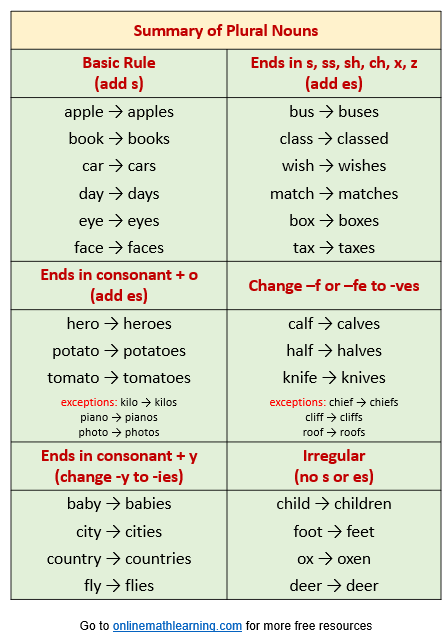
Let's list the most important rules you must remember:
- Add -s: For most nouns. (
cat→cats) - Add -es: For nouns ending in -s, -ss, -sh, -ch, -x, -z. (
box→boxes,brush→brushes) - Nouns ending in -y:
- If preceded by a consonant, change -y to -ies. (
city→cities,story→stories) - If preceded by a vowel (a, e, i, o, u), just add -s. (
boy→boys,day→days)
- If preceded by a consonant, change -y to -ies. (
- Nouns ending in -f or -fe: Change -f or -fe to -ves. (
leaf→leaves,wife→wives). Exceptions exist, likeroof→roofs. - Nouns ending in -o:
- Usually add -es if preceded by a consonant. (
hero→heroes,potato→potatoes) - Many exceptions exist where you only add -s (e.g.,
photo→photos,piano→pianos).
- Usually add -es if preceded by a consonant. (
- Irregular Plurals: These don't follow any rule and must be memorized.
man→men,woman→women,child→children,foot→feet,tooth→teeth,mouse→mice
- Special Cases (Very Important for SSC):
- Always Plural: These nouns refer to items with two parts and always take a plural verb.
- Examples:
scissors,trousers,jeans,spectacles. - Incorrect: My new jean is blue.
- Correct: My new jeans are blue.
- Examples:
- Look Plural, but are Singular: Nouns ending in -s that are actually singular and take a singular verb.
- Examples:
news,mathematics,physics,politics. - Incorrect: The news are bad.
- Correct: The news is bad.
- Examples:
- Same Singular and Plural Form:
- Examples:
sheep,deer,fish,series. - Correct: One sheep is grazing. Ten sheep are grazing.
- Examples:
- Always Plural: These nouns refer to items with two parts and always take a plural verb.
Test your understanding!
Provide the plural form for each singular noun below.
- Match
- Lady
- Life
- Potato
- Child
- Sheep
Show answer
- Matches (ends in -ch)
- Ladies (ends in consonant + y)
- Lives (ends in -fe)
- Potatoes (ends in consonant + o)
- Children (irregular)
- Sheep (same singular and plural form)
Conclusion
Excellent work today. We have taken a detailed look at the first part of speech, the Noun, which is a critical building block for mastering English grammar.
Key Takeaways:
- Nouns can be classified into different types: Common, Proper, Collective, Abstract, and Material.
- Nouns have a number: singular (one) and plural (more than one).
- We learned the key rules for forming plurals, including regular endings (-s, -es, -ies, -ves), irregular forms (child/children), and special cases frequently tested in exams (scissors, mathematics, sheep).
Your ability to identify the correct noun form and number will directly help you score marks in Error Spotting and Sentence Improvement questions.
What's Next?
In our next lesson, we will continue exploring nouns by focusing on another important classification: distinguishing between countable and uncountable nouns. This distinction comes with its own set of rules, particularly about which words (like many/much or few/little) can be used with them. This is another high-frequency topic in the SSC English section. Keep up the great work