Welcome to the final lesson of the Investor and Trader Discipline module, and the capstone to your entire course on investing.
In our previous lesson, we transformed your trading journal from a simple logbook into a powerful analytical tool. You learned how to perform a professional self-review, quantify your mistakes through "fault analysis," and identify the specific strategies and behaviors that either make or cost you money. This process of data-driven self-awareness is the foundation for everything we do today.
Today, we take all the knowledge you've accumulated—from understanding stocks and executing trades to analyzing charts and, most importantly, analyzing yourself—and forge it into a single, indispensable tool. Our learning outcome is to develop a personalized trading plan that defines rules for entry, exit, and risk management.
A trading plan is your personal business plan for the markets. It is the constitution that governs your trading decisions, designed to enforce discipline, eliminate emotional errors, and systematically leverage your unique strengths. For someone with your interests in psychology and economics, you can think of it as the ultimate commitment device—a structured framework to navigate the complex interplay of market forces and your own cognitive biases.
Why a Trading Plan is Your Most Important Asset
Before we start building, let's be clear on what a trading plan is and why it's non-negotiable for serious traders. It's not just a strategy; a strategy is merely one component of the plan. The plan itself is a comprehensive document outlining how you will find, execute, manage, and review every trade.
Without a plan, you are susceptible to the market's (and your own) emotional whims. With a plan, you replace impulsive reactions with disciplined, pre-determined actions.
Trading Plan Template: Unlock Your Trading Success
To understand how a plan acts as a defense mechanism against common trading pitfalls, please read the first part of this article from ChartsWatcher.
Read the section 'Why Most Traders Fail Without a Structured Trading Plan' and the subsection 'How a Trading Plan Prevents Costly Mistakes.' Notice how it directly addresses issues like overtrading and revenge trading, which are psychological traps.
Your Trading Plan Blueprint: The Core Components
Now, let's get practical. Open a document or grab a notebook. We are going to build the skeleton of your personal trading plan. The best plans are built on a few core pillars. We will tackle them one by one.
Part 1: The Foundation - Philosophy and Goals
This section is about your "Why." It’s the compass that guides you and the anchor that holds you steady during the inevitable tough times. A strong psychological foundation prevents you from chasing quick profits at the expense of long-term consistency.
To build this foundation, let's watch a segment from a detailed guide on building a trading plan.
How to Build your Trading Plan
This first video from trader Iliya Sivkov will guide you through the process of defining your deeper purpose for trading and setting realistic financial goals. This is a crucial first step that many aspiring traders skip.
Watch from 10:37 to 21:26. As you watch, seriously consider and write down the answers to these questions in your plan: Your 'Why' (10:37 - 14:28): Beyond just 'making money,' what is your true purpose? Is it financial security for your family? Freedom to pursue other interests? Be specific. Your Financial Goals (14:28 - 21:26): Complete the 'want' vs. 'need' exercise. Calculate your actual monthly living expenses ('need') and compare it to what you thought you 'wanted.' This grounds your expectations in reality.
In your plan, you should now have a clear statement of purpose and a realistic, data-driven set of financial objectives. This turns a vague dream into an actionable business target.
Part 2: The Business Plan - Risk Management
This is the part of your plan that keeps you in the business of trading. Your first job is not to make money, but to protect the capital you have. Every professional trader is a risk manager first.
Your trading journal review from the last lesson will be invaluable here. If you noticed that your biggest losses came from breaking risk rules, this section is your chance to codify stricter, non-negotiable limits.
This next video segment lays out the essential risk parameters you must define.
How to Build your Trading Plan
Now, let's define the five key risk parameters that will form the backbone of your capital protection strategy.
Watch from 23:01 to 30:17. As you watch, define these five rules for yourself in your trading plan. Use the presenter's personal example as a guide, but choose numbers that fit your own risk tolerance. Risk per Trade: (e.g., 1% of account balance) Max Daily Loss: (e.g., 3% or 3 losing trades) Max Weekly Loss: (e.g., 5%) Drawdown Threshold ('Flatlining'): At what point will you reduce your risk size? (e.g., if down 4% for the week, cut risk in half). Profit Scaling: (Optional for now) When will you allow yourself to take more risk?
Part 3: The Playbook - Your Trading Strategies
This is where you define exactly what you will trade and the precise conditions for entry and exit. This section should be built directly from the strategies you've learned and tested, and most importantly, from the patterns you identified in your trading journal.

In your plan, create a section for each strategy you intend to trade. For each strategy, define the following:
- Strategy Name: E.g., "Daily Chart Breakout" or "1-Hour Moving Average Crossover."
- Instruments: What will you trade with this strategy? (e.g., Large-cap tech stocks, SPY ETF).
- Timeframes: Which chart timeframes will you use? (e.g., Daily for trend direction, 1-hour for entry signal).
- Entry Rules (Your Setup Checklist): This must be a specific, non-negotiable checklist. No trade is placed unless all criteria are met.
- Example Entry Checklist for a Breakout:
- [ ] Stock is in a clear uptrend on the daily chart (price above 200 SMA).
- [ ] Price has consolidated sideways for at least 5 trading days.
- [ ] Volume is decreasing during consolidation.
- [ ] Entry Signal: Enter on a candle that closes decisively above the consolidation range's resistance.
- [ ] Confirmation: Entry candle's volume is at least 1.5x the 20-day average volume.
- Example Entry Checklist for a Breakout:
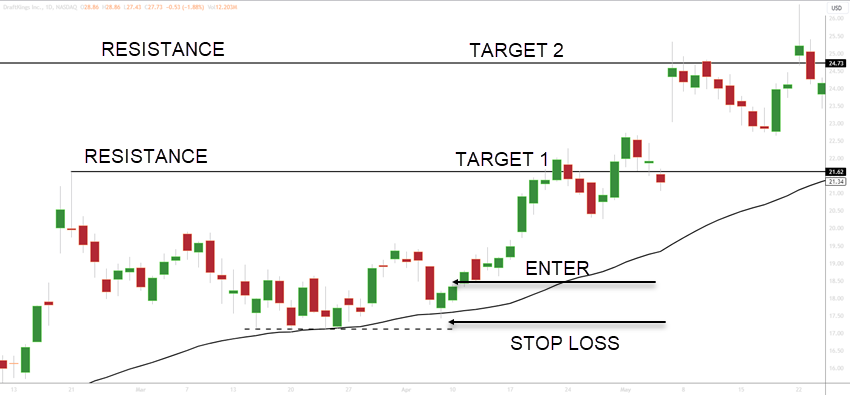
- Exit Rules (For a Loss - Stop-Loss): Where is your trade idea proven wrong?
- Example Stop-Loss Rule: Place stop-loss just below the low of the consolidation range.
- Exit Rules (For a Profit - Target): How will you take profits?
- Example Profit Target Rule: Set a profit target at a 2:1 risk/reward ratio. (If your stop-loss is $1 away, your target is $2 away). Alternatively, sell at the next major resistance level.
Here is a visual example of these rules on a real chart:
Test your understanding!
Your trading journal shows that your most profitable trades happen when you buy a stock that has pulled back to its 50-day moving average while in a long-term uptrend. Your biggest losses, however, come from chasing stocks that are already far above their moving averages (FOMO).
How would you translate this insight into a specific rule within the "Entry Rules" checklist of your trading plan?
Show answer
You could add two rules to your checklist:
- Inclusionary Rule: "Price must be testing or have recently bounced off the 50-day moving average."
- Exclusionary Rule: "Do NOT enter a new long position if the price is more than 10% above its 50-day moving average."
This codifies what you've learned works for you and builds a defense against your known weakness (FOMO).
Part 4: The Execution - Routines and Reviews
A great plan is useless if it isn't implemented consistently. This final section defines your professional routines.
How to Build your Trading Plan
A successful trader's life is simple and structured. This final video clip discusses the importance of creating habits and routines that support your trading.
Watch from 38:13 to 41:08. Based on this, add the following sections to your trading plan: My Trading Routine: Define your daily process. What do you do before the market opens (e.g., check news, review watchlist)? When will you trade (your 'trading window')? What do you do after the market closes (e.g., fill out journal)? Non-Trading Rules: Based on what you know about yourself, when will you absolutely NOT trade? (e.g., 'I will not trade if I am feeling angry or tired,' or 'I will stop trading for the day after hitting my max daily loss.'). My Review Schedule: When will you formally review your trading journal and this trading plan? (e.g., 'Every Sunday afternoon for 1 hour.').
Conclusion: Your Living Blueprint for Success
Congratulations! You have now constructed a comprehensive, personalized trading plan. This document is the culmination of everything you have learned in this course. It is your guide, your rulebook, and your primary defense against emotional decision-making.
Key Takeaways:
- A trading plan is a holistic business plan for your trading, not just a single strategy.
- It must be built on a foundation of your personal philosophy and goals.
- Risk management rules are paramount; they are what ensure your longevity as a trader.
- Your entry and exit criteria should be a specific, non-negotiable checklist derived from your strategies and journal analysis.
- Routines and review schedules ensure that you execute your plan with discipline and that the plan itself evolves as you do.
The most important thing to remember is that this is a living document. The review schedule you created is not just for your journal; it is for this plan. As your journal data provides new insights, you will come back to this plan and refine it. You may add or remove strategies, tighten your risk rules, or adjust your routines. This cycle of Plan -> Execute -> Record -> Review -> Refine is the engine of professional development.
This marks the end of our course, but it is the true beginning of your journey as a disciplined investor and trader. You now possess the foundational knowledge and the critical tools used by professionals. The path forward is one of application, patience, and continuous self-improvement. Trade your plan, and may your discipline bring you consistent success.