Hello! Welcome back to the course.
In our last lesson, we established the critical importance of diversification for managing risk. You learned that spreading your investments across many different companies and industries is the best defense against the risk of any single company performing poorly.
This naturally leads to a practical question: How can you, as an individual investor, efficiently buy small pieces of hundreds of companies without it being incredibly complex and costly?
This lesson introduces the answer: the index fund. We will define what an index fund is and explore the powerful investment philosophy behind it, known as passive management. We will then contrast this with active management, the traditional approach of trying to beat the market. Understanding this distinction is fundamental to building the low-cost, diversified, long-term portfolio that aligns with your investing goals.
Part 1: What is an Index Fund?
Before we can define an index fund, we need to understand what a "fund" and an "index" are.
-
A Fund: Think of a fund like pooling money with friends for a big pizza party. Instead of one person buying everything, everyone chips in. With that combined money, you can buy many different kinds of pizza. A financial fund works the same way: it pools money from thousands of investors to buy a wide variety of assets, like stocks or bonds.
-
An Index: An index is simply a list of securities that acts as a representative sample of the market. When you hear news anchors say "the market was up today," they are usually referring to the performance of an index. For example, the S&P 500 is a famous index that tracks the 500 largest publicly-traded companies in the United States.
An index fund, therefore, is a fund designed to do one simple thing: buy all the investments on a specific index and hold them. Its goal is not to be clever or pick winners, but to mechanically replicate the performance of the index it tracks. If you buy an S&P 500 index fund, you instantly own a tiny slice of all 500 of those companies. This is diversification made easy.
To get a clearer picture of how this works, let's watch a video that explains this concept in detail.
Index Funds vs Mutual Funds vs Hedge Funds vs ETFs Explained!
The video 'Index Funds vs Mutual Funds vs Hedge Funds vs ETFs Explained!' from Martik Finance provides an excellent breakdown of what an index fund is and how it functions.
Please watch the segment on Index Funds, from 01:38 to 04:40. As you watch, focus on: How an index fund's strategy is simply to copy an index like the S&P 500. The concept of passive management. The major benefits: instant diversification and very low fees (expense ratios).
To reinforce this, let's look at a description from Vanguard, the company whose founder, John Bogle, created the first index fund for individual investors.
What is an index fund? - Vanguard
The article 'What is an index fund?' from Vanguard offers a clear, authoritative definition and a practical example.
Please read the sections 'Definition of an index fund' and 'How it works'. The example of the Vanguard 500 Index Fund (VFIAX) shows exactly how an S&P 500 index fund is structured to passively mirror the index.
Part 2: Passive vs. Active Management: A Tale of Two Philosophies
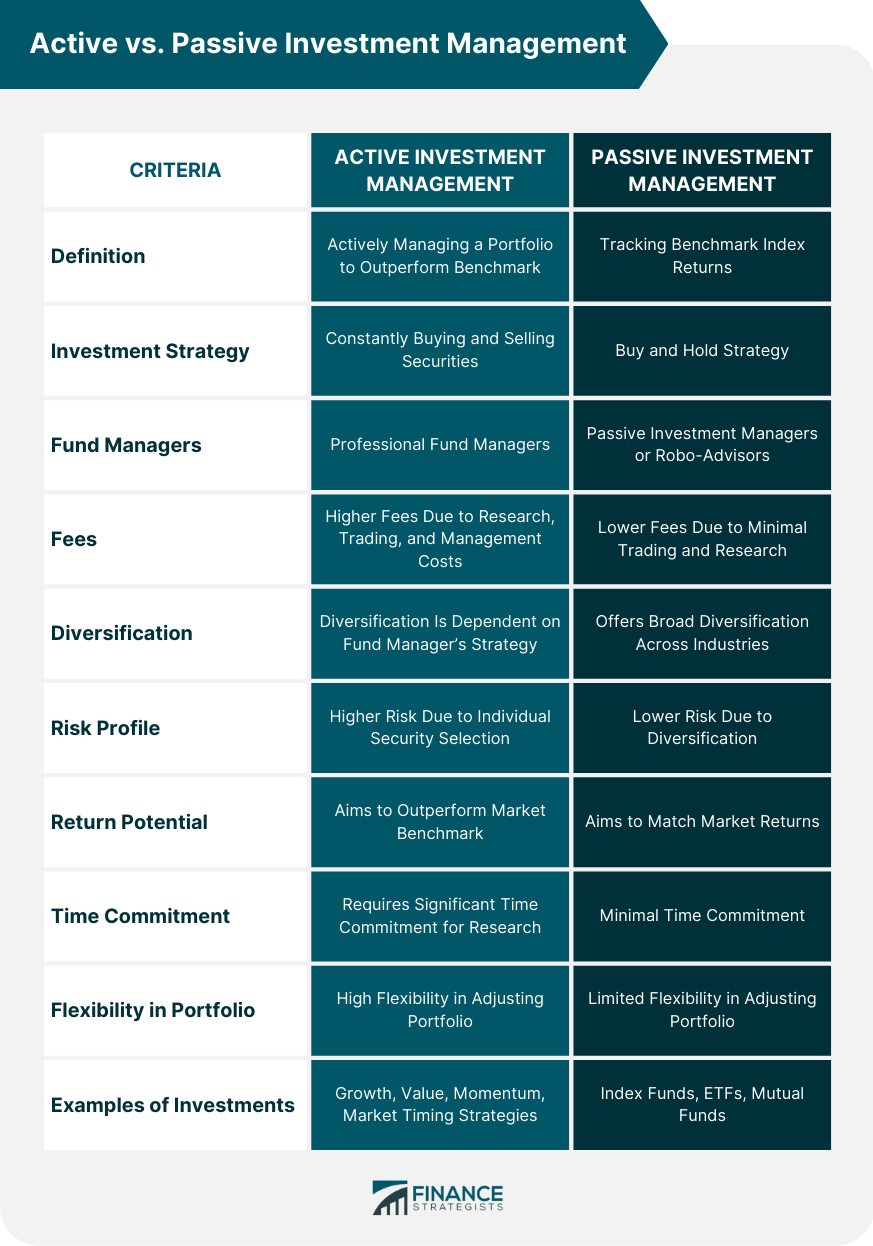
The strategy used by index funds is called passive investing. It's "passive" because the fund manager isn't making active decisions or doing research to find undervalued stocks. They are simply following the rules of the index.
The opposite of this is active investing. An active fund manager's job is to beat the market. They conduct research, analyze companies, and trade frequently, trying to pick investments that will outperform a benchmark like the S&P 500.
This difference in approach stems from two competing philosophies about how the market works, which may appeal to your interest in economics and philosophy.
- Passive investors tend to believe in the Efficient Market Hypothesis (EMH). This theory suggests that a stock's price already reflects all publicly available information. Therefore, it's nearly impossible to consistently find "bargains" or "overpriced" stocks. The most logical approach is to simply buy the entire market and capture its average return.
- Active investors believe markets are not perfectly efficient. They argue that investor psychology, irrational behavior, and overlooked information create opportunities to identify mispriced stocks and outperform the market.
The following video does an excellent job of framing this debate.
The Active Vs Passive Investing Debate
In 'The Active Vs Passive Investing Debate,' The Plain Bagel channel clearly lays out the core tenets of both strategies and the philosophies that underpin them.
Please watch from 01:41 to 05:31. This covers: The key characteristics of active and passive strategies. The goal of an active investor to achieve 'alpha' (outperformance). The theoretical foundations for each approach (including the Efficient Market Hypothesis).
To summarize the key differences, have a look at this comparison table.
Part 3: Why This Matters: The Impact of Costs and Performance
So, why has this debate become so central to modern investing? It boils down to two practical factors that directly impact your returns: fees and long-term performance.
-
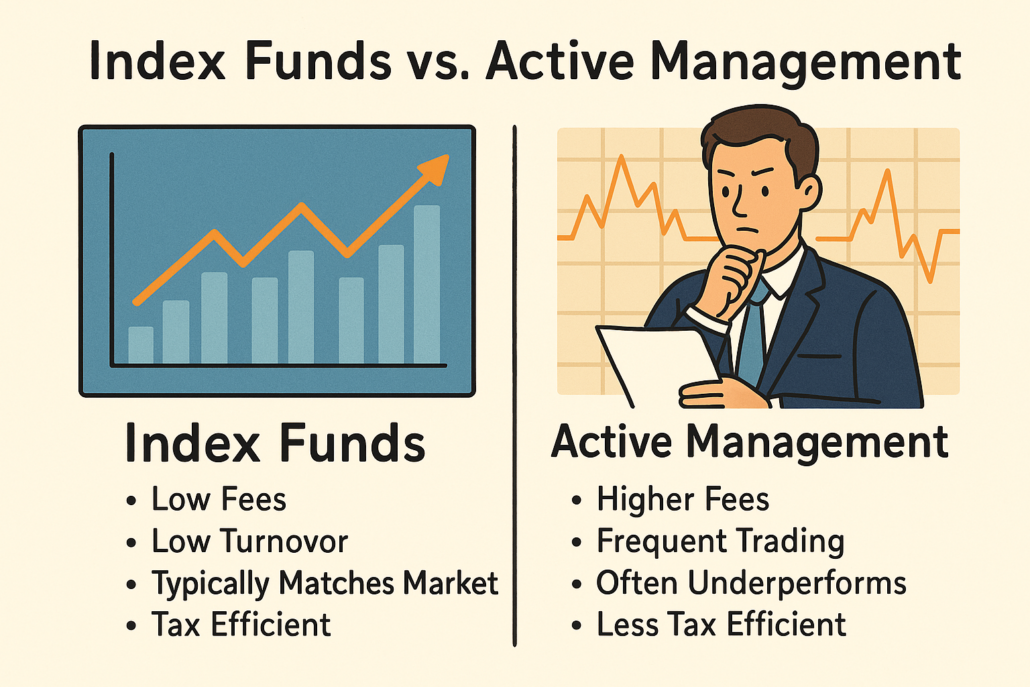
Fees (Expense Ratios): Active management requires a team of expensive analysts and frequent trading, all of which costs money. These costs are passed on to you, the investor, through a higher expense ratio (the annual fee for a fund). Passive index funds, which can be largely run by computers, have dramatically lower fees.
- Active Fund Expense Ratio: Typically 0.50% - 1.50% or more.
- Passive Index Fund Expense Ratio: Typically 0.02% - 0.20%.
While a 1% difference might sound small, over an investing lifetime of 30 or 40 years, this difference in fees can consume a massive portion of your potential returns due to the power of compounding.
-
Performance: The central promise of active management is to deliver returns that are high enough to justify the higher fees. However, decades of data consistently show that the vast majority of active fund managers fail to beat their benchmark index over long periods. After their higher fees are deducted, their performance is often worse than that of a simple, cheap index fund.
Test your understanding!
An investor is choosing between two funds that both invest in the largest US companies.
- Fund A is managed by a star portfolio manager who actively researches and picks stocks with the goal of outperforming the S&P 500. Its expense ratio is 1.10%.
- Fund B makes no attempt to pick stocks and simply owns all 500 companies in the S&P 500 to match its performance. Its expense ratio is 0.03%.
- Which fund is actively managed and which is passively managed?
- What is the primary risk the investor takes by choosing Fund A over Fund B?
Show answer
- Fund A is actively managed. Fund B is passively managed (it's an index fund).
- The primary risk is that the manager of Fund A will fail to outperform the S&P 500 by at least 1.07% (the difference in fees). The investor is paying a significantly higher fee for the hope of outperformance, but historical data shows this is an unlikely outcome over the long term. With Fund B, the investor is virtually guaranteed to receive the market's return, minus a tiny fee.
Conclusion
You have now learned about one of the most powerful and efficient tools available to an investor. The concepts of index funds and passive management have revolutionized investing for millions of people.
Here are the key takeaways from this lesson:
- An index fund is a low-cost fund that provides instant diversification by tracking a market index, like the S&P 500.
- It uses a passive management strategy, which aims to match market performance, not beat it.
- Active management is the opposite strategy, where a manager tries to beat the market by picking investments. This approach comes with much higher fees.
- Due to the impact of higher fees and the difficulty of consistently picking winners, most active funds underperform passive index funds over the long term.
In our last lesson, we answered why you should diversify. Today, we answered what tool you can use to do it effectively. In our next lesson, we will get even more practical by comparing the two main structures that these funds come in: mutual funds vs. Exchange-Traded Funds (ETFs). You will learn the key differences in how they trade, their costs, and their tax efficiency, helping you make the right choice for your brokerage account.