Hello and welcome back!
In the last lesson, we covered the essential skill of monitoring your open positions and transaction history. Now that you know how to see what you own, the next crucial question is: what should you own? Is it wise to put all your money into a single stock you believe in, or is there a better way to manage the inherent risks of investing?
This lesson introduces one of the most important concepts in modern finance: diversification. We will explore what it means to diversify, why it's a fundamental strategy for managing risk, and how it protects you from the unpredictable nature of markets. Mastering this principle is a cornerstone of building a resilient long-term portfolio, which is a key part of your investing goals.
Part 1: The Core Idea: Don't Put All Your Eggs in One Basket
At its heart, diversification is the simple practice of spreading your investments across various assets so that the poor performance of any single investment doesn't sink your entire portfolio.
Imagine you owned stock in just one company. If that company faces a major setback—a failed product, a new competitor, or a scandal—your entire investment could suffer a significant loss. By contrast, if you own small pieces of many different companies, the failure of one has a much smaller impact on your overall wealth.
This image provides a great visual metaphor for how this works.
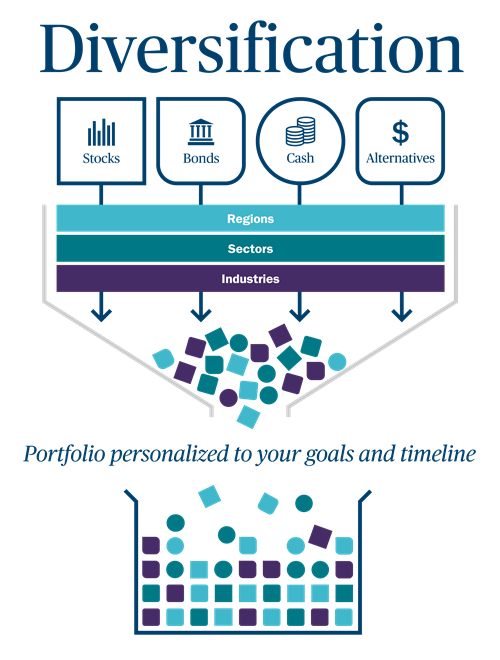
The power of this approach was starkly illustrated in recent years. To see just how risky it can be to pick individual stocks, even in a strong market, let's look at an article from iShares, a major ETF provider.
A Masterclass In Diversification - A How-To Guide
The article 'A Masterclass In Diversification' uses real market data to show why diversification is so critical. It highlights how many individual stocks can lose value even when the market as a whole is going up.
Please read the section titled "Spreading the risk around through diversification." Pay close attention to the statistic about the percentage of stocks that declined over a five-year period. This powerfully demonstrates the risk of concentrating your money in just a few stocks.
As the article points out, trying to pick the handful of "winners" is incredibly difficult. Diversification is the investor's primary defense against the risk of backing the wrong horse.
Part 2: The Two Types of Investment Risk
To understand how diversification works, we need to distinguish between two types of risk. The following video explains this distinction clearly and provides a powerful visual aid.
Systematic Vs Unsystematic Risk Explained In 5 Minutes
In 'Systematic Vs Unsystematic Risk Explained In 5 Minutes,' Ryan O'Connell breaks down the two fundamental types of risk. This is key to understanding what diversification can and cannot do for your portfolio.
Watch the video from the beginning until 04:48. Focus on these key points: The definition of unsystematic risk (also called company-specific or diversifiable risk). The definition of systematic risk (also called market or undiversifiable risk). The graph that shows how total risk decreases as you add more stocks to a portfolio.
Let's recap the key ideas from the video:
-
Unsystematic Risk: This is the risk that affects a specific company or industry. Examples include a disappointing earnings report, a factory shutdown, or a new regulation targeting a single industry. This is the type of risk that diversification is designed to eliminate. By owning stocks across many different industries, you insulate your portfolio from a disaster at any single company. The video's graph shows that as you add more stocks, this unsystematic risk falls dramatically. A common rule of thumb is that much of this risk is diversified away once you hold around 30 different stocks from various sectors.
-
Systematic Risk: This is the risk inherent to the entire market, which you cannot get rid of through diversification. Examples include a global recession, a major war, or an interest rate hike by the central bank. These events tend to affect almost all stocks at once. No matter how many stocks you own, you will still be exposed to systematic risk. This is the price of admission for earning the long-term returns the stock market offers.
Test your understanding!
An investor's portfolio consists of only two stocks: Ford and General Motors. An unexpected, month-long labor strike forces both companies to halt all production, and their stock prices fall by 15%.
- What type of risk is primarily demonstrated here?
- How could the investor have minimized the impact of this event on their portfolio?
Show answer
- This is unsystematic risk. The event is specific to the auto manufacturing industry, not the entire market.
- The investor could have minimized the impact by diversifying their holdings to include stocks from other industries, such as technology, healthcare, or consumer goods. While the auto stocks would still have fallen, their losses would have been a smaller part of the total portfolio's value.
Part 3: Putting Diversification into Practice
Knowing the theory is one thing, but applying it is what matters. Diversification can be achieved at several levels:
- Across companies and industries: As we've seen, this involves owning stocks from different sectors of the economy.
- Across asset classes: This means investing in different types of assets, primarily stocks and bonds. Stocks offer higher potential growth but come with more volatility. Bonds are generally more stable and provide income, acting as a shock absorber when the stock market falls.
- Across geographies: Spreading investments between your home country (e.g., the U.S. market) and international markets.
A practical way to think about this is through asset allocation—deciding what percentage of your portfolio to put into major categories like stocks and bonds. This decision is deeply personal and depends on your time horizon and risk tolerance, which connects to your interest in psychology.
The following video introduces a simple yet powerful strategy—the "3 Fund Portfolio"—that bundles these concepts into an easy-to-execute plan.
The 3 Fund Portfolio - Simple Investing for Beginners
The video 'The 3 Fund Portfolio' by Humphrey Yang provides a fantastic, practical example of a diversified portfolio. It shows how you can achieve broad diversification with just a few funds and how to tailor it to your personal risk tolerance.
Please watch the following two segments: Benefits of Diversification (01:51 - 03:08): This section reinforces the 'why' and features a famous quote from Warren Buffett about diversification. Asset Allocation (07:11 - 08:08): This part explains the practical decision of how to split your money between stocks and bonds based on whether you are an aggressive or conservative investor.
As the video explains, a younger investor with a long time horizon might choose a more "aggressive" allocation with a higher percentage in stocks (e.g., 80% stocks, 20% bonds) to maximize long-term growth. An investor nearing retirement might prefer a "conservative" allocation with more bonds (e.g., 40% stocks, 60% bonds) to preserve capital and reduce volatility.
Finally, a comprehensive guide from Fidelity can serve as a great reference for putting these ideas together.
Guide to diversification | Fidelity
The 'Guide to diversification' from Fidelity reinforces these concepts and provides a historical example of how diversification performed during a major market downturn.
Please read two sections of this guide: "Why diversify?" This section explains the goal of diversification and discusses spreading investments not just across stocks and bonds, but also within each category (e.g., by company size and geography). "Diversification has proven its long-term value." This part uses the 2008-2009 financial crisis to show how a diversified portfolio, while not immune to losses, fell significantly less than an all-stock portfolio.
Conclusion
You have now learned the foundational principle of diversification. It is not a magic wand to prevent all losses, but it is the most reliable tool for managing risk and building a portfolio that can weather market storms.
Here are your key takeaways:
- Diversification is the strategy of spreading investments across various assets to reduce risk.
- It works by eliminating unsystematic (company-specific) risk, but it cannot remove systematic (market) risk.
- In practice, diversification involves holding a mix of asset classes (like stocks and bonds) and ensuring variety within those classes (across industries and geographies).
- Your personal asset allocation (the mix of stocks vs. bonds) should reflect your own goals, time horizon, and comfort with risk.
This lesson forms the strategic "why" behind the structure of a long-term portfolio. In our next lesson, we will explore one of the most efficient and popular tools for achieving this diversification: the index fund. You'll learn what an index fund is and how its "passive" approach differs from "active" fund management.