Hello! Welcome back to your second lesson.
In our first lesson, we established the fundamental concept that a stock is a piece of ownership in a company. Now that you know what you're buying, the logical next step is to understand where you buy and sell it.
Today, we'll answer that question by exploring the world of stock exchanges. Our goal is to explain how major exchanges like the New York Stock Exchange (NYSE) and the NASDAQ facilitate the buying and selling of stocks. Think of this as looking under the hood of the market to see the machinery that makes trading possible.
What is a Stock Exchange?
A stock exchange is essentially a marketplace. Just like a farmer's market brings together farmers selling produce and customers looking to buy it, a stock exchange brings together investors who want to sell their shares and investors who want to buy them.
The exchange itself doesn't own the stocks being traded. Its primary functions are to:
- Provide the physical or electronic infrastructure for trading.
- Establish rules to ensure trading is fair and orderly.
- Display real-time price information to the public.
The two most famous stock exchanges in the United States are the New York Stock Exchange (NYSE) and the NASDAQ.
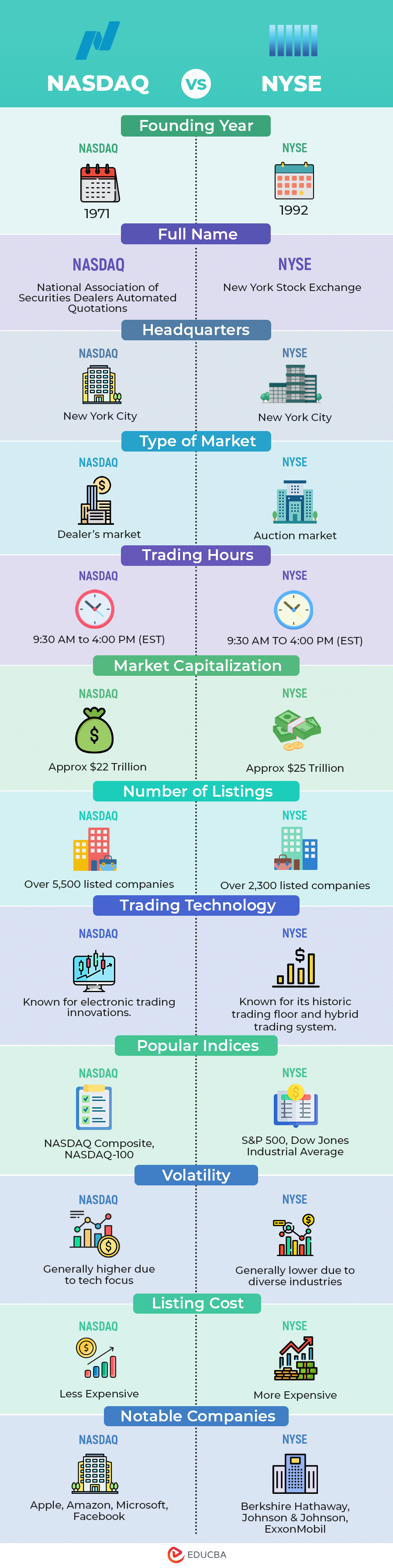
The NYSE is the older of the two, with a history stretching back to 1792 and a famous physical trading floor on Wall Street. The NASDAQ, founded in 1971, was the world's first electronic stock market, born from the need to handle trading volumes that were becoming too large for manual processing.
To understand this evolution, let's look at the story of how and why the NASDAQ was created.
The video 'What Exactly Is The NASDAQ?' provides excellent context on why a purely electronic exchange was needed and how it grew to become a major competitor to the NYSE.
Please watch from 01:09 to 03:22. This section explains how the manual processes of the NYSE in the 1960s couldn't keep up with demand, leading to the creation of the NASDAQ as an electronic quotation and trading system.
This historical context is important: the shift from manual, floor-based trading to high-speed electronic systems is the central story of modern stock markets.
The Lifecycle of a Trade: From Your Click to Execution
Since your goal is to learn the practical "how-to" of investing, let's trace the path your order takes when you decide to buy a stock. It's not as simple as your order going directly to the exchange floor.
The short video below provides a simple, clear overview of the journey.
How orders get to the exchange
This clip from Udacity, 'How orders get to the exchange,' visualizes the basic path of a trade from your computer to your broker, and then to the various exchanges where the best price is sought.
Watch the first part of the video, from the beginning to 01:14. It clearly illustrates how your broker acts as an intermediary, routing your order to an exchange for execution.
As the video showed, your broker plays a crucial role. When you hit "buy," your broker receives the order and then decides the best place to send it to get it filled. This "best place" is often a stock exchange.
For a more detailed breakdown, we can turn to FINRA (the Financial Industry Regulatory Authority), which oversees brokerage firms in the U.S.
How Online Stock Trading Works: Understanding the Trade Lifecycle
FINRA's article, 'How Online Stock Trading Works,' gives an authoritative step-by-step description of what happens behind the scenes. This will solidify your understanding of the process.
Please read from 'STEP ONE: You place an online stock order' through 'STEP FOUR: Your trade is executed.' This walks you through the initial stages of an order, from placement to execution on a venue like an exchange.
The process can be summarized visually in a flowchart.

Two Different Ways to Facilitate a Trade: Auction vs. Dealer Markets
While both the NYSE and NASDAQ bring buyers and sellers together, they do so using fundamentally different models. Understanding this difference is key to grasping how they facilitate trading.
Let's examine each model using a helpful article from SmartAsset.
NASDAQ vs NYSE: Key Differences
The article 'NASDAQ vs NYSE: Key Differences' clearly explains the distinct market structures of the two major exchanges. We will read the sections that define each model.
Please read three sections from this article: 'Understanding the NYSE': Focus on the paragraphs describing the roles of brokers and specialists in creating an auction. 'Understanding the NASDAQ': Read this section to learn about the 'dealer's market' model, where trades go through market makers. 'NASDAQ vs. NYSE: The Differences': Read this section to see a direct comparison of the two models.
Let's break down what you just read:
1. NYSE: The Auction Market
- Concept: This is like a traditional auction. Buyers compete with each other to bid the highest price for a stock, while sellers compete to offer the lowest price. A trade occurs when a bid and an ask price match.
- Key Player: The NYSE uses a Designated Market Maker (DMM), formerly known as a specialist. This is a single, designated person/firm on the trading floor responsible for maintaining a "fair and orderly market" for specific stocks. They act as the auctioneer, and if there's an imbalance of buyers and sellers, they are obligated to use their own capital to step in and complete trades, providing liquidity. While most NYSE trading is now electronic, the DMM still plays this crucial role, especially at the market open and close.
2. NASDAQ: The Dealer Market
- Concept: Instead of one central auctioneer, the NASDAQ has many market makers (or "dealers") for each stock. These are firms that are required to continuously post prices at which they are willing to buy (the bid) and sell (the ask) a stock.
- How it works: When you place an order, your broker sends it to one of these market makers, and you trade directly with them, not another investor. The market makers compete with each other by offering the most attractive bid and ask prices. This entire process is electronic, with no physical trading floor.
In short:
- On the NYSE, you're more likely to trade against another investor in an auction managed by a single DMM.
- On the NASDAQ, you trade against one of many competing dealers (market makers).
Test your understanding!
An investor wants to buy shares of two different companies:
- Company A: A large, established industrial company listed on the NYSE.
- Company B: A fast-growing technology company listed on the NASDAQ.
Based on the typical market structure of each exchange, briefly describe the different processes their buy orders will go through to be executed.
Show answer
- For Company A (NYSE): The order would enter an auction market. It would be matched against sell orders from other investors. A Designated Market Maker (DMM) would oversee this process to ensure it's orderly.
- For Company B (NASDAQ): The order would enter a dealer market. It would likely be executed by one of many competing market makers, who would sell the shares to the investor from their own inventory at a posted price.
Conclusion
In this lesson, we demystified the role of stock exchanges as the core engines of the stock market. You learned that they are not just abstract concepts but organized marketplaces with specific rules and technological models for facilitating trades.
Here are the key takeaways:
- A stock exchange is a centralized marketplace that provides the infrastructure and rules for buying and selling stocks.
- When you place a trade, your broker receives the order and routes it to an execution venue, such as an exchange, to find a buyer or seller.
- The NYSE primarily operates as an auction market, where buyers and sellers compete on price, with a Designated Market Maker overseeing the process.
- The NASDAQ is an electronic dealer market, where multiple market makers compete by posting buy and sell prices, and you trade directly with them.
You now understand what a stock is and where it's traded. But how do you identify a specific stock among the thousands listed on an exchange? In our next lesson, we will cover stock tickers and how they serve as unique identifiers for every publicly traded company.