Hello! Welcome to your third lesson.
In our last session, we explored the major stock exchanges like the NYSE and NASDAQ, understanding them as the organized marketplaces where stocks are traded. Now that you know where trading happens, the next logical question is: with thousands of companies out there, how do you specify exactly which one you want to trade?
Today's lesson answers that question. We will focus on distinguishing between a company's name and its stock ticker symbol. This is a fundamental piece of market language you'll use every time you look up a stock, research a company, or place a trade. Our goal is to make you comfortable finding and using these unique identifiers.
What is a Ticker Symbol?
A stock ticker symbol is a short, unique code made up of letters used to identify a publicly traded company on a stock exchange. Think of it as a company's nickname or username in the world of trading. While a company's full name might be long or similar to another's, its ticker is distinct.
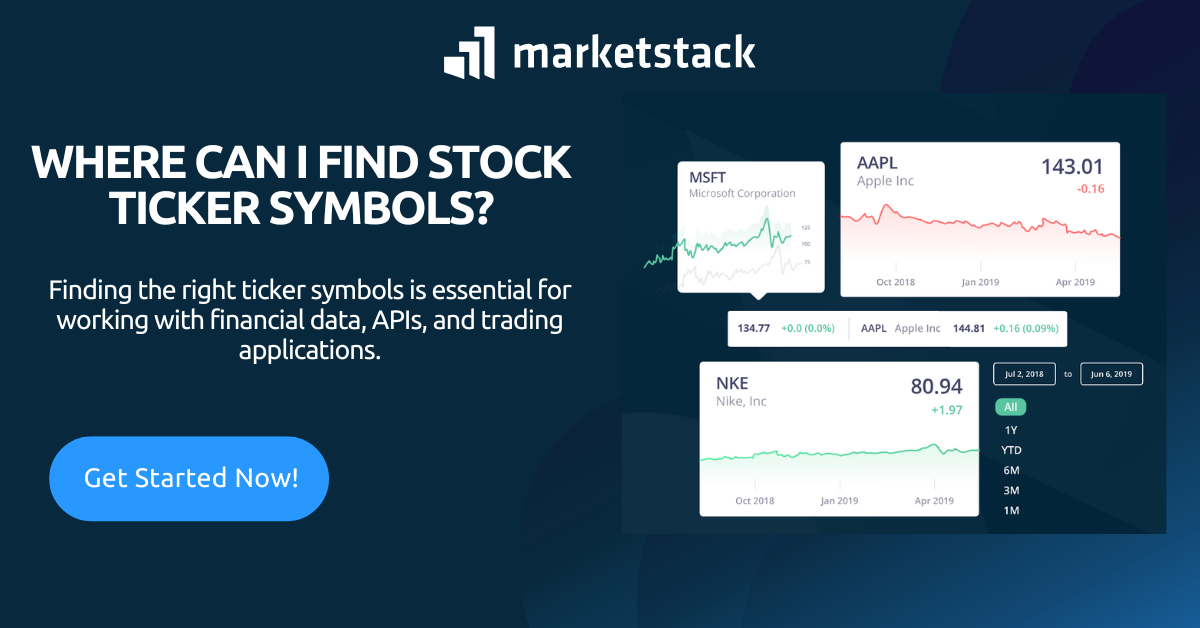
For example:
- The company is Microsoft Corporation, but its ticker symbol is MSFT.
- The company is Apple Inc., but its ticker symbol is AAPL.
- The company is NIKE, Inc., but its ticker symbol is NKE.
This image provides a clean visual breakdown of this relationship.
Why Tickers are Essential
The primary purpose of ticker symbols is to eliminate confusion and increase speed. In the fast-paced environment of the stock market, accuracy is critical.
To get a quick overview of why tickers were invented and their purpose, let's start with a short video.
What is a Stock Symbol or Ticker Symbol? A Simple Explanation for Teens and Beginners
The video 'What is a Stock Symbol or Ticker Symbol?' from Easy Peasy Finance provides a concise explanation of what a ticker is and why it's necessary for trading.
Please watch the segment from 00:11 to 00:44. It defines a ticker symbol and explains its role in avoiding confusion between companies.
As the video explained, tickers ensure that when you place an order for a stock, you are buying or selling shares in the exact company you intend.
For a more detailed explanation of their origin and importance, let's turn to a written resource.
Stock Symbol (Ticker Symbol): Abbreviation for a ...
The article 'Stock Symbol (Ticker Symbol)' from Investopedia gives a great overview of the history and function of ticker symbols.
Please read the sections titled 'What Is a Stock Ticker Symbol?' and 'Why Did Investors Start Using Ticker Symbols?'. These sections explain the historical need for tickers (originating from the 'ticker tape' machine) and give a concrete example of how they prevent mix-ups.
The Investopedia article highlights a perfect real-world scenario: Citigroup (ticker: C) and Citizens Financial Group (ticker: CFG). Both are financial companies with similar names trading on the NYSE. Without unique ticker symbols, it would be easy to accidentally invest in the wrong one.
Ticker Symbol Conventions and Nuances
While many tickers are intuitive abbreviations of the company name (like WMT for Walmart), there are some important details to be aware of.
1. Ticker Length and Exchange
Generally, tickers on the NYSE have been 1 to 3 letters long (e.g., F for Ford, KO for Coca-Cola), while tickers on the NASDAQ are typically 4 or 5 letters long (e.g., AMZN for Amazon, TSLA for Tesla). While these conventions have become more flexible over time, they can still serve as a rough guide.
2. Different Classes of Stock
Sometimes, a single company will have more than one ticker symbol. This usually happens when the company issues different classes of stock, which may have different voting rights for shareholders.
The video we watched earlier has a great section explaining this.
What is a Stock Symbol or Ticker Symbol? A Simple Explanation for Teens and Beginners
Let's return to the 'What is a Stock Symbol or Ticker Symbol?' video to understand how one company can have multiple tickers.
Watch the segment from 01:09 to 01:40. It uses the example of Berkshire Hathaway (BRK.A and BRK.B) to explain different stock classes.
A famous example is Google's parent company, Alphabet Inc. It has two main tickers:
- GOOGL: Class A shares, which come with one vote per share.
- GOOG: Class C shares, which come with no voting rights.
3. Special Suffixes
You might occasionally see an extra letter appended to a ticker symbol, separated by a dot or space. These suffixes provide additional information. For example, a ".Q" (or a fifth letter "Q" on NASDAQ) indicates the company has filed for bankruptcy. For now, just be aware that these exist; we'll cover them more if they become relevant to your trading.
Test your understanding!
An investor sees that Southwest Airlines has the ticker symbol "LUV". Why might a company choose a ticker that isn't a direct abbreviation of its name?
Show answer
Companies sometimes choose creative or "vanity" tickers for branding purposes. Southwest Airlines chose "LUV" as a nod to its home base at Love Field airport in Dallas and to project a friendly, customer-focused brand image. Another example is Harley-Davidson, which uses the ticker "HOG".
How to Find and Use Ticker Symbols
Since your goal is to become a proficient investor, knowing how to use tickers is essential. This is a very practical skill. You will use tickers to:
- Look up a stock's price on a financial website or brokerage app.
- Pull up charts to analyze a stock's performance.
- Find financial data and news about a specific company.
- Place a buy or sell order through your broker.

So, how do you find the ticker for a company you're interested in? The process is simple.
Identifying Ticker Symbols and Interpreting Stock Quotes
This guide from the SIFMA Foundation, which runs The Stock Market Game for students, provides a straightforward, practical method for finding a ticker symbol.
Read the section titled 'Search for Ticker Symbol, Search By Stock Description, Validate Ticker/ Get Details' (it's on page 2 of the PDF). This describes exactly how you would use a trading platform's search function to find a ticker symbol by typing in the company's name.
The process described is universal: on almost any financial platform (like Yahoo Finance, Google Finance, or your future brokerage account), you can simply type the company's name into the search bar, and it will suggest the corresponding ticker symbol.
Conclusion
In this lesson, we've established the critical difference between a company's name and its ticker symbol. You now know that the ticker is the unique code used to identify a stock for all trading-related activities.
Here are the key takeaways:
- A ticker symbol is a unique, short code for a stock, while the company name is its formal legal title.
- Tickers are essential for ensuring speed and accuracy in trading, preventing confusion between similarly named companies.
- A single company can have multiple tickers if it offers different classes of stock (e.g., BRK.A and BRK.B).
- To trade, research, or track a stock, you must use its ticker symbol.
You now know what a stock is, where it's traded, and how to identify it. The next step is to understand what its price movements mean. In our next lesson, we will interpret price changes on a stock chart as a result of shifts in supply and demand, connecting these core economic principles to the practical world of investing.