Hello! Welcome back to our module on tax-advantaged investing.
In our last lesson, we established the "big picture" of investment accounts, comparing taxable brokerage accounts with the two main types of tax-advantaged retirement accounts: Traditional (tax-deferred) and Roth (tax-free). We saw how the choice of account can dramatically affect your long-term wealth due to taxes.
Today, we're going to zoom in on what many consider one of the most powerful tools for long-term investors: the Roth IRA. This lesson will provide a detailed look at its key features, including its famous tax-free growth, contribution limits, and the rules you need to know to use it effectively. For a young investor, understanding the Roth IRA is fundamental to building a tax-efficient foundation for the future.
The Core Power of the Roth IRA: Tax-Free Growth
The fundamental principle of a Roth IRA is simple but incredibly powerful: you contribute money that you've already paid taxes on (after-tax dollars), and in exchange, your investments can grow and be withdrawn in retirement completely tax-free.
You pay the taxes now, so you don't have to later. For someone at the beginning of their career, this is often a fantastic trade-off. You're likely in a lower tax bracket today than you will be in your peak earning years or retirement. By paying taxes now, you lock in today's lower rate and let all your future growth compound without any "tax drag."
Let's look at a visual representation of how this plays out over time.
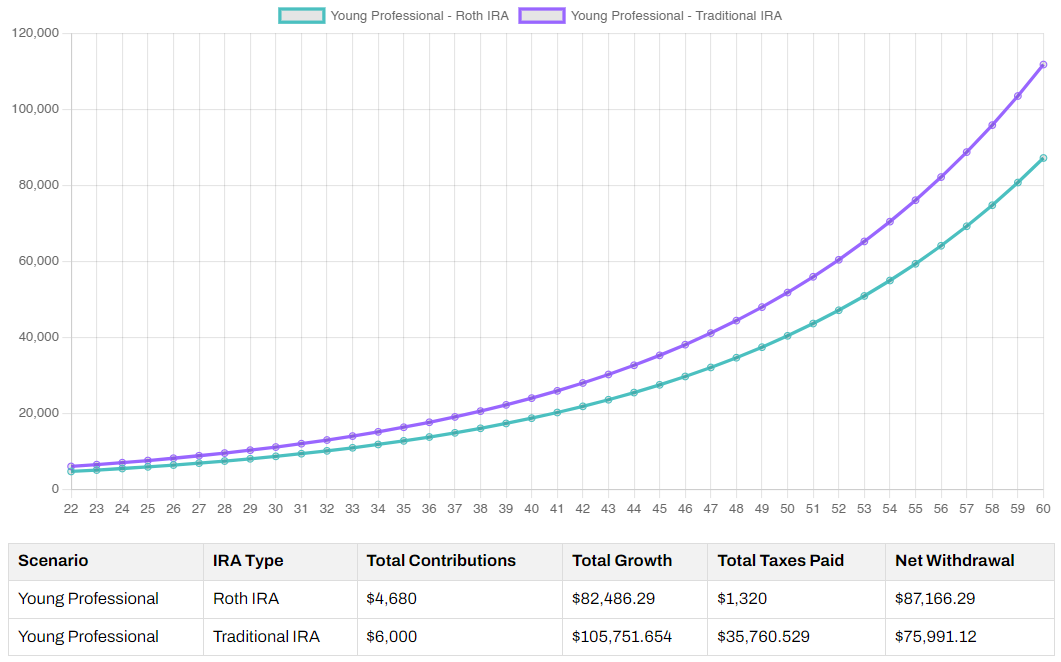
As you can see, even though the gross account value might look similar to other account types, the fact that you owe zero tax on qualified Roth withdrawals can make a significant difference in your actual spendable money in retirement.
How a Roth IRA Works: The Mechanics
It's important to remember that a Roth IRA is not an investment itself—it's the account or "container" that holds your investments (like the stocks and ETFs we've discussed). The "Roth" designation simply refers to its tax treatment.
Roth IRA Growth: Tax-Free Compounding and Wealth ...
To start, let's get a formal definition and understand the growth mechanism from Investopedia's article 'Roth IRA Growth: Tax-Free Compounding and Wealth ...'.
Read the sections 'What Is a Roth IRA?' and 'Understanding Roth IRA Growth Mechanisms'. Pay close attention to the explanation of how after-tax contributions lead to tax-free growth through compounding.
As the article highlights, the tax-free compounding is where the magic happens. Every dollar your investments earn—whether through capital appreciation or dividends—gets reinvested and starts earning its own returns, all without the government taking a cut each year.
To use a Roth IRA effectively, you need to understand its three main sets of rules: contributions, withdrawals, and income limits.
1. Contribution Rules and Limits
Not everyone can contribute to a Roth IRA, and there are limits on how much you can put in each year.
FINANCIAL ADVISOR Explains: Retirement Plans for Beginners (401k, IRA, Roth 401k/IRA, 403b) 2024
The video 'FINANCIAL ADVISOR Explains: Retirement Plans for Beginners' provides a concise summary of the key numbers you need to know for contributing to a Roth IRA.
Watch the section from 07:32 to 08:00 to learn the contribution limits for 2024. Then, watch from 09:30 to 09:49 to understand the concept of income limits.
Let's break down those rules:
- Earned Income Requirement: You must have earned income (from a job or self-employment) to contribute.
- Annual Contribution Limit: For 2024, the maximum you can contribute is $7,000 (or $8,000 if you are age 50 or older). This limit is shared across all IRAs you own, meaning if you contribute $4,000 to a Roth IRA, you can only contribute $3,000 to a Traditional IRA in the same year.
- Income Limits: Your ability to contribute is phased out and eventually eliminated if your income is too high. This is based on your Modified Adjusted Gross Income (MAGI), which is essentially your total income with some specific deductions added back.
This flowchart provides a clear, step-by-step guide to see if you're eligible to contribute based on 2024 rules.

For those who earn too much to contribute directly, there is a common strategy known as a "backdoor Roth IRA." This involves contributing to a Traditional IRA and then converting it to a Roth IRA. While we won't detail the process here, it's useful to know this option exists, as it's a key part of the investing landscape you've expressed interest in.
2. The Power of Tax-Free Withdrawals (and the Rules)
The tax-free withdrawal of your earnings is the main benefit of a Roth IRA, but it comes with conditions. This is where we need to clearly distinguish between your contributions (the money you put in) and your earnings (the growth).
To get a crystal-clear understanding of these rules, particularly the "5-Year Rule," the following video is excellent.
Roth IRA Tax-Free Withdrawals (5-Year Rule Explained)
Certified Financial Planner James Conole breaks down the withdrawal rules in his video 'Roth IRA Tax-Free Withdrawals (5-Year Rule Explained)'. This is one of the most important and often misunderstood aspects of Roth IRAs.
Please watch these segments carefully: (00:46 - 01:07) Understand the three sources of money in a Roth IRA. (01:07 - 01:46) Focus on the rule for withdrawing your direct contributions. (02:24 - 03:46) Learn about the first 5-year rule required for qualified distributions of earnings. (05:56 - 07:25) Understand the IRS's ordering rule for withdrawals (how they assume which money comes out first).
Let's summarize the key withdrawal rules from the video:
-
Contributions: You can withdraw your direct contributions at any time, for any reason, without tax or penalty. This provides incredible flexibility and makes a Roth IRA a potential backup for major life expenses (though ideally, you should leave it for retirement).
-
Earnings: For your earnings to be withdrawn tax-free and penalty-free (a "qualified distribution"), you must meet two conditions:
- You must be age 59½ or older.
- You must have made your first-ever Roth IRA contribution at least 5 years prior (the "5-Year Rule").
-
Withdrawal Order: The IRS assumes money comes out of your Roth IRA in a specific order:
- First, all of your contributions.
- Second, any converted amounts (from a Traditional IRA, for example).
- Last, your earnings.
This ordering rule is fantastic because it means you can access a large portion of your account (all your contributions) penalty-free before ever touching the earnings that are subject to stricter rules.
Test your understanding!
Imagine you are 35 years old. Over the past few years, you have contributed a total of $15,000 to your Roth IRA. Thanks to good market performance, your account is now worth $20,000 (meaning you have $5,000 in earnings). You have a major emergency and need to withdraw $18,000.
What are the tax and penalty implications for this withdrawal?
Show answer
Let's break down the $18,000 withdrawal based on the IRS ordering rule:
- First $15,000: This is considered a return of your original contributions. You can withdraw this amount completely tax-free and penalty-free.
- Next $3,000: This comes from your earnings. Because you are under age 59½, this portion is a "non-qualified distribution." It will be subject to both ordinary income tax AND a 10% early withdrawal penalty.
So, you would get $15,000 with no issue, but you would owe taxes and penalties on the remaining $3,000.
3. No Required Minimum Distributions (RMDs)
One final, powerful feature distinguishes Roth IRAs from almost all other retirement accounts. Traditional IRAs and 401(k)s require you to start taking money out at age 73, whether you need it or not. These are called Required Minimum Distributions (RMDs).
Roth IRAs have no RMDs for the original owner. This means you can leave the money in your account to grow tax-free for your entire lifetime if you wish. This provides ultimate control and makes the Roth IRA an excellent tool for passing wealth to heirs, as they can inherit the account and continue to benefit from tax-free growth.
Conclusion
The Roth IRA is a cornerstone of modern retirement planning, especially for those with a long investment horizon. Its combination of tax-free growth and flexible access to contributions is unmatched.
Key Takeaways:
- Core Concept: You contribute with after-tax money, and in return, qualified withdrawals in retirement are completely tax-free.
- Tax-Free Growth: Your investments compound over time without the drag of annual taxes on dividends or gains.
- Contribution Limits: In 2024, you can contribute up to $7,000 (or $8,000 if 50+), but only if you have earned income and your MAGI is below the annual limit.
- Withdrawal Rules: You can withdraw your contributions anytime without tax or penalty. Earnings can be withdrawn tax-free and penalty-free after age 59½, provided your account has been open for at least five years.
- No RMDs: You are never forced to withdraw money from your Roth IRA during your lifetime, giving you more control and tax-planning flexibility.
A Look Ahead:
Now that you have a firm grasp of the Roth IRA, you're probably wondering about the other side of the coin. When might a Traditional IRA or 401(k) be a better choice? In the next lesson, we will explore the key features of these tax-deferred accounts, focusing on the power of the upfront tax deduction and helping you understand the trade-offs in the "pay taxes now vs. pay taxes later" decision.