Hello! Welcome to the first lesson in our module on Tax-Advantaged Investing.
In the last module, you learned how to build a powerful, diversified long-term portfolio using a simple three-fund strategy. We answered the question of what to invest in. Now, we need to answer an equally important question: where should you hold those investments?
The type of account you use can have a massive impact on your wealth over your lifetime, primarily due to one factor: taxes. This lesson is designed to help you compare taxable brokerage accounts with tax-advantaged retirement accounts (like IRAs and 401(k)s). Understanding these differences is the foundation for making smart decisions that can save you tens, or even hundreds, of thousands of dollars in taxes over the long run.
The Account is Just a Container
Before we dive in, it's crucial to understand a key concept. An investment account—whether it's a 401(k), an IRA, or a brokerage account—is not the investment itself. Think of the account as a container or a "bucket." The investments you learned about, like the VTI and VXUS ETFs, are what you put inside the bucket.
The primary difference between these buckets is how the government treats them for tax purposes. Let's explore the three main types.
Should You Invest In A Roth IRA or Brokerage Account?
To start, this video 'Should You Invest In A Roth IRA or Brokerage Account?' gives a clear, high-level introduction to the three main categories of investment accounts we'll be discussing.
Watch the first minute of the video (from 00:20 to 01:05) to get an overview of tax-deferred, post-tax, and taxable accounts.
As the video outlined, we can group investment accounts into three broad categories based on their tax treatment:
- Taxable Accounts (e.g., a standard brokerage account)
- Tax-Deferred Accounts (e.g., Traditional 401(k), Traditional IRA)
- Tax-Free Growth Accounts (e.g., Roth IRA, Roth 401(k))
Let's break down each one.
1. The Taxable Brokerage Account
This is the most straightforward and flexible type of investment account. It has no special retirement designation.
Roth IRA vs. brokerage account guide
The article 'Roth IRA vs. brokerage account' from Fidelity provides a clear definition of a taxable brokerage account and its primary uses.
Read the short section titled 'What is a brokerage account?'. Note its flexibility for both short-term and long-term goals.
Here’s how a taxable brokerage account works:
- Contributions: You fund it with after-tax dollars (money from your paycheck after taxes have already been taken out).
- Growth: You pay taxes along the way.
- Dividends/Interest: Any dividends or interest your investments generate are taxed in the year you receive them.
- Capital Gains: When you sell an investment for a profit, that profit is taxed. The tax rate depends on how long you held the investment:
- Short-Term Capital Gains: If you hold for one year or less, the profit is taxed at your regular income tax rate. This is relevant for your interest in active trading.
- Long-Term Capital Gains: If you hold for more than one year, the profit is taxed at a lower, more favorable rate.
- Withdrawals: You can withdraw your money at any time, for any reason, without penalty.
Key takeaway: The taxable account offers maximum flexibility but is the least tax-efficient for growing wealth because the growth is taxed annually.
2. Tax-Advantaged Retirement Accounts
This is a special category of accounts created by the government to encourage people to save for retirement. In exchange for significant tax benefits, you agree to certain restrictions, most notably that you generally can't withdraw the money without penalty until you reach age 59½.
Within this category, there are two main flavors: Traditional (pre-tax) and Roth (post-tax).
A. Traditional (Tax-Deferred) Accounts: 401(k) & IRA
These accounts give you a tax break today.
401(k) vs. IRA vs. Brokerage Account: How to Choose the ...
The article '401(k) vs. IRA vs. Brokerage Account' explains the features of a Traditional 401(k) and IRA.
First, read the sections '1. 401(k)' and '2. IRA'. Focus on the descriptions of the 'Traditional' versions of these accounts and how their tax implications differ.
Here's the structure for Traditional accounts:
- Contributions: You contribute pre-tax dollars. This means your contribution is deducted from your taxable income for the year, lowering your tax bill now.
- Growth: Your investments grow tax-deferred. You pay no taxes on dividends or capital gains as long as the money stays in the account. This allows your entire investment to compound without being slowed down by taxes.
- Withdrawals: All withdrawals in retirement (after age 59½) are taxed as ordinary income.
Special notes:
- A 401(k) is an employer-sponsored plan. Its biggest advantage is the potential for an employer match, which is essentially free money.
- An IRA (Individual Retirement Arrangement) is an account you open on your own. It offers more investment choices than most 401(k)s.
B. Roth (Tax-Free) Accounts: IRA & 401(k)
These accounts provide their tax break in the future.
Here's the structure for Roth accounts:
- Contributions: You contribute after-tax dollars, just like a taxable brokerage account. There is no upfront tax deduction.
- Growth: Your investments grow completely tax-free.
- Withdrawals: All qualified withdrawals in retirement (after age 59½) are completely tax-free.
This last point is the superpower of Roth accounts. A million dollars in a Roth account is a million dollars you can spend. A million dollars in a Traditional account is something less, because you still owe income tax on it.
Head-to-Head Comparison
Now let's put it all together. Seeing these accounts side-by-side makes the differences clear.
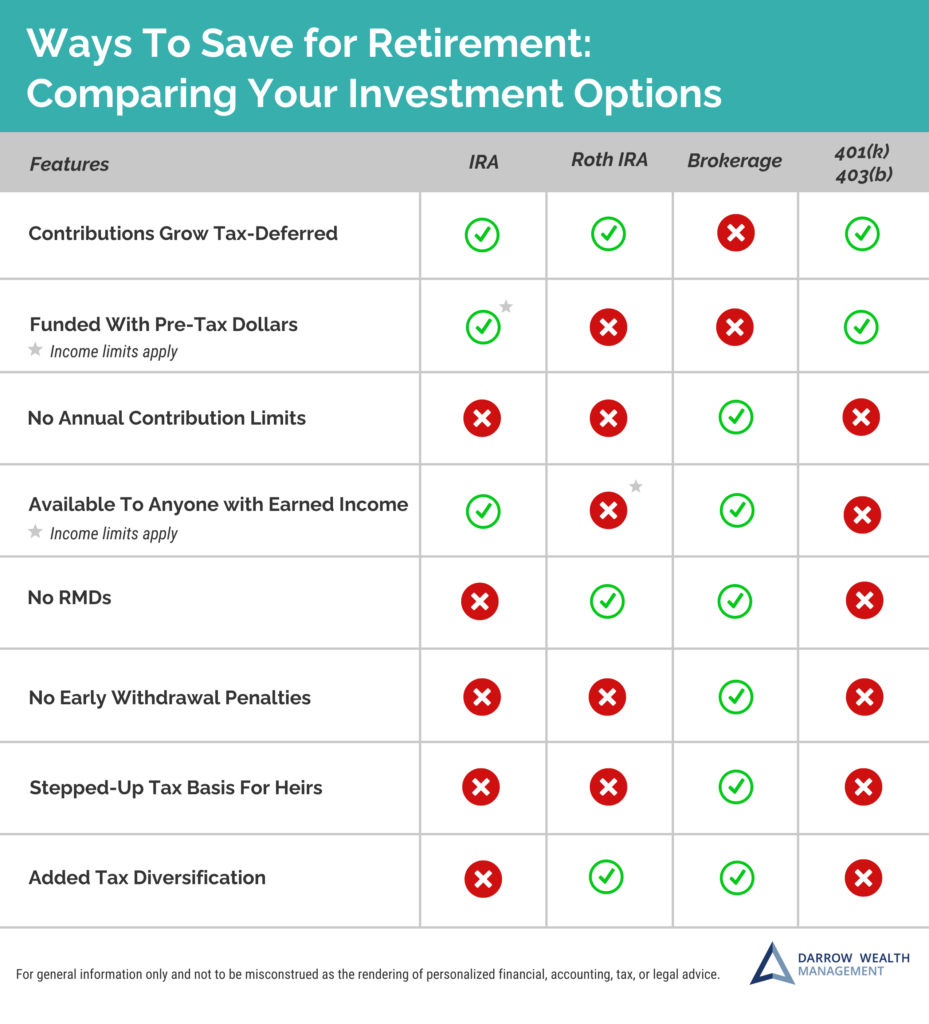
To make this even more tangible, let's see how these tax differences can play out over a long investment horizon.
Should You Invest In A Roth IRA or Brokerage Account?
This section of 'Should You Invest In A Roth IRA or Brokerage Account?' presents a powerful hypothetical scenario comparing the final value of investing in a Roth IRA versus a taxable brokerage account.
Watch from 09:33 to 12:12. Pay close attention to the final after-tax values and the reason for the significant difference.
The nearly $600,000 difference in the video's example highlights the immense power of tax-free growth in a Roth account compared to a taxable account, where taxes on dividends and capital gains create a drag on your returns over time.
Test your understanding!
You are considering investing $1,000. For each scenario, identify which account type is being described. Your options are Taxable Brokerage, Traditional IRA/401(k), or Roth IRA/401(k).
- You invest the $1,000 and get to deduct it from your income, lowering your taxes this year. When you retire, you'll pay income tax on whatever you withdraw.
- You invest the $1,000 (after it's already been taxed). If it grows to $50,000 by retirement, you can withdraw the entire $50,000 without paying a single dollar in taxes.
- You invest the $1,000 (after it's already been taxed). Next year, your investments pay you $20 in dividends, and you have to report that $20 as income on your tax return.
Show answer
- Traditional IRA/401(k): The key features are the upfront tax deduction and paying taxes on withdrawal.
- Roth IRA/401(k): The key feature is paying taxes upfront in exchange for completely tax-free withdrawals in retirement.
- Taxable Brokerage: The key feature is the lack of tax shelter; you pay taxes on investment income (like dividends) as you earn it.
Strategic Choices: Which Account Should You Use?
So, which account is best? The answer depends on your goals and your financial situation. There isn't one "best" account, but rather a best strategy that often involves using several of them.
The "Taxes Now vs. Taxes Later" Decision
When choosing between Traditional and Roth retirement accounts, the central question is: Do you think your income tax rate will be higher or lower in retirement than it is today?
- If you expect to be in a higher tax bracket in the future, the Roth is generally better. It's better to pay taxes now while your rate is low and enjoy tax-free withdrawals later when your rate is high. This is often the case for young investors early in their careers.
- If you expect to be in a lower tax bracket in retirement, the Traditional account might be better. You get the tax deduction now while your rate is high and pay taxes later when your rate is lower.
The "Flexibility vs. Tax-Efficiency" Decision
While retirement accounts offer incredible tax advantages, their main drawback is a lack of flexibility. This is where the taxable brokerage account shines.
Which Investing Account is Best? (401k vs IRA vs Taxable)
The common wisdom is that retirement accounts are always superior. This video, 'Which Investing Account is Best?', offers a thought-provoking counter-argument, highlighting the immense flexibility of taxable accounts and some surprising tax benefits they can have in retirement.
First, watch from 01:57 to 03:26 to understand the limitations and complexity of retirement accounts. Then, jump to 08:59 - 12:06 to see the surprising argument for how flexible and tax-efficient a taxable account can be in retirement.
The taxable brokerage account is your tool for goals that come before retirement: saving for a house down payment, a car, or simply having a pool of accessible money. It's also the account you use after you've already contributed the maximum allowed to your retirement accounts.
Conclusion
You now have a map of the primary investment "buckets" available to you. Understanding how they are taxed is the first step toward building a truly efficient investment plan that aligns with your life goals.
Key Takeaways:
- Investment accounts are containers for your investments, and their main difference is tax treatment.
- Taxable Brokerage Accounts offer maximum flexibility but no tax advantages on growth. You pay taxes on dividends and capital gains along the way.
- Traditional Retirement Accounts (401k/IRA) offer an upfront tax deduction (pre-tax contributions) and tax-deferred growth, but withdrawals are taxed as income. You pay taxes later.
- Roth Retirement Accounts (401k/IRA) are funded with after-tax money but offer tax-free growth and tax-free withdrawals in retirement. You pay taxes now.
- The choice between accounts involves a trade-off between tax efficiency, flexibility, and your expectation of future income tax rates.
A Look Ahead:
Now that you have the big picture, we can zoom in on the specific details of these accounts. In our next lesson, we will do a deep dive into what is often considered the most powerful retirement savings tool for young investors: the Roth IRA. We'll cover its specific features, contribution limits, and the rules that make it so advantageous.