Welcome to the first lesson of your Sound Engineering Diploma Program. Your journey to becoming a professional audio engineer begins here, with the fundamental science that underpins all sound recording and manipulation. Since you're starting fresh, our first goal is to build a solid theoretical foundation, focusing on why and how things work.
This lesson addresses the first learning outcome of the course: to define the physical properties of sound waves. We will explore the four essential characteristics that describe any sound: frequency, amplitude, wavelength, and phase. Understanding these concepts is not just academic; it is the key to making informed decisions in every aspect of audio, from placing a microphone to crafting a final mix.
What is a Sound Wave?
At its most basic level, sound is a form of energy that travels as a mechanical wave. This means it needs a medium—a substance like air, water, or a solid—to travel through. It cannot exist in a vacuum. A sound is created when an object vibrates, causing the particles of the medium around it to oscillate.
Imagine dropping a stone into a still pond. You see ripples spread out from the point of impact. A sound wave propagates similarly, but in three dimensions, like an expanding sphere. A vibrating object, such as a guitar string or your vocal cords, alternately pushes and pulls on the air molecules around it.
- The "push" compresses the molecules together, creating a small area of high pressure called a compression.
- The "pull" spreads them apart, creating an area of low pressure called a rarefaction.
This chain reaction of compressions and rarefactions traveling through the air is what we call a sound wave. When this wave reaches our ears, it causes our eardrums to vibrate, and our brain interprets these vibrations as sound.
To understand this foundational concept more deeply, let's turn to our first resource.
Understanding Sound Waves: The Basics of Audio Engineering
This article from Dark Horse Institute provides a clear, beginner-friendly introduction to the nature of sound waves. It explains how vibrations create these waves and how they travel.
Please read the first few sections of the article. Start from the beginning and read down to the end of the section on "How Sound Travels." Focus on the descriptions of sound as a mechanical vibration and the process of compression and rarefaction. The guitar string example is particularly helpful for visualization.
While we often visualize sound waves as the wavy line you see in audio software, this is just a graph of pressure over time. The physical reality is a longitudinal wave of pressure. The following video provides an excellent animation that helps visualize how the energy moves through the air particles.
Audio Basics: Amplitude, Frequency & Wavelength
This video from Audio University shows an animation that contrasts the graphical representation of a sound wave with a more physically intuitive model of particle movement.
Watch the segment from the animation. Notice how the individual particles oscillate back and forth but don't travel across the screen. What does travel is the wave of energy, visible as the moving bands of compression and rarefaction.
The Four Properties of a Sound Wave
Now that we understand what a sound wave is, we can describe it using four fundamental properties. These are the parameters we manipulate as audio engineers to shape sound. The image below provides a great overview of these properties on a standard waveform graph.

Let's break down each of these properties.
1. Amplitude
Amplitude refers to the intensity of the sound wave, or the magnitude of the pressure change from the normal, ambient atmospheric pressure. On a waveform graph, it is represented by the height of the wave from the center line.
- High Amplitude: Corresponds to a large pressure change (a very dense compression and a very sparse rarefaction).
- Low Amplitude: Corresponds to a small pressure change.
The perceptual counterpart to amplitude is loudness. A wave with a higher amplitude will be perceived as a louder sound. In audio engineering, we measure amplitude using the decibel (dB) scale, a topic we will explore in detail in a future lesson.
2. Frequency
Frequency is the number of complete cycles (one full compression and rarefaction) that a wave completes in one second. The unit for frequency is Hertz (Hz).
- High Frequency: Many cycles per second.
- Low Frequency: Few cycles per second.
The perceptual counterpart to frequency is pitch. A wave with a higher frequency is perceived as a higher-pitched sound (like a whistle), while a low-frequency wave is perceived as a lower-pitched sound (like a deep bass note). The range of human hearing is typically considered to be from 20 Hz to 20,000 Hz (or 20 kilohertz, kHz).
3. Wavelength
Wavelength (represented by the Greek letter lambda, λ) is the physical distance in space that a single wave cycle occupies. It's measured from one point on a wave to the identical point on the next wave (e.g., from one crest to the next).
Wavelength has an inverse relationship with frequency:
- High-frequency sounds have short wavelengths.
- Low-frequency sounds have long wavelengths.
For example, a 20 Hz sound wave (the lowest perceivable pitch) has a wavelength in air of over 17 meters (about 56 feet), while a 20 kHz sound wave (the highest perceivable pitch) has a wavelength of just 1.7 centimeters (about 0.7 inches). This physical size has profound implications for everything from microphone placement and speaker design to the acoustic treatment of a room, all of which we will study later in this course.
4. Phase
Phase describes the specific point in the cycle of a waveform at a given moment in time. It is typically measured in degrees, from 0° to 360°, much like a circle.
- 0° is the start of the cycle, at the center line, moving positive.
- 90° is the peak of the wave (maximum compression).
- 180° is the next crossing of the center line, moving negative.
- 270° is the trough of the wave (maximum rarefaction).
- 360° is the completion of the cycle, back at the starting point.
While the phase of a single wave isn't very meaningful on its own, it becomes critically important when we combine two or more sound waves. The phase difference between waves determines how they interact.
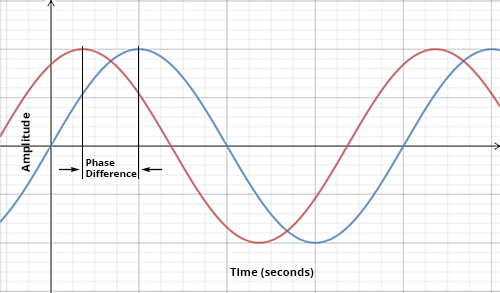
When waves are "in phase," their compressions and rarefactions align, and they reinforce each other, resulting in a louder sound. When they are "out of phase," the compression of one wave aligns with the rarefaction of another, causing them to cancel each other out, resulting in a quieter sound or even silence. This principle is fundamental to understanding stereo imaging, microphone placement techniques, and certain audio effects.
To solidify your understanding of these four core properties, the following reading provides concise, formal definitions for each.
Sound wave definition, characteristics, and use in acoustics.
This technical article from Svantek offers precise definitions of the key properties of an acoustic wave.
In this article, find the section titled "What are the properties of acoustic wave?" Read the short definitions for Frequency, Wavelength, Amplitude, and Phase. Notice how it explicitly states the relationships between these properties and their perceptual effects (pitch and loudness).
Conclusion
In this lesson, we have established the foundational concepts of sound physics. We started by defining a sound wave as a mechanical vibration propagating through a medium as a series of compressions and rarefactions. We then defined the four primary properties used to describe any sound wave:
- Amplitude: The intensity of the wave, which we perceive as loudness.
- Frequency: The rate of vibration, which we perceive as pitch.
- Wavelength: The physical length of a wave cycle, which is inversely related to frequency.
- Phase: The position within a wave's cycle, which is crucial for understanding how different sound waves interact.
These four properties are the essential vocabulary of audio engineering. Every tool in the studio, from an EQ to a compressor to a microphone, is designed to manipulate one or more of them.
In our next lesson, we will build directly on this foundation by examining the relationship between these physical properties and our human perception. We'll delve deeper into how frequency relates to pitch and how amplitude relates to our complex perception of loudness.