Welcome back. In our last lesson, we scrutinized the enigmatic art of the Indus Valley Civilization, learning that historical interpretation is a process of building, challenging, and refining hypotheses. We saw this in action with the "Pashupati" seal, where the initial "proto-Shiva" theory has been largely superseded by more contextually-grounded interpretations. This critical skill of weighing evidence is essential as we now turn to two of the greatest questions in Indian history.
Today, your learning objective is to assess theories for the IVC's decline and evaluate evidence for continuity with later Dravidian and Vedic traditions. We will investigate what happened to the vast network of cities and people after 1900 BCE and trace the aftershocks of this de-urbanization. This lesson connects directly to your goal of building a chronological and analytical understanding of India's philosophical landscape by examining the very roots of the cultures that would later produce the Vedas and Sangam literature.
The End of an Era: Deconstructing the Collapse
For nearly a century, the popular story of the IVC's demise was a dramatic tale of invasion and conquest. This "Aryan Invasion Theory" (AIT), however, has crumbled under the weight of modern archaeological and genetic evidence. Before we explore the current understanding, let's see why the old theory was discarded.
The following video provides a concise, evidence-based dismantling of the AIT and its more recent variant, the Aryan Migration Theory (AMT), by focusing on a crucial point: the complete absence of material culture from the supposed migrants in the Indian archaeological record. Your background in data engineering will make you appreciate this approach of testing a hypothesis against the "ground truth" of material evidence.
Did Archaeologists Just EXPOSE the 1500 BCE Vedas Timeline as a LIE?
This video by Harry Sahota systematically compares the archaeological signatures of the Central Asian steppe cultures (the proposed origin of the "Aryans") with the continuous archaeological record of the Indian subcontinent.
Watch the following three segments closely: Material Culture Comparison: Pay attention to the stark contrast in technological sophistication between the pottery and metallurgy of the steppe cultures (e.g., Sintashta, Andronovo) and the pre-existing, advanced traditions in India. Note the key takeaway: there is no layer in Indian archaeology that shows an intrusion or even hybridization with steppe material culture around 1500 BCE. The BMAC Bridge: This section tests the hypothesis that the migration happened via the Bactria-Margiana Archaeological Complex (BMAC) in Central Asia. Notice how the evidence points in the opposite direction—Indus material culture moving north into the BMAC, not the other way around. Rigveda vs. Post-IVC Archaeology: The video argues that the pastoral, cattle-centric society described in the Rigveda does not match the archaeological reality of post-1900 BCE India, which was one of settled, village-based agriculture. This creates a chronological paradox for the 1500 BCE dating.
The AIT was a simple, linear narrative. The modern explanation is more complex, fitting a systems-level collapse where multiple stressors interact. It was not a sudden death, but a gradual de-urbanization.
INDUS VALLEY 3D: walk the streets of a 5000-year-old civilization.
This 3D reconstruction video from Odd Compass effectively visualizes the current scientific consensus on the IVC's decline.
As you watch, focus on the interplay of factors: Debunking the Invasion: This serves as a quick recap of why the invasion theory is no longer accepted by mainstream scholarship. A Multi-Causal Decline: This is the core of the modern theory. Trace the causal chain: shifting monsoons and river courses (especially the drying of the Ghaggar-Hakra, identified as the Vedic Sarasvati) led to agricultural failure. This was compounded by the collapse of trade networks with Mesopotamia. The result was urban decay, breakdown of public administration, and internal conflict over scarce resources. Dispersal and Transformation: Notice the key outcome was not annihilation, but dispersal. The population ruralized, migrating eastward to the Gangetic plain and southward to the Deccan, carrying with them "fragments of older Indus traditions."
The conclusion is clear: the Indus cities emptied, but the people and their knowledge did not simply vanish. They moved, adapted, and transformed. This brings us to the second, more complex part of our inquiry: where did their cultural DNA surface next?
Tracing the Legacy: Continuity and Transformation
The decline of the IVC created a power vacuum and a cultural diaspora across the subcontinent. Scholars trace the legacy of this diaspora along two primary, and sometimes conflicting, lines of evidence: one pointing towards continuity with Vedic culture, and the other towards continuity with Dravidian culture.
The Dravidian Connection: Migration and Memory
The most widely discussed theory, championed by linguists and epigraphists like the late Iravatham Mahadevan, posits that the Indus language was a form of proto-Dravidian. In this view, the post-IVC dispersal included a significant southward migration, carrying the seeds of Indus culture into what would become the Dravidian heartland.
[PDF] Interpreting the Indus Script: The Dravidian Solution - Harappa
In this paper, Mahadevan outlines the evidence for a Dravidian Indus and its survival in the South. He combines linguistic analysis with a fascinating re-reading of ancient legends.
Please read the following sections to grasp his argument: Start with the section Indus Civilisation was Dravidian. Mahadevan lists several arguments, including Dravidian loanwords in the Rigveda, the Dravidian-like suffix-only structure of the Indus language, and religious elements like mother-goddess worship. Next, read Aryan Migration into South Asia and Southern Migration of the Indus people. Here, Mahadevan introduces his central thesis: the legend of the sage Agastya migrating from the north to found the Tamil language is not a story of "Aryanization," but a historical memory of the Indus people's exodus. Continue with his interpretation of the Agastya legend. He connects the Vēḷir clan leaders of ancient Tamilakam with the priest-rulers of the IVC. Note his linguistic decoding of Agastya's name from proposed Indus script words. Finally, review the Archaeological evidence of Indus-like graffiti from Tamilnadu. This is the material anchor for his theory. He points to discoveries like the Sembiyan-Kandiyur axe and pottery graffiti from various South Indian sites that bear symbols strikingly similar to Indus signs, suggesting a direct cultural transmission.
This theory provides a powerful narrative for the continuity of specific religious motifs. The worship of a horned, seated deity, the mother goddess, and sacred trees/animals in the IVC finds strong echoes in later Dravidian folk traditions and mainstream Shaivism and Shaktism.
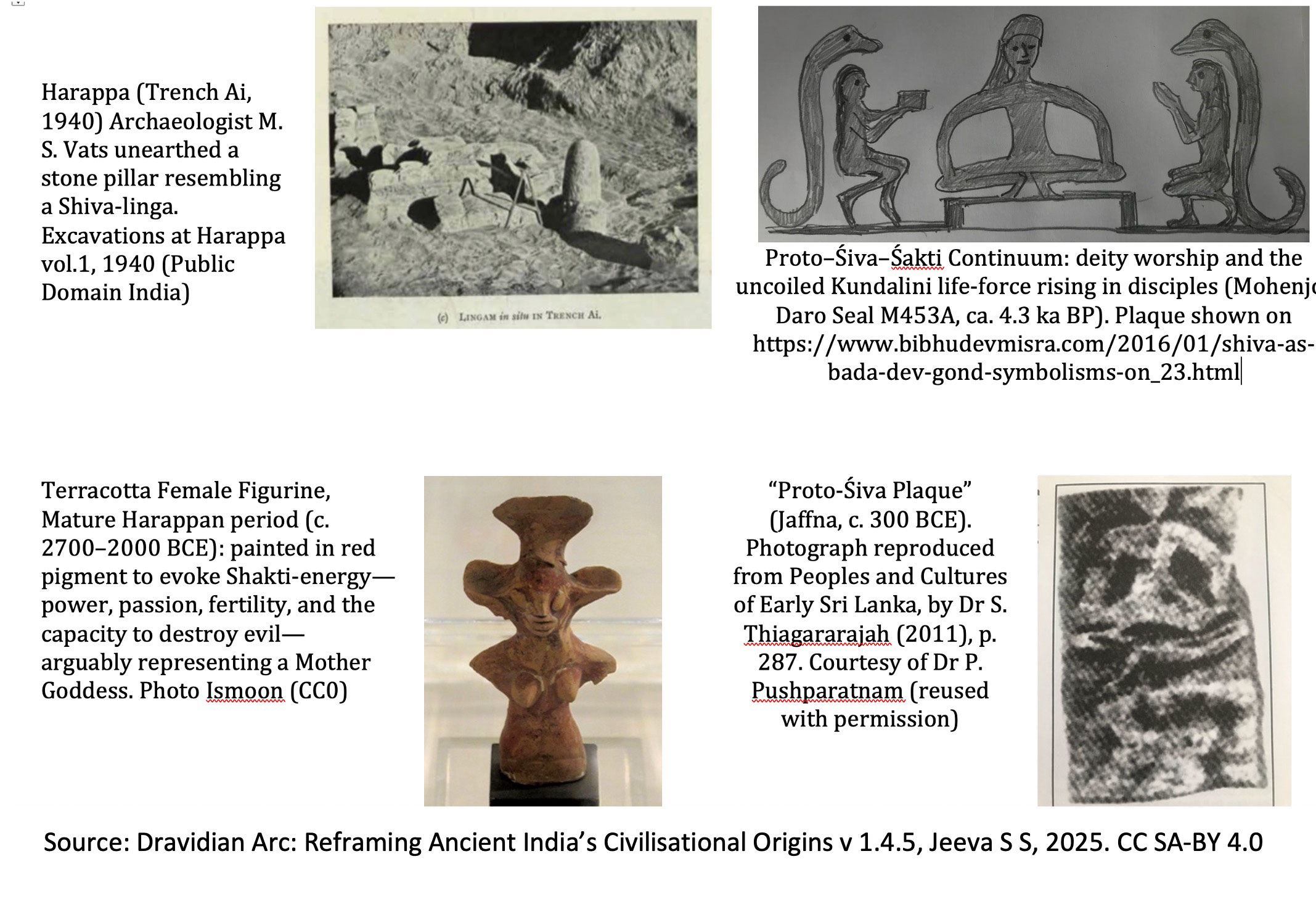

The Vedic Connection: The Identity Hypothesis
A powerful counter-argument challenges the entire timeline. Instead of seeing Vedic culture as a successor to the IVC, this view proposes that the Harappan civilization was the material expression of the culture described in the Rigveda. This "Vedic-Harappan Identity" hypothesis reframes the narrative from one of succession to one of identity.
Microsoft Word - Prof. Shivaji Singh_2
Prof. Shivaji Singh's paper argues forcefully for identifying the Vedic and Harappan cultures as two facets of a single tradition.
This is a dense but rewarding text. Focus on two main parts: First, read the section The paradigm change: the authors of the Vedic Culture, the Aryans, sons of the soil, not aliens. This reviews the evidence against the AIT and AMT, including historical, archaeological, and biological evidence. It establishes the premise that the Vedic people were indigenous. Now, read the core of his argument in the section The Vedic and Harappan cultures represent a single cultural tradition. Singh builds his case on three parities. As you read, identify his evidence for each: Geographical Parity: Note that the core area for both cultures was the Sarasvati-Indus region, with the Sarasvati being central to both. Chronological Parity: The key point here is the synchronous end. The drying up of the Sarasvati river around 1900 BCE is the event that marks the end of the IVC's urban phase and, he argues, the end of the creative, hymn-composing Rigvedic period. Cultural Parity: This section challenges the old rural/urban dichotomy. Find his examples of urbanism and trade in the Rigveda, and how Harappan features like horse bones and weaponry contradict the old image of a peaceful, horseless culture.
This hypothesis resolves certain paradoxes. For instance, the Rigveda's profound reverence for the Sarasvati river makes more sense if the hymns were composed when the river was a mighty, flowing system, i.e., during the Mature Harappan phase, rather than centuries after it had become a seasonal stream.
Conclusion: A Shared and Complex Heritage
In this lesson, we have deconstructed the fall of a civilization and explored the complex web of its legacy. We've seen that history is rarely a story of clean breaks and simple replacements; it is one of transformation, migration, and cultural fusion.
Key Takeaways:
- The IVC's decline was a process, not an event. A confluence of environmental crises (especially river system changes) and economic disruption led to de-urbanization and the dispersal of its population over several centuries. The "Aryan Invasion Theory" is no longer supported by evidence.
- The IVC legacy is a matter of intense debate, with two major theories of continuity.
- The Dravidian Continuity hypothesis is primarily linguistic, suggesting the Indus people spoke a proto-Dravidian language and migrated south after the collapse, preserving cultural memories (Agastya legend) and symbols (pottery graffiti).
- The Vedic Identity hypothesis argues that the Harappan civilization was the material culture of the Rigvedic people. It rests on geographical, chronological, and cultural parallels, suggesting the IVC did not "decline" but simply transformed into the later, post-urban Vedic culture.
- Both theories point to a composite Indian culture. As Mahadevan notes, the Indus heritage is ultimately shared. Even if the language was Dravidian, its cultural elements were absorbed by incoming Indo-Aryan speakers. If the culture was Vedic, it undeniably incorporated local, non-Vedic elements. The "unity in diversity" of India has roots that are 5,000 years deep.
You are now equipped with the primary frameworks for understanding the transition from the Bronze Age Indus Valley to the Iron Age cultures that followed.
In our next module, we will shift our focus fully to the textual evidence and enter the world of the Early Vedic Era. We will explore the society, economy, and cosmology of the people who composed the Rigveda, the foundational text of the Astika philosophical traditions.