Welcome back. In our last lesson, we surveyed the material evidence for religious practices in the Indus Valley Civilization, noting how artifacts like the Great Bath, fire altars, and terracotta figurines offer clues to a belief system we cannot read. We concluded with an introduction to the most enigmatic of these artifacts: the "Pashupati" seal, and Sir John Marshall's influential "proto-Shiva" hypothesis.
Today, we will dive deep into the very heart of the interpretive challenge. Your learning objective is to evaluate the scholarly debates surrounding IVC iconography, focusing on the 'Pashupati' seal hypothesis. This is not simply about learning different theories; it is about understanding the logic, evidence, and assumptions that underpin them. For your UPSC preparation and your personal goal of achieving analytical depth, mastering this skill of critically evaluating historical arguments is paramount. We will act as historical detectives, scrutinizing the evidence and weighing the arguments to see how a compelling narrative can be built, challenged, and revised.
The "Proto-Shiva" Hypothesis: A Case Study in Interpretation
Let's begin by refreshing our memory of the Pashupati seal and the core arguments for its identification as a prototype of the Hindu god Shiva.
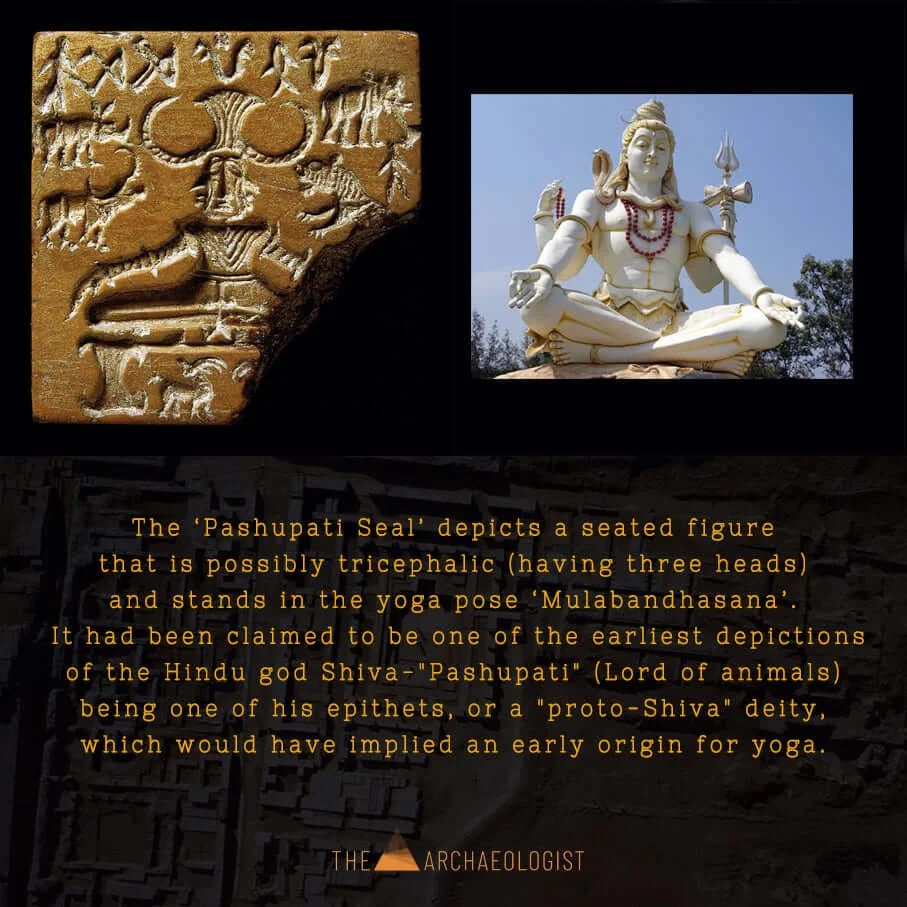
As introduced previously, archaeologist Sir John Marshall built his case on four key correspondences:
- Three Faces (Tricephalic): The figure appears to have three faces, a feature sometimes seen in later Shiva iconography.
- Yogic Posture: The seated posture resembles meditative poses, linking to Shiva as Mahayogi, the great ascetic.
- Horned Headdress: The horns are linked to Shiva's bull-mount, Nandi, and the central part to his trident (trishula).
- Lord of Animals (Pashupati): The figure is surrounded by wild animals, evoking Shiva's epithet Pashupati.
This interpretation has been incredibly influential, shaping the public and scholarly understanding of the IVC for decades. However, nearly every component of this argument has been systematically challenged. Our task is to understand these challenges.
Deconstructing the Hypothesis: A Scholarly Autopsy
We will now turn to a landmark academic paper by the art historian Doris Srinivasan, which provides one of the most thorough critiques of Marshall's theory. Her approach is a masterclass in using contextual evidence—comparing the seal not to much later Hindu concepts, but to other artifacts from the Indus culture itself.
[PDF] The So-Called Proto-iva Seal from Mohenjo-Daro - HubSpot
This paper by Doris Srinivasan is our primary guide for dissecting the "proto-Shiva" theory. It moves systematically through Marshall's points and proposes a new interpretation grounded in the IVC's own artistic world.
Begin by reading the Introduction to understand the history of the debate. Pay attention to how Srinivasan frames her objective: to assess the seal by comparing its features to remains from Indus sites rather than later Vedic or Hindu symbolism. Then, examine her critiques of Marshall's four points: The Headdress: In the section THE HEADDRESS, read her analysis comparing the headdress to a terracotta 'cake' from Kalibangan and other seals. Note her conclusion that it's a "horn and branch miter," possibly connoting fertility, and that the link to a trident is doubtful. The Face: In the section THE FACE, follow her argument that the face is not tricephalic. She compares it to horned masks and pottery designs, arguing it's a single, stylized face of a bull-man (a bucranium). Crucially, she points out that when Indus artists wanted to depict three heads on animals, they did so unambiguously. The Posture: Read the section THE POSTURE. Srinivasan argues the yogic pose is a formal, cultic pose indicating divinity, but to call it an attestation of Shiva as Yogisvara is an anachronistic leap. The Animals: Finally, read THE SURROUNDING ANIMALS. This is a critical section. She analyzes the Vedic term Pasupati and shows that it referred to the protector of domestic animals. Rudra (Shiva's forerunner) was feared for harming these animals. The animals on the seal are wild, so the Vedic concept doesn't fit. By the end of this reading, you should have a clear understanding of how Srinivasan dismantles the proto-Shiva theory and builds her own "divine bull-man" hypothesis based on internal evidence.
Srinivasan's analysis demonstrates a fundamental principle of historical inquiry: the danger of anachronism, which is the projection of later ideas onto the past. Her alternative—the "divine bull-man"—is powerful because it is parsimonious; it explains the seal's features using motifs (like the bull) that are already known to be central to the IVC's artistic and symbolic world.
Alternative Theories: Widening the Interpretive Lens
Srinivasan's "divine bull-man" is not the only alternative. The debate has evolved to include other compelling ideas that place the seal in different contexts.
1. The Eurasian "Master of Animals"
One of the most powerful critiques comes from comparative mythology. The motif of a central human or divine figure flanked by and seemingly in control of animals is not unique to India. It is a widespread trope found across ancient Eurasia.
Pashupati Seal in Ancient Europe? | Pashupati Seal & Cernunnos | Sepia Diaries
This video provides a striking visual comparison between the Pashupati seal and a similar figure from Celtic mythology.
Watch the segment from 02:35 to 04:42, where the narrator compares the Pashupati figure to the Celtic horned god Cernunnos. Notice the similarities: the seated posture, the horns, and the association with wild animals. This parallel suggests the Indus seal could be a local expression of a much broader, ancient mythological theme—the "Master of Animals"—rather than the unique origin of a specific Indian deity.
Leading archaeologist J. Mark Kenoyer also supports this view, arguing that such myths of heroes grappling with wild beasts are extremely old, likely dating back to the Paleolithic, and emerged independently in various cultures.
2. The Buffalo-Man and the Mahishasura Legend
Another intriguing theory, proposed by scholar Alf Hiltebeitel, connects the figure not to Shiva, but to the buffalo demon Mahishasura from the later Puranic tradition. The theory suggests the seal might depict an early form of this powerful buffalo-man figure, who is famously slain by the goddess Durga.

This interpretation gains some traction when we see other Indus seals that depict scenes of conflict with buffaloes.
Mark Kenoyer | Meluhha: the Indus Civilization and Its Contacts with Mesopotamia
In this lecture, J. Mark Kenoyer discusses narrative seals from the late Harappan period.
Watch the clip from 00:33:21 to 00:33:57. Here, Kenoyer shows seals depicting the sacrifice of a water buffalo and a deity in a yogic position. He explicitly connects this iconography to the later Tantric depiction of a goddess slaying the "evil water buffalo demon." This shows that the theme of a powerful, ritually significant buffalo was indeed present in the IVC worldview.
The Debate Beyond the Seal
The critical lens we've applied to the Pashupati seal can be extended to other key pieces of IVC iconography. The "proto-Shiva" was part of a larger interpretive framework by Marshall that has been largely revised.
Religion of the Indus Valley Civilization | Encyclopedia MDPI
This encyclopedia entry provides a concise summary of the current scholarly consensus on several contested artifacts.
Quickly read the following sections to see how the pattern of "influential early theory followed by modern critique" applies to other items: Pashupati Seal: Proto Shiva: This section summarizes the debate we've just explored, mentioning Srinivasan's buffalo-man thesis and the Master of Animals motif. Priest King: Read about this famous statuette. Note how the term, coined to support the idea of a theocratic ruling class, is now considered highly speculative and without foundation</for an egalitarian society>. Stones (Yonis and Lingams): Review the debate on these objects. Marshall identified them as phallic and vulval symbols, but critics like Sankalia noted they were often found in streets and drains, and later excavations have supported alternative interpretations like architectural pieces.
Conclusion: History as a Process
In this lesson, we have moved beyond simply listing facts and have engaged in the process of historical analysis itself. By focusing on the debates surrounding IVC iconography, we have seen how historical knowledge is constructed, contested, and refined over time.
Key Takeaways:
- The "Proto-Shiva" hypothesis is a classic example of anachronistic interpretation. While influential, its core tenets (tricephalic, yogic, Pasupati) do not hold up well to scrutiny when compared with contextual evidence from the IVC itself or with a careful reading of later texts.
- Alternative interpretations are often more robust. The "divine bull-man" theory is grounded in the IVC's own artistic vocabulary, while the "Master of Animals" hypothesis places the seal within a wider, cross-cultural context. Both are considered more plausible by many modern scholars.
- Interpretation is always provisional. Without a deciphered script, all conclusions about IVC religion, philosophy, or social structure remain well-reasoned hypotheses, not certainties. The ability to weigh the evidence for these competing claims is the essential skill.
You have now grappled with one of the most famous interpretive puzzles in ancient history. You've seen the evidence, heard the arguments, and evaluated the logic. This critical approach is precisely what will allow you to build the deep, layered understanding you seek.
In our next lesson, we will tackle the great mystery of the IVC's end. We will assess theories for the civilization's decline and evaluate the evidence for continuity with the later Dravidian and Vedic traditions. Having seen how difficult it is to prove continuity even with an artifact as suggestive as the Pashupati seal, you are now perfectly equipped to critically examine the larger claims of cultural and philosophical inheritance.