Hello. Last lesson showed why a two-year market rate can move before an MPC decision: it reflects expectations about short-term rates over the coming two years, not just today’s Bank Rate. This lesson brings that distinction to mortgages. The key is to separate the rate written into an existing mortgage contract from the price a lender offers someone taking out a new deal.
Allow about 35–40 minutes, including the short video and readings.
Start with the contract
A Bank Rate announcement does not directly rewrite every mortgage. The first step is to identify what determines the borrower’s rate during the current deal. The mortgage comparison image gives a useful overview, though the precise timing always depends on the contract.
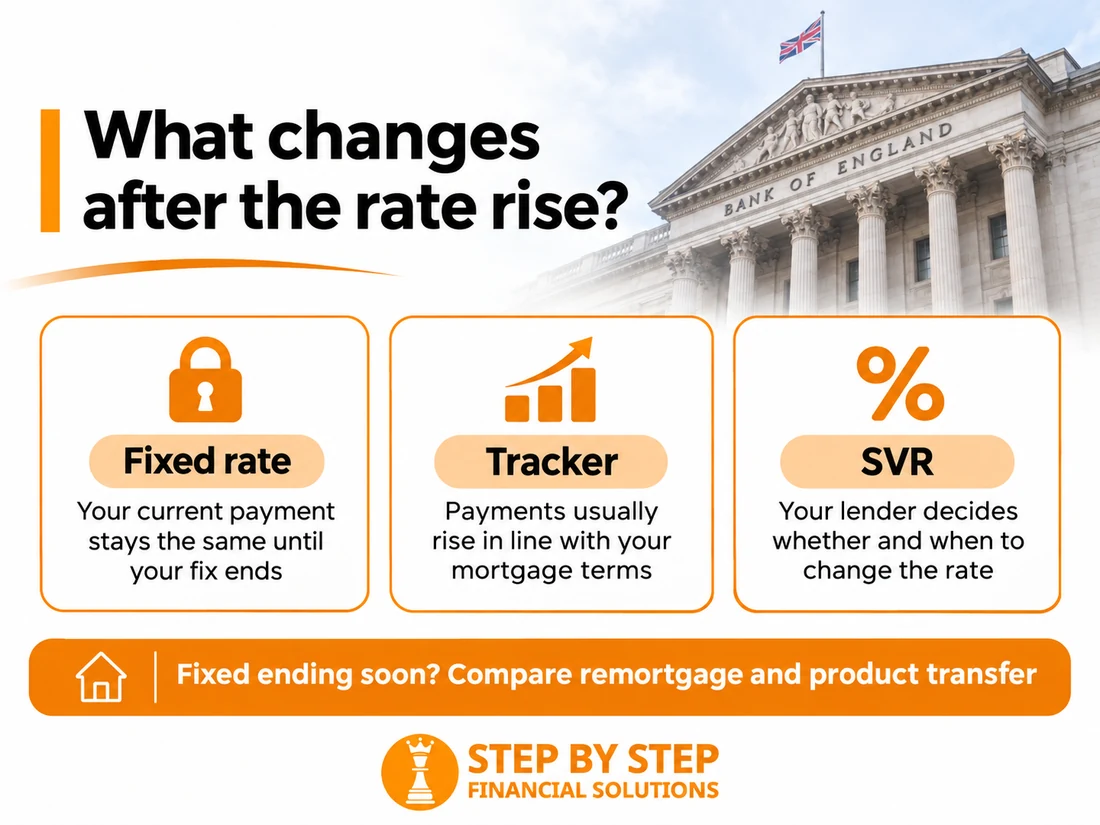
A tracker mortgage has a contractual link to an external reference rate, usually Bank Rate. For example, a deal might specify Bank Rate plus 1 percentage point. If Bank Rate rises from a hypothetical 4% to 4.25%, the mortgage rate rises from 5% to 5.25%, provided no other contract term limits the change. That is a change in the interest rate, not necessarily an identical percentage change in the monthly payment.
Read the definition and example in Which?’s Tracker mortgages. Treat the base-rate figure printed in the article as a snapshot from its publication, not as a figure needed for this lesson.
What is a tracker mortgage? - Which?
Which? introduces the contract rule that makes a tracker respond differently from other mortgages.
In “What is a tracker mortgage?”, read the definition and example. Stop after the sentence explaining what happens when the base rate rises; the product listings below it are not needed. Focus on the reference rate plus set percentage rule, rather than the article’s dated rate figure.
“Tracker” does not mean “changes instantly and without exception.” A contract specifies when the new rate takes effect, and the resulting payment may change on a later payment date. Some deals also have a collar, below which the mortgage rate cannot fall, or a cap, above which it cannot rise. A tracker may cease tracking at the end of its deal period and revert to another rate. Those qualifications matter especially when interpreting a headline about a Bank Rate cut: a borrower at a collar may not receive the full reduction.
What is a tracker mortgage? - Which?
Return to Which?’s tracker guide for the terms that qualify the simple “Bank Rate plus a margin” rule.
Read “How long do tracker mortgage deals last?” from the deal-period explanation. Then read “What are ‘collars’ and ‘caps’?” from the minimum and maximum rate explanations. Finally, in “What happens when your tracker mortgage ends?”, read the description of reversion. Notice that the contract can change how much of a Bank Rate movement reaches the borrower, as well as when it does.
There is also a distinction between an existing tracker and a new tracker offer. The agreed margin on an existing deal is normally set by its contract. A lender setting up a new deal can choose a different margin or fee to reflect its costs and desired pricing. Even within the same mortgage type, existing borrowers and new applicants need not face the same rate.
The lender’s standard variable rate
A standard variable rate, or SVR, is set by the lender rather than defined as Bank Rate plus a fixed contractual margin. Borrowers often move onto their lender’s SVR when an introductory fixed or tracker deal ends, unless they arrange another deal. A Bank Rate rise may prompt a lender to raise its SVR, but there is no general rule requiring an SVR to change on the same day or by the same number of percentage points. The lender can also change it when Bank Rate has not changed.
Read Which?’s Standard variable rate mortgages for the pricing distinction and the contrast with a fixed deal.
What is a SVR mortgage? - Which?
Which? explains why an SVR is influenced by Bank Rate without mechanically tracking it.
In “How is the standard variable rate set?”, read the lender-pricing explanation. Then, in “Standard variable rate vs fixed-rate mortgages”, read the contract comparison. Stop before the article moves on from that comparison. Focus on who controls each rate during the deal.
Why might a lender choose a different SVR increase from the Bank Rate increase? Bank Rate influences the wider cost of obtaining funds, but a mortgage lender can draw on several sources, including customer deposits and market borrowing. Those costs need not all move by the same amount or at the same time. The lender also sets prices in light of its risks, operating costs, commercial objectives and competition for borrowers. These influences help explain an SVR decision; they do not give the borrower a contractual formula for predicting it.
For example, after a hypothetical 0.25-percentage-point Bank Rate rise, a lender could raise its SVR by 0.25 points, by a smaller amount, or not immediately. Another lender could make a different decision. An SVR is therefore a variable rate, but it is not a tracker.
A fixed rate: protected now, repriced for the next deal
An existing fixed-rate mortgage keeps its agreed interest rate for its fixed period. If Bank Rate rises tomorrow, that change does not by itself increase the contracted rate. For a typical repayment mortgage, scheduled payments also remain the same during the fix if the other loan terms are unchanged. The fix, however, usually lasts for less time than the full mortgage: a borrower may have a two- or five-year fixed deal on a loan being repaid over many more years.
At the end of the fixed period, that protection ends. The borrower might take a new deal or, under the mortgage’s terms, move to the lender’s SVR. The rate on the new deal is not guaranteed to equal the old fixed rate, even if Bank Rate has not changed on the day the old deal expires.
To see why new fixed deals can change price while existing ones stay fixed, watch this short lender-perspective explanation in Fidelity UK’s Fixed-rate mortgage or tracker? Where interest rates go next.
Fixed-rate mortgage or tracker? Where interest rates go next
Fidelity UK contrasts a rate that can adjust with a rate promised for a fixed period. Watch for its discussion of what a lender must consider when setting a new fixed rate.
Watch the lender comparison, starting as the speaker describes the lender’s choice between variable and fixed deals and ending after the discussion of expected average rates over the fixed period. The account of who bears interest-rate risk is a simplification: lenders can manage or hedge that risk, and trackers do not remove every lending risk.
Here the previous lesson becomes useful. A lender offering a new two-year fix must price a promise covering two future years. Its relevant market funding and hedging costs can reflect expectations of rates throughout that period. It must also allow for lending risk, other costs, fees and the price it needs to offer to compete for customers. A market rate is therefore an input to pricing, not a rule saying that a mortgage offer must equal a market rate plus a fixed margin.
Suppose markets come to expect Bank Rate to stay higher for longer. Two-year market rates may rise before the next MPC meeting, and newly advertised two-year fixed deals may become more expensive even though today’s Bank Rate is unchanged. Conversely, stronger expectations of future cuts can put downward pressure on new fixed offers before any cut occurs. Neither outcome is automatic: funding conditions, competition and other pricing choices can offset or reinforce the market move.
This does not mean fixed deals must always cost more than trackers. Their relative advertised rates depend on expected future rates and the other elements of each offer. Nor does a change in new fixed-rate offers alter an existing fix. Those are different contracts agreed at different times.
Putting the three responses side by side
Imagine Bank Rate rises by 0.25 percentage points. The table separates what follows from an existing borrower’s terms from what a lender may decide when pricing deals.
| Mortgage position | What the rise means for the borrower’s rate |
|---|---|
| Existing Bank Rate tracker | Usually rises by 0.25 percentage points under the agreed tracking rule, subject to its timing and any applicable cap or other terms. |
| Existing SVR | May rise, but the lender determines whether, when and by how much. |
| Existing fixed deal | Agreed rate stays unchanged until the fixed period ends. |
| New fixed deal being offered | Can be repriced as market funding costs and expectations change, including before the Bank Rate decision. It need not move by 0.25 points. |
A change in the mortgage rate is not the same thing as an equal-sized change in the monthly payment. Payments also depend on the outstanding balance, the remaining term, the repayment arrangement and when the lender applies the new rate. For scale, 0.25 percentage points on an outstanding balance of £200,000 amounts to £500 of interest over a year if that balance stayed constant. An actual repayment mortgage’s balance falls over time, so that calculation is not a prediction of its monthly payment increase.
The most reliable way to interpret a mortgage-rate report is thus to identify which rate it describes: Bank Rate, a market rate, an advertised offer for a new borrower, or the rate payable under an existing contract. They are connected, but they are not interchangeable.
What to carry forward
A tracker’s response is primarily contractual: its reference rate, margin, adjustment timing and any limits determine what happens. An SVR is lender-set: Bank Rate matters, but funding costs and pricing choices mean it need not move in step. An existing fixed deal provides temporary rate certainty, while new fixed deals can respond to expected future rates and market funding costs before an MPC vote.
Next, the course turns from borrowing to savings rates. The same Bank Rate change can reach deposit accounts unevenly, but the provider’s funding needs, competition and account terms play a different role.