Hello! Welcome to the next lesson in our journey through the Transformer architecture.
In our last session, we introduced the complete formula for scaled dot-product attention and broke down its constituent parts: the Query, Key, and Value projections, the dot-product for similarity, the crucial scaling factor, and the softmax function for normalization.
Today, we will build directly on that foundation. Our learning outcome is to describe how scaled dot-product attention works. While this sounds similar to the last lesson, our focus will be on solidifying your understanding of the process and the flow of information. We'll move beyond the formula as a static equation and see it as a dynamic, step-by-step computational recipe. We'll use visual diagrams and a concrete numerical example to trace how raw input is transformed into context-aware output.
The Roadmap: Scaled Dot-Product Attention
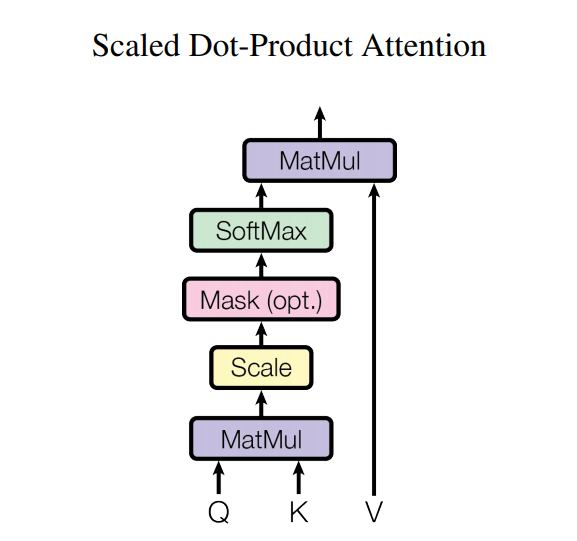
Let's start with a high-level visual map of the process. This diagram represents the entire workflow we'll be dissecting today.
The Core Idea: A Library Analogy
Before we dive into the matrix operations, let's revisit the core idea with a helpful analogy. Think of the attention mechanism as a sophisticated information retrieval system, like a digital library.
- Query (Q): This is your specific question or topic of interest. For a given word, the query vector represents what it's looking for in the rest of the sentence.
- Key (K): These are like the keywords, titles, or chapter headings of all the books in the library. For each word in the sentence, the key vector advertises its own content and properties.
- Value (V): This is the actual content of the books. For each word, the value vector contains the information it will contribute if it's deemed relevant.
The attention mechanism works by:
- Taking your Query (what you're looking for).
- Comparing it against all the Keys (the available information) to find the most relevant ones.
- Retrieving a mix of the corresponding Values (the actual content), giving more weight to the content from the most relevant books.
This excellent article uses this exact metaphor to introduce the concept.
This article, 'Scaled Dot-Product Attention', provides a great introduction using the library analogy and then walks through the full calculation.
Read just the first part of the article, down to 'The Metaphor'. This will help frame the Q, K, and V roles in your mind as we proceed.
A Step-by-Step Walkthrough
Now, let's follow the data through the diagram, using a detailed video explanation to guide us.
Self-Attention Using Scaled Dot-Product Approach
The video 'Self-Attention Using Scaled Dot-Product Approach' by Machine Learning Studio provides an exceptionally clear, step-by-step explanation of the entire mechanism. We will walk through it together.
Watch from 04:39 to 16:02. The video breaks down the process into the exact steps shown in our diagram. Pay attention to how the dimensions of the matrices change at each step.
Let's summarize and reinforce what you just saw in the video.
Step 1: Compute Similarity Scores (MatMul)
First, we calculate the dot product between the Query matrix and the transpose of the Key matrix .
As you know from your linear algebra experience, this matrix multiplication results in a new matrix. Each element at position in this Scores matrix represents the similarity between the query of the -th word and the key of the -th word. A higher value means a stronger potential relationship.
Step 2: Scale (Scale)
This is the "scaled" part of "scaled dot-product attention." As we discussed in the last lesson, we divide all the scores by the square root of the dimension of the key vectors, .
The primary reason for this is to ensure stable training. Without scaling, for large values of , the dot products can become very large. When these large values are fed into the softmax function (our next step), they can fall into regions where the function is "saturated" (either close to 0 or 1), resulting in extremely small gradients. This is the vanishing gradient problem, which makes it nearly impossible for the model to learn. Scaling keeps the variance of the scores under control and ensures that the gradients remain healthy.
The article we looked at earlier has a fantastic interactive section that visualizes this exact problem.
Let's return to the 'Scaled Dot-Product Attention' article to get a deeper intuition for the scaling problem.
Read the sections 'The Discovery: Dot Product = Similarity', 'The Problem: Dimension Explosion', 'The Solution: Scale by √d_k', and 'The Scaling Problem' under 'Why Scaled Dot-Product?'. The 'Why It Matters' box clearly illustrates the impact of scaling on the softmax output and gradients.
Step 3: Compute Attention Weights (Softmax)
Next, we apply the softmax function row-wise to the scaled scores matrix.
This step converts the raw, scaled similarity scores into a probability distribution. For each word (each row), the weights now sum to 1. An entry at tells us the percentage of attention the -th word should pay to the -th word.
Step 4: Aggregate the Values (MatMul)
Finally, we use these attention weights to create a weighted sum of the Value vectors. This is done by multiplying the Attention Weights matrix by the Value matrix .
The result is a new matrix of the same dimension as the input. Each row in this output matrix is a new, contextually-enriched representation of the corresponding input word. It's a blend of all the other words' values, mixed according to the attention weights.
To see this final step in a beautifully intuitive way, let's watch one more clip.
Attention in transformers, step-by-step | Deep Learning Chapter 6
This video from 3Blue1Brown masterfully visualizes how the attention pattern is used as weights to combine the value vectors, thereby 'updating' each word's embedding with context from the words it attends to.
Watch from 13:04 to 15:44. Focus on how the attention weights in each column are used to calculate a 'change' vector (delta-e), which is then added to the original embedding to produce the final, context-aware output.
Test your understanding!
Imagine you are designing a Transformer. An engineer on your team suggests removing the scaling step () to simplify the architecture and potentially speed up computation.
Based on what you've learned, what would be your argument against this suggestion? What specific problem are you likely to encounter during model training, and why does it happen?
Show answer
The argument against removing the scaling step is that it would make the model very difficult, or even impossible, to train effectively.
The specific problem is vanishing gradients.
Here's why:
- The dot products of the Q and K vectors tend to grow in magnitude as their dimension () increases.
- These large dot product values become the input to the softmax function.
- The softmax function becomes "saturated" for large inputs, meaning its output is pushed to be very close to 0 or 1.
- In these saturated regions, the gradient of the softmax function is nearly zero.
- During backpropagation, these tiny gradients would be passed back through the network, meaning the model's weights would barely update. The model would fail to learn.
The scaling factor normalizes the variance of the dot products, keeping them in a reasonable range and ensuring the softmax function operates in a "healthy" region with meaningful gradients, allowing for stable training.
A Concrete Numerical Walkthrough
You have an engineering background, so seeing the numbers flow through the system can make these concepts much more concrete. The following article provides a complete, step-by-step numerical example with Python code.
Understanding Scaled Dot-Product Attention in Transformer Models
This article, 'Understanding Scaled Dot-Product Attention in Transformer Models', will walk us through a full calculation for the sentence 'the cat sat on the mat'.
Read the article from the 'Self-Attention Mechanism' section down to 'Interpreting Attention Weights'. Trace the numerical values through each of the four steps we just discussed: matrix multiplication, scaling, applying softmax, and the final weighted sum of values. This will connect the abstract formula to concrete arithmetic.
Conclusion
In this lesson, we took a deep dive into the operational mechanics of scaled dot-product attention. By following the flow of data through the canonical diagram and a numerical example, we've moved from knowing the formula to understanding how it actually works in practice.
Key Takeaways:
- A Four-Step Process: Scaled dot-product attention is a sequence of four key operations: calculating similarity scores (), scaling them (), normalizing to get attention weights (), and finally creating a weighted sum of values ().
- Scaling is Not Optional: The scaling step is critical for stabilizing the training process by preventing the vanishing gradient problem in the softmax function.
- Output is a Contextual Blend: The final output for each token is a new vector that is a weighted combination of all value vectors in the sequence, allowing it to incorporate rich contextual information.
Preview of the Next Lesson:
The mechanism we've mastered today is powerful, but it's like looking at a sentence from only one perspective. For instance, it might learn to focus on subject-verb agreement. But what if we also want it to focus on adjective-noun relationships, or pronoun-antecedent relationships, all at the same time? To do this, Transformers run multiple scaled dot-product attention calculations in parallel. This is called multi-head attention. In our next lesson, we'll explore how this technique allows the model to capture different types of relationships simultaneously, leading to a much richer and more robust understanding of language.