Introduction
Welcome to the final lesson of our course on Indian Politics. Over the past several modules, we have dissected the intricate forces shaping contemporary India, from the ideological foundations of Hindutva to the complex dynamics of caste, regionalism, and institutional integrity. In our last two lessons, we constructed two powerful, competing narratives. First, the case for "democratic consolidation," built on the pillars of historic electoral mandates, transformative welfare delivery, and a resurgent national pride. Then, we explored the counter-argument of "democratic backsliding," which points to the erosion of referee institutions, the marginalization of minorities, and a shrinking space for civic dissent.
Today, we arrive at the capstone of our inquiry. This lesson is designed to help you formulate a concluding analysis of the current state of Indian democracy by weighing these competing narratives. We will not seek a simple verdict on whether democracy is "winning" or "losing." Instead, our goal is to synthesize the evidence you have encountered throughout this course to build a nuanced, multi-layered understanding. The surprising results of the 2024 general election, which defied simplistic predictions, provide a crucial and timely lens for this final analysis, forcing us to re-evaluate both the consolidation and backsliding theses.
The 2024 Election: A Moment of Reckoning
The 2024 general election was framed by both sides as a pivotal moment. The ruling BJP campaigned on a narrative of national progress and strong leadership, while the opposition INDIA bloc cast the election as a battle to "save democracy and the constitution." The outcome—in which the BJP lost its single-party majority and now governs through its NDA coalition, while the opposition emerged significantly stronger—did not deliver a decisive victory for either narrative. Instead, it created a more complex political landscape that demands a more sophisticated analysis.
This result acts as a democratic check, challenging the idea of an unstoppable majoritarian consolidation while also refuting the notion that democratic institutions had been hollowed out beyond repair. To begin our synthesis, let's examine an analysis from the German Institute for Global and Area Studies, which, though written before the election, perfectly encapsulates the questions the results now force us to address.
India after the 2024 Elections: Trends and Implications
This GIGA Focus report frames the 2024 elections as a critical juncture for Indian democracy. It outlines the core tensions between centralization and federalism, majoritarianism and civil liberties, which we will now analyze in light of the election results.
Please read the following sections: Begin with the short section A Watershed Moment. Notice how it explicitly frames the election as a contest between the "progress of the country" and the need to "save democracy." Next, read the section Centralisation of Power. This provides a concise summary of the institutional trends that defined the "backsliding" narrative leading up to the election. Finally, read the concluding paragraphs in the section A Cautious Outlook. This part highlights the disconnect between voter priorities (inflation, unemployment) and elite concerns (civil liberties), a key paradox we need to understand.
The GIGA report sets our analytical stage. The Indian electorate delivered a verdict that seems to endorse elements of both competing narratives, rewarding the government for some aspects of its performance while simultaneously pushing back against its concentration of power.
Synthesizing the Narratives: A Thematic Analysis
To formulate your own conclusion, let's weigh the evidence for consolidation against the evidence for backsliding across three key thematic areas we've studied, using the 2024 election results as a real-world test.
1. Electoral Mandates vs. Institutional Health
- The Consolidation Argument: The BJP's third consecutive term, with Prime Minister Modi at the helm, is a historic achievement that signals a clear popular mandate. This continuity suggests that a large segment of the electorate endorses the government's direction and leadership.
- The Backsliding Argument: As we saw in the previous lesson, the credibility of "referee institutions" like the Election Commission, the judiciary, and the media has been a central concern. The weaponization of agencies against the opposition was a major issue.
Analysis: The 2024 results suggest that Indian voters are capable of making a sophisticated distinction. They returned the ruling alliance to power but simultaneously cut down its majority, empowering the opposition and reasserting the importance of checks and balances. This act can be interpreted as the electorate itself stepping in as the ultimate "referee" when it perceives other institutions as weakened.
Public intellectual Yogendra Yadav, in a recent discussion, captures this very tension. He is sharply critical of institutional decay but retains a deep faith in the democratic intelligence of the Indian people.
Yogendra Yadav vs 10 Students On Politics, Power & the Future of India | Take That EP 05
In this wide-ranging interview, "Yogendra Yadav vs 10 Students," Yadav articulates the paradox of failing institutions and a resilient electorate.
Please watch two key segments: First, listen to his concluding remarks on the future of Indian politics, from this point. He argues that the 2024 election shock came not from the opposition's brilliance, but because "the people of this country are getting smarter," drawing a parallel to the 1977 post-Emergency election. Next, watch his critique of the Election Commission of India (ECI) from this segment. He explains how his view of the ECI changed from praise to criticism as the institution itself changed, exemplifying the process of institutional erosion.
Yadav's perspective suggests that while institutional erosion is real, the democratic system retains a capacity for self-correction through the ballot box. The voter has, in effect, enforced a move from single-party dominance back to a coalition framework, which inherently necessitates more consultation and consensus.

2. Welfare Politics vs. Identity Politics
- The Consolidation Argument: The BJP built a powerful political coalition around the labharthi (beneficiary) class, delivering tangible welfare benefits like cooking gas, toilets, and direct cash transfers, transcending traditional caste and community lines.
- The Backsliding Argument: This economic narrative has been coupled with a strong majoritarian ideology, creating anxiety among religious minorities and using identity as a tool for polarization.
Analysis: Here, the 2024 results, particularly in the crucial state of Uttar Pradesh (UP), are revealing. The BJP's seat count in UP fell significantly. A key reason appears to be the re-emergence of caste-based social justice concerns, which challenged the all-encompassing labharthi identity.
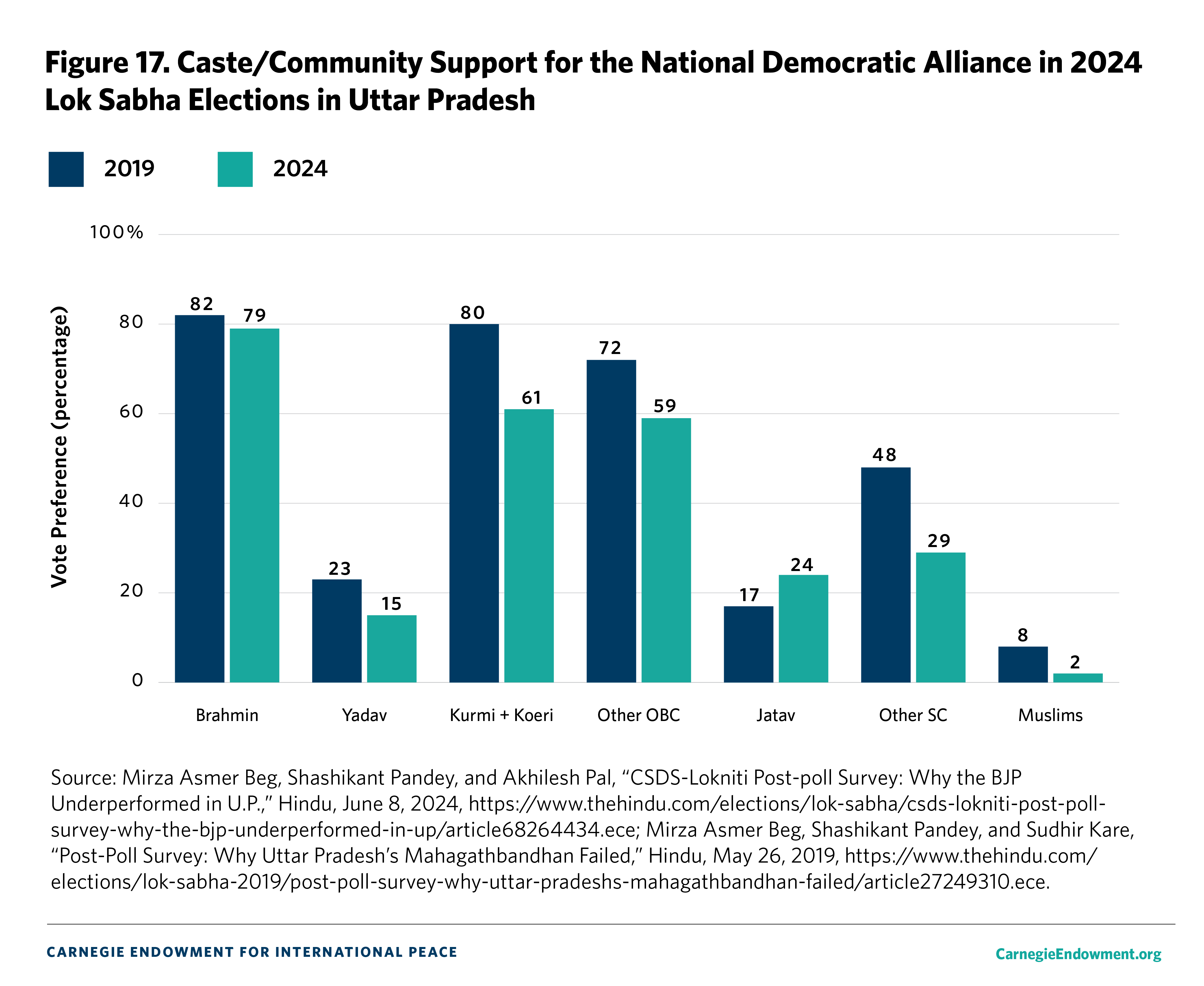
The data indicates that while welfare delivery is a potent political tool, it does not erase other identities. Economic anxieties (unemployment, inflation) combined with concerns about social justice and representation for marginalized communities proved to be a powerful counter-narrative. Voters are not single-issue beings; they weigh economic benefits against issues of dignity, representation, and social harmony.
3. Centralization vs. Federalism
- The Consolidation Argument: A strong, centralized government is presented as essential for decisive governance, rapid infrastructure development, and enhancing India's stature on the world stage. Slogans like "One Nation, One Election" epitomize this vision.
- The Backsliding Argument: This drive for centralization has strained India's federal structure, with states governed by opposition parties alleging financial discrimination and political interference through centrally appointed governors.
Analysis: The 2024 verdict is a clear pushback against over-centralization. By delivering a coalition government, voters have made regional parties and their interests indispensable. The new government will have to negotiate with powerful regional allies, strengthening the federal dimension of Indian politics. Political scientist Pratap Bhanu Mehta, speaking before the election, raised a crucial and worrying question about whether a ruling establishment so accustomed to absolute power would be willing to give it up.
Has Indian democracy entered a one-party era? Pratap Bhanu Mehta explains | SpeakEasy - Episode 2
In this "SpeakEasy" episode with Frontline Magazine, Pratap Bhanu Mehta dissects the nature of power in contemporary India.
Watch the segment from this timestamp. He discusses the immense challenge for a dominant party to contemplate losing power, given the high stakes and the breakdown of old political norms.
The 2024 results did not force the BJP from power, but they did force it to share power. This enforces a level of accountability and decentralization that was absent in a single-party majority government. The mandate can be seen as a vote for a more balanced federal equation.
Beyond the Binary: A Framework for Indian Democracy
So, where does this leave us? Is India's democracy consolidating or backsliding? Perhaps the binary itself is the problem. Many analysts argue that applying Western models of liberal democracy to India is insufficient, as it misses the unique trajectory of the world's largest and most complex democratic experiment.
This perspective suggests we need a new analytical framework that can account for seemingly contradictory trends happening simultaneously.
Resilience of Indian Democracy Demands New Analytical Framework
This article from the Institute for Security & Development Policy argues for moving beyond simplistic binaries and understanding Indian democracy on its own terms, highlighting its unique, "home-grown" roots.
Please read the following sections: Start with the section discussing the West-based democracy indices and the criticisms of their methodology. Read from this point. Next, read the section on "India's Democratic Roots," which argues that India's democratic journey is distinct from the West's and paradigmatic for the Global South. Continue to the section "Democratic Processes Still Strong." It points to evidence like high voter turnout and public confidence as signs of democratic health, even amidst other concerns. Finally, read the concluding paragraphs starting from this final section. It introduces the key idea of a "simultaneous consolidation and attrition of democratic values."
The author suggests a powerful concept: the simultaneous consolidation and attrition of democratic values. This framework allows us to make sense of the paradoxes we've observed. We can have an expansion of political participation for marginalized groups (consolidation) happening at the same time as a decline in the autonomy of elite institutions (attrition). We can have vibrant, high-stakes elections (consolidation) alongside a shrinking space for media freedom (attrition).
This view doesn't dismiss the very real concerns of the backsliding narrative, but it places them in a broader context of a dynamic, contentious, and evolving democratic culture that defines its own standards.
Conclusion
As we conclude this course, it is clear that the state of Indian democracy defies easy labels. The past decade has witnessed a powerful centralizing and majoritarian political project, which aligns with the "democratic consolidation" narrative from the government's perspective. Simultaneously, this project has produced significant institutional strain, social polarization, and pressure on civil liberties, providing ample evidence for the "democratic backsliding" narrative.
Key Takeaways:
- Beyond the Binary: The narratives of "consolidation" and "backsliding" are not mutually exclusive. They represent two sides of the same coin, describing a period of intense political and social churn. A complete analysis must hold both truths in tension.
- The Voter as the Final Arbiter: The 2024 election results served as a powerful reminder of the agency of the Indian voter. Despite concerns about institutional decay, the electorate demonstrated its ability to act as a crucial check on executive power, reinforcing a more federal and competitive political landscape.
- A Unique Democratic Trajectory: Understanding Indian democracy may require a framework that moves beyond Western-centric models. The idea of a simultaneous "consolidation and attrition" of democratic values helps explain the coexistence of vibrant electoral participation with the erosion of certain liberal norms.
- Enduring Questions: The fundamental tensions we have explored—between a strong center and federal rights, between majority rule and minority rights, and between national security and individual liberty—are not resolved. They remain the central, defining conflicts of Indian democracy.
You have now journeyed through the core debates that animate Indian politics. The goal was never to arrive at a final, settled answer, but to equip you with the critical frameworks and empirical knowledge to continue analyzing this dynamic and profoundly important democracy for yourself. The questions we have grappled with will continue to shape India's path, and you are now better prepared to understand the stakes.