Introduction
Welcome to the next stage of our exploration of Indian politics. In our last lesson, we delved into the internal dynamics of caste-based reservation, analyzing the debates around 'sub-categorization' and the 'creamy layer' to understand how affirmative action is being refined to address inequalities within marginalized communities. Today, we pivot from the vertical cleavages of caste to the horizontal divisions of region and language, another powerful force that has shaped the Indian political landscape.
This lesson addresses the creation of linguistic states through the States Reorganisation Act of 1956. We will examine why this monumental task, promised long before independence, was initially met with hesitation by India's first leaders. We will then trace the dramatic events that forced the issue, explore the principles behind the reorganization, and analyze its profound role in managing regional aspirations and strengthening the foundations of Indian federalism. This process literally redrew the map of India, and understanding it is key to grasping the nature of regional politics today.
The Colonial Inheritance and the Nationalist Promise
At independence in 1947, India did not inherit a rationally organized set of administrative units. Instead, the map was a "confused mosaic," a patchwork of British-governed provinces and over 560 semi-autonomous princely states of vastly different sizes and shapes, a legacy of colonial expansion and historical accidents.
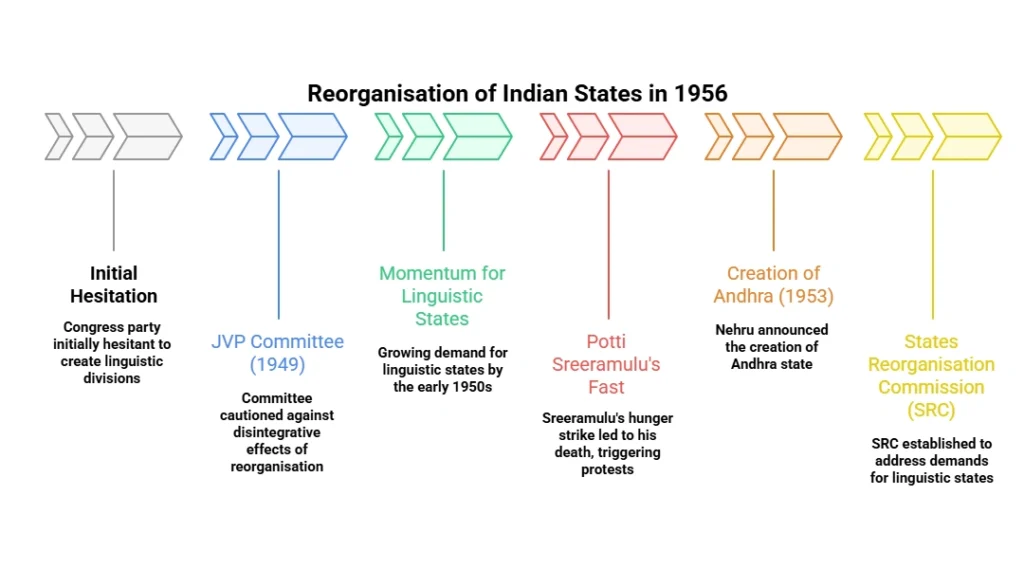
Recognizing this, the Indian National Congress had, as early as its 1920 Nagpur session, committed to reorganizing the states along linguistic lines after independence. The logic was clear: states based on a common language would be more culturally cohesive, administratively efficient, and politically democratic.
However, once in power, the new national leadership, particularly Prime Minister Jawaharlal Nehru and Home Minister Vallabhbhai Patel, became deeply cautious. The fresh trauma of the 1947 Partition, which had torn the country apart along religious lines, created a profound fear of any further disintegration. The following reading explains the leadership's mindset and the anxieties that led them to delay their long-held promise.
[PDF] Redrawing the Body Politic: Federalism, Regionalism ... - SciSpace
This excerpt from "Redrawing the Body Politic" by Stuart Corbridge and colleagues provides excellent context on the mindset of India's leadership immediately after independence, explaining why a long-held promise was initially shelved.
Start from the beginning of the section THE MAP OF STATES: INDEPENDENCE AND AFTER. Read down to the paragraph that describes the clumsy division of states into 'Class A', 'B', and 'C'. As you read, focus on Nehru's concern that linguistic provinces might encourage the development of "sub-nationalities" and the warning from the Dar Commission about the dangers to Indian unity.
As the reading highlights, the leadership's primary concern was national unity. This led to the formation of the Dar Commission (1948) and the high-profile JVP Committee (Jawaharlal Nehru, Vallabhbhai Patel, Pattabhi Sitaramayya), both of which advised against undertaking linguistic reorganization at that moment, citing threats to national stability. India was temporarily organized into a complex four-tiered system of Part A, B, C, and D states, largely preserving the old, illogical boundaries.
From Agitation to Action: The Making of Andhra
The leadership's caution, however, could not contain the groundswell of popular demand. The desire for linguistic states was not merely an elite concern but a powerful mass movement across several regions. The most potent of these was the demand for a separate Telugu-speaking state, to be carved out of the large, multilingual Madras Presidency.
This movement reached a dramatic and tragic climax in 1952. A respected Gandhian leader, Potti Sriramulu, undertook a fast unto death to press for the creation of an Andhra state. After 58 days, he passed away. His death triggered widespread riots and protests across the Telugu-speaking regions, paralyzing the government. Faced with this intense public pressure, Nehru’s government was forced to concede. In October 1953, Andhra became the first state in India to be created on a linguistic basis.
The creation of Andhra opened the floodgates. Recognizing that a comprehensive solution was now unavoidable, the government acted. The next reading details this crucial turning point and the establishment of the institution that would reshape India's map.
States Reorganization and Accommodation of Ethno- ...
This section from Harihar Bhattacharyya's paper details the crucial moment when popular pressure forced the government's hand, leading to the creation of the States Reorganisation Commission (SRC).
First, read about the political mobilization that broke the government's inertia, focusing on the story of Potti Sriramulu and how it forced the larger issue. Next, continue reading about the formation and mandate of the States Reorganisation Commission (SRC). Note the four guiding principles that constituted the SRC's "balanced approach," which went beyond the single test of language to include factors of unity, administration, and economic viability.
The States Reorganisation Act of 1956: Redrawing the Map
In December 1953, Prime Minister Nehru announced the formation of the States Reorganisation Commission (SRC), headed by former Supreme Court Judge Fazl Ali, with H.N. Kunzru and K.M. Panikkar as its other members. As you've read, the SRC was tasked not just with applying the linguistic principle rigidly but with finding a "balanced approach."
After extensive consultations, the SRC submitted its report in 1955. Its recommendations formed the basis of the States Reorganisation Act, passed by Parliament in 1956. This was a landmark piece of legislation that fundamentally altered the political geography of India.
The Act's two most significant changes were:
- Abolition of the State Categories: It did away with the confusing and hierarchical distinction between Part A, B, and C states, placing all states on an equal footing within the federal structure.
- Creation of Linguistic States: It redrew state boundaries to create 14 new or revised states and 6 Union Territories, largely based on language.
The image below provides a powerful visual summary of this transformation.

This massive restructuring was made possible by Article 3 of the Indian Constitution, a unique federal provision that grants the Union Parliament the power to form new states and alter the boundaries or names of existing states by a simple majority. This article provided the institutional tool to carry out the reorganisation.
The outcome was transformative:
- The Telugu-speaking regions of the former Hyderabad state were merged with Andhra to create Andhra Pradesh.
- The Malayalam-speaking regions of Travancore-Cochin and the Malabar coast of Madras were united to form Kerala.
- The Kannada-speaking areas of Bombay, Madras, and Hyderabad were integrated with the princely state of Mysore to form a larger Mysore state (renamed Karnataka in 1973).
A Story of Success, with Unfinished Business
In hindsight, the linguistic reorganization is widely regarded as a masterstroke of democratic statecraft. Instead of leading to the disintegration Nehru feared, it strengthened the Indian Union. By giving political recognition to regional linguistic identities, it channeled potentially secessionist energies into manageable regional politics within the federal framework. It allowed for the development of regional languages, cultures, and political leadership, effectively "clearing the ground for national integration," as one scholar put it.
However, the 1956 Act was not the final word. It left some contentious issues unresolved, proving that managing regional aspirations is an ongoing process.
- Bombay: The SRC's recommendation to create a large, bilingual state of Bombay, comprising both Marathi and Gujarati speakers, was met with fierce opposition. Agitations by the Samyukta Maharashtra Samiti (for a united Maharashtra) and the Maha Gujarat Janata Parishad (for a separate Gujarat) led to the eventual bifurcation of the state in 1960 into Maharashtra and Gujarat.
- Punjab: The demand for a Punjabi-speaking state was more complex, as language was deeply intertwined with religious identity (Sikhism). The demand for a "Punjabi Suba" (Punjabi province) was initially rejected. After years of agitation, in 1966, the state of Punjab was trifurcated. The Punjabi-speaking areas formed the new state of Punjab, the Hindi-speaking areas became the state of Haryana, and the northern hilly regions were merged with Himachal Pradesh.
Conclusion
In this lesson, we traced the pivotal journey of India's states reorganization. We saw how a pre-independence nationalist promise was initially deferred due to post-Partition anxieties, only to be forced back onto the agenda by powerful popular movements. The resulting States Reorganisation Act of 1956 was a monumental act of political engineering that reshaped India's internal map and has been crucial to the nation's stability.
Key Takeaways:
- From Promise to Hesitation: The Indian National Congress promised linguistic states but hesitated after 1947 due to fears of national disintegration fueled by the trauma of Partition.
- The Power of Popular Agitation: The fast-unto-death of Potti Sriramulu and the subsequent creation of Andhra Pradesh in 1953 were the catalysts that forced the government to undertake a comprehensive reorganization.
- The 1956 Act: Based on the recommendations of the States Reorganisation Commission, this act abolished the old state categories and created 14 states and 6 union territories, primarily along linguistic lines but balanced by administrative and economic considerations.
- Strengthening Federalism: By giving political expression to linguistic identities, the reorganization largely succeeded in managing regional aspirations and integrating diverse regions into the national mainstream, turning potential conflicts into manageable federal politics.
- An Ongoing Process: The initial act left some issues, like Bombay and Punjab, unresolved, leading to further reorganizations in the 1960s and demonstrating that federal accommodation is a continuous process.
This process created a political landscape where regional identity could flourish. In our next lesson, we will dive deep into one of the most distinctive and influential examples of this: the rise of the Dravidian movement in Tamil Nadu and its role in shaping the state's unique political identity through the anti-Hindi agitations.