Introduction
In our last lesson, we focused on the direct legal pressures faced by journalists in India, using the cases of Siddique Kappan and Mohammed Zubair to illustrate how the criminal justice system can be used to silence dissent. We saw how the process of legal action can become a punishment in itself. Today, we shift our focus from these overt, individual-level pressures to a more systemic and subtle force that shapes the media landscape: the concentration of media ownership.
This lesson directly addresses the learning outcome of analyzing patterns of media ownership concentration and its impact on journalistic independence. We will investigate who owns India's major media outlets, exploring the intricate web of corporate and political interests that lie behind the news you consume. By examining this structure, we will analyze the mechanisms through which ownership can influence editorial content, foster self-censorship, and ultimately impact the media's role as the "fourth estate" in a democracy.
The Landscape: Who Owns the Media?
The question "Who owns the media?" is fundamental to understanding its function. In India, the answer reveals a significant concentration of ownership in the hands of a few large corporate houses and politically connected families. This is not a random occurrence but a deliberate market structure with profound implications.
The image below, from a Media Ownership Monitor report, illustrates the direct affiliation between prominent political figures and major media outlets in television, radio, and print.
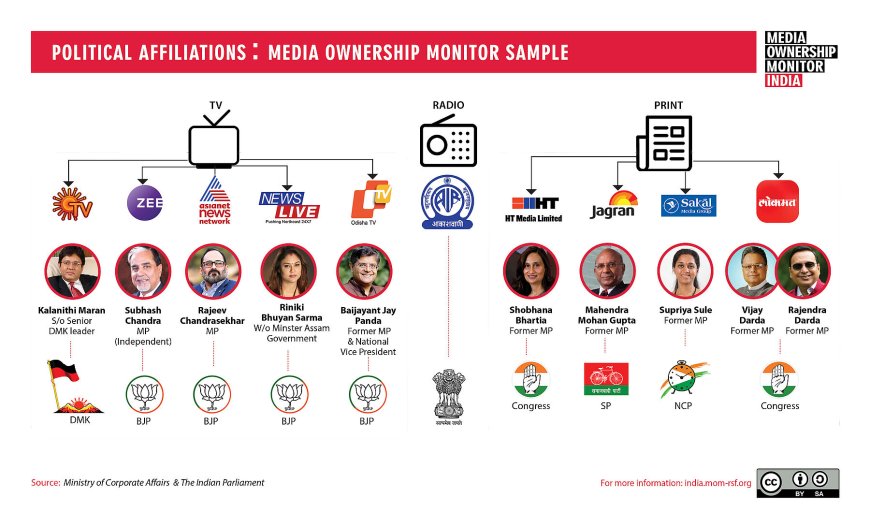
This chart shows only a fraction of the picture. Beyond direct ownership by politicians, many of India's largest media groups are owned by vast business conglomerates with interests spanning from telecommunications and energy to real estate and retail.
To grasp the scale of this concentration, let's look at some data from a survey conducted by Reporters Without Borders and DataLeads.
[PDF] 1.Media-ownership-pattern-and-political-interference-in-Television ...
This research paper provides data-driven insights into the concentration of media ownership in India. The findings from the Media Ownership Monitor (MOM) survey are particularly revealing.
Please read the section titled "Huge Markets Controlled by a Few as Media Giants". As you read, focus on the statistics presented for both the national Hindi print market and the regional language markets. Note the conclusion the authors draw about this trend towards concentration.
As the reading shows, a handful of companies dominate viewership and readership across both national and regional markets. This high concentration means that a small number of owners have the potential to control the flow of information and shape public opinion on a massive scale. This raises critical questions about diversity of viewpoints and the potential for bias.
Mechanisms of Influence: From the Boardroom to the Newsroom
How exactly does ownership translate into influence over news content? The process is multifaceted, operating through both direct pressure and more subtle, structural means. Corporate ownership introduces inherent conflicts of interest and commercial pressures that can systematically undermine journalistic independence.
A short, insightful video explains the three primary problems that arise from the corporatization of media.
Media Corporatisation, Media Ownership and Media Independence | Explained
This video from "THE UPFRONT" clearly breaks down the consequences of corporate ownership on journalism.
Please watch two key segments: First, watch the section explaining the concepts of private treaties, advertorials, and paid news. Pay close attention to how each of these practices blurs the line between journalism and advertising, compromising objectivity. The examples given for "paid news" are particularly stark. Then, watch the quick summary at the end, which recaps the three major problems: conflict of interest, the threat to objectivity, and the dependence on advertisers for revenue.
The video highlights several key mechanisms:
- Conflict of Interest: A media house owned by a conglomerate may hesitate to publish a critical story about another company within that same conglomerate, or about a sector where the owner has business interests. Board members with diverse business interests can also exert influence to protect their ventures from negative press.
- Advertorials and Paid News: These are perhaps the most flagrant violations of journalistic ethics. Content that is paid for by a political or corporate entity is disguised as genuine news, deceiving the reader or viewer. This practice becomes rampant during elections.
- Advertising Pressure: Media outlets depend heavily on advertising revenue from both corporations and governments. The threat of pulling ads can be a powerful tool to soften critical coverage or ensure positive portrayal.
- Self-Censorship: Perhaps the most pervasive effect. Journalists and editors, aware of their owners' business and political affiliations, may preemptively avoid sensitive topics or tone down their reporting to avoid conflict. This "chilling effect" doesn't require direct orders; it's a product of the environment.
To see how these issues are framed in academic research, the following text expands on these dynamics.
[PDF] The Influence of Corporate Ownership on Press Freedom in India
This paper provides a structured analysis of the impact of corporate ownership, corroborating the points made in the video.
Please read two parts of this paper: First, in the "KEY FINDINGS" section, read the paragraphs under the headings 1. Corporate ownership... and 3. Corporate influence.... These formalize the concepts of compromised independence and biased reporting. Next, navigate to the subsection "CORPORATE OWNERSHIP IN INDIAN MEDIA" and read the paragraph under Impact on Press Freedom. Note the specific example cited of an editor being forced to resign after publishing reports critical of a major corporate group.
Case Study: The Hostile Takeover of NDTV
No recent event illustrates the raw power of corporate ownership over media more vividly than the acquisition of NDTV by the Adani Group, a conglomerate with close ties to the ruling government. For years, NDTV was widely seen as one of the few remaining mainstream television channels that maintained a degree of critical distance from the government, focusing on issues like unemployment and public welfare rather than jingoistic debates.
The takeover in 2022 was described as "hostile" because it happened without the consent of NDTV's founders and promoters, Prannoy and Radhika Roy. The mechanism used was a brilliant, if ruthless, financial maneuver that exploited a loan agreement from over a decade prior. This case study is a masterclass in how corporate finance can be weaponized to acquire a media asset and potentially silence a critical voice.
The following video by Dhruv Rathee, featuring commentary from veteran journalist Ravish Kumar (formerly of NDTV), breaks down this complex story.
How Adani Trapped NDTV | The Hidden Agenda | Ravish Kumar | Dhruv Rathee
This video provides a detailed account of the Adani Group's takeover of NDTV, explaining the context, the financial strategy, and the implications for press freedom.
Please watch these two crucial segments: First, watch from this point to understand why NDTV was considered different from other news channels and the kind of pressure and harassment it faced for its independent journalism. This provides the crucial context for the takeover. Next, watch the detailed explanation of the takeover mechanism, starting from this section. Focus on the role of the shell company VCPL, the loan warrants, and how Adani's acquisition of VCPL allowed it to gain control of the founders' stake in NDTV. This is a real-world example of the financial power dynamics we've been discussing.
The NDTV case is a powerful culmination of all the themes in this lesson. It demonstrates:
- The strategic value that powerful corporate and political players place on controlling media narratives.
- How financial instruments (loans, warrants, shell companies) can be used to engineer a takeover.
- The potential for a new owner to drastically change the editorial direction of a news organization, raising fears about the future of independent journalism within that institution.
Conclusion
Today's lesson has moved our analysis from direct state attacks on journalists to the structural power of capital in shaping the media landscape. We have seen that the ownership of Indian media is highly concentrated, with deep-seated corporate and political connections that pose a fundamental challenge to journalistic independence.
Key Takeaways:
- Concentration of Ownership: A small number of large corporations and politically-linked families control a vast majority of India's media market, limiting the diversity of voices.
- Mechanisms of Control: Influence is exerted not just through direct orders, but through conflicts of interest, advertising dependence, the packaging of "paid news," and the pervasive culture of self-censorship.
- Erosion of the Fourth Estate: When media outlets act in the interest of their corporate owners rather than the public, their ability to hold power accountable is compromised, weakening a cornerstone of democratic society.
- The Power of Finance: As the NDTV case shows, corporate takeovers can be executed through complex financial strategies, making media outlets vulnerable to acquisition by entities that may not share their journalistic values.
In our next lesson, we will examine another critical lever of control over information: state regulation. We will analyze the IT Rules 2021, exploring the tension between the government's stated goals of ensuring user safety and combating misinformation, and the concerns raised by civil liberties groups about censorship and the erosion of privacy in the digital sphere.