Welcome back. In our previous lesson, we established the precise constitutional and historical context of the Uniform Civil Code (UCC), defining it as an aspirational, non-enforceable goal under Article 44 of the Directive Principles. We saw how its placement was a deliberate compromise by the Constitution's framers, who balanced the ideals of unity and gender justice with the realities of India's deep religious and cultural pluralism.
Now, with that foundation in place, we will dive into the heart of the contemporary controversy. This lesson directly addresses the learning outcome by analyzing the fierce, competing arguments that define the UCC debate. We will dissect the case for the UCC, which is typically built on the pillars of gender justice and national integration, and then scrutinize the case against it, which raises alarms about threats to pluralism and the potential for majoritarian control. This will equip you to understand one of the most significant ideological fault lines in modern Indian politics.
The Case For a Uniform Civil Code: Equality and Integration
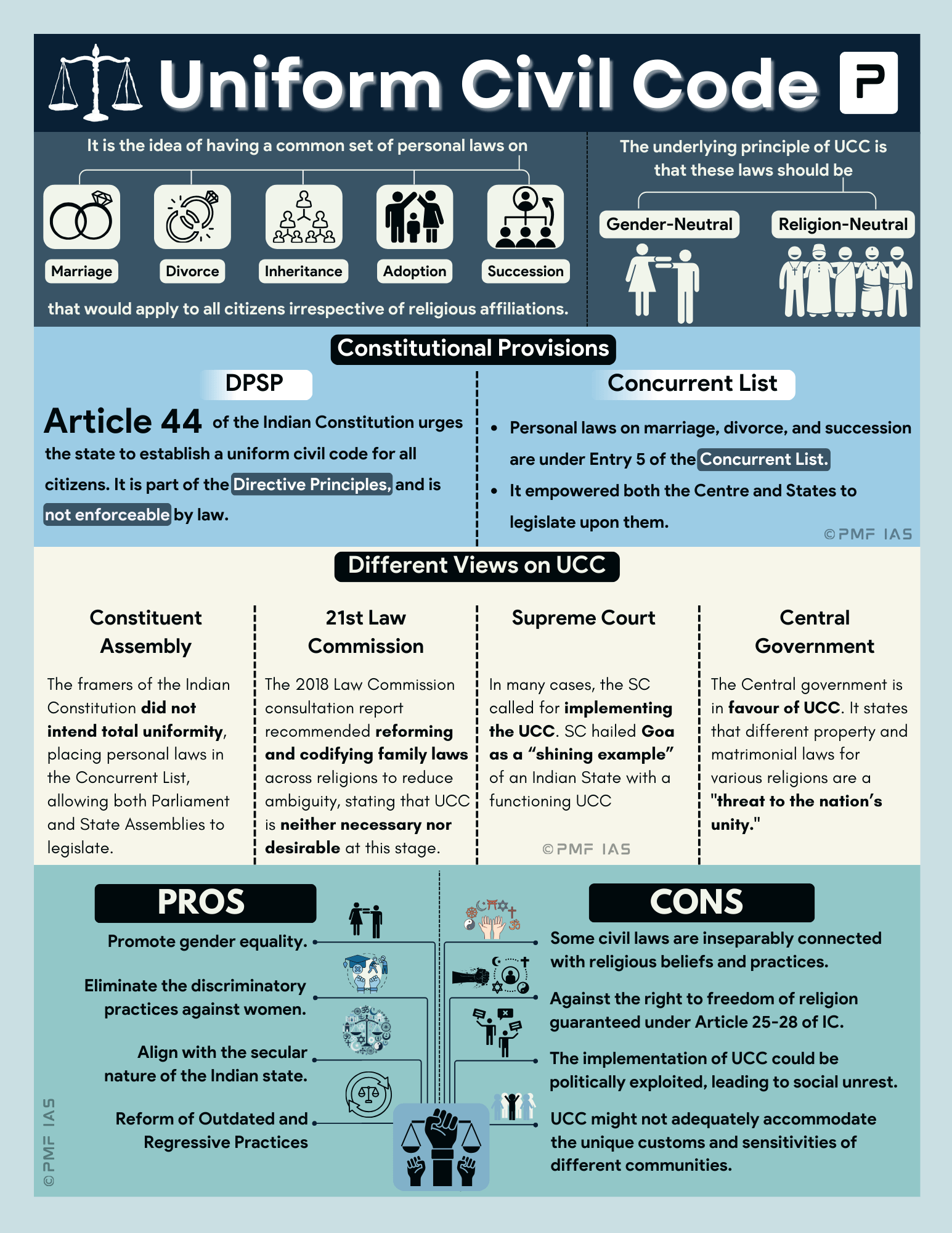
The arguments in favor of a UCC are powerful and appeal to core constitutional values of equality, secularism, and national unity. Proponents argue that in a modern, democratic republic, the legal rights of a citizen should not depend on their religious affiliation. This case rests on two primary pillars.
1. Promoting Gender Justice
Perhaps the most compelling argument for the UCC is its potential to eliminate discriminatory practices against women embedded in various personal laws. Critics of the current system point to numerous instances where personal laws, across different religions, perpetuate gender inequality.
A UCC, proponents argue, would provide a common legal foundation that guarantees equal rights for all women in matters of marriage, divorce, inheritance, and adoption. The video from Priya Jain, which we touched upon in the last lesson, powerfully illustrates this by highlighting specific disparities.
One Nation, One Law | Uniform Civil Code 2023
This video effectively frames the UCC debate around the issue of discriminatory practices that persist under the current system of personal laws.
Watch the opening section from the start which poses direct questions about practices like polygamy and unequal inheritance. Then, jump to the segment from the section with examples, which details differences in laws regarding bigamy, divorce grounds, and inheritance shares between men and women. Finally, note the powerful framing from the analogy used, where the speaker likens the removal of these laws to the abolition of untouchability, arguing that certain principles of justice should be universal.
This argument is not merely theoretical; it has been consistently reinforced by the judiciary. Landmark cases like Shah Bano (1985) and Shayara Bano (2017), which challenged maintenance rules and the practice of triple talaq, respectively, brought the issue of gender justice within Muslim personal law to the forefront. The Supreme Court has repeatedly used such cases to nudge the legislature towards enacting a UCC, seeing it as a crucial step for protecting the fundamental rights of women.
2. Strengthening National Integration and Secularism
The second major argument is that a UCC is essential for fostering a unified national identity. The slogan "One Nation, One Law" encapsulates this idea. Proponents contend that having different legal regimes for different communities perpetuates divisions and undermines the sense of a common Indian citizenship.
If criminal law is uniform for every citizen—meaning the punishment for theft or murder does not depend on one's religion—then why, they ask, should civil laws concerning family life be different? A uniform code would, in this view, strengthen India's secular credentials by ensuring the state applies the law equally to all, without preference for any particular religion's code.
The following academic paper provides a structured overview of the arguments favoring the UCC, covering both the gender justice and national integration aspects.
[PDF] Revisiting the Uniform Civil Code: Issues, Challenges, and the Way ...
This research paper offers a balanced summary of the UCC debate. We will first focus on the sections articulating the need for and arguments in favor of the code.
First, read the section titled Need for Uniform Civil Code, starting from the beginning of the section. This part explains how a UCC is seen as a step towards true secularism, gender equality, legal simplification, and reducing vote-bank politics. Next, read the bulleted list under Arguments in Favour of UCC. These four points concisely summarize the case, focusing on national unity, gender equality, and legal simplification.
The Case Against a Uniform Civil Code: Pluralism and Minority Rights
The opposition to the UCC is equally passionate, rooted in concerns about preserving India's celebrated diversity and protecting the rights of minority communities. Critics fear that "uniformity" could become a euphemism for "homogeneity," imposed by the majority community.
1. Threat to Pluralism and Religious Freedom
Opponents argue that India's unique identity is built on its pluralism—the co-existence of diverse cultures, traditions, and religions. Personal laws, in this view, are not just legal rules but are deeply intertwined with the religious and cultural identity of a community. Imposing a single code, they contend, would be an assault on this diversity and would violate the freedom of religion guaranteed by Article 25 of the Constitution.
The fear is that a UCC would steamroll over the customs of minority groups and tribal communities, whose traditions regarding marriage and inheritance may differ significantly from the mainstream. The infographic below highlights this core tension, listing both the pro-integration arguments and the counter-arguments based on religious freedom and unique customs.
2. The Fear of Majoritarianism
This is arguably the most significant political obstacle. Many minority communities, particularly Muslims, are apprehensive that a UCC will not be a truly secular code synthesized from the best practices of all religions. Instead, they fear it will be a thinly veiled imposition of Hindu personal law on the entire country. The debate, they argue, often presumes that practices like monogamy (from the Hindu Code Bill) are "modern" while others like polygamy are "outdated," revealing an inherent majoritarian bias.
This perspective questions whether the UCC is genuinely about equality or is a political tool for cultural assimilation and majoritarian control.
This critical viewpoint is thoroughly explored in an essay from the Jindal School of Government and Public Policy.
The Uniform Civil Code: A Step Toward Equality or A Tool for ...
This essay critically examines the UCC proposal, arguing that true equality is better achieved through internal reforms rather than enforced uniformity. It directly confronts the charge of majoritarianism.
Start with the introduction, which frames the core question: is the UCC about equality or enforcement? Next, read the section Freedom, Control, and the Constitution. This part explains how a state-determined code could be seen as a tool for control that infringes upon personal freedom and Article 25. Then, move to the section on Minority Rights and the Risk of Majoritarianism. This is a crucial part of the critique. It directly addresses the fear that a UCC would privilege majoritarian norms and provides the example of monogamy being labeled modern while polygamy is deemed outdated. Finally, read the argument presented under Gender Equality: Reform or Uniformity?. It makes the case that if gender justice is the real goal, then targeted internal reforms within personal laws—like the 2005 amendment to the Hindu Succession Act—are a more effective and less divisive approach than imposing a blanket code.
Beyond a Simple Binary: Models for Implementation
The debate over the UCC is often presented as a simple yes-or-no question. However, the reality is far more nuanced. Even those who support the idea disagree on what form it should take. The infographic below illustrates four potential models for implementing a UCC, moving the discussion from "if" to "how."

Let's briefly consider these models:
- Model 1: Status Quo with Internal Reforms: This approach avoids a single code and instead focuses on amending existing personal laws to remove discriminatory provisions. This aligns with the 2018 Law Commission's recommendation and is favored by those who want to prioritize gender justice without sacrificing pluralism.
- Model 2: Common Code with Exceptions: This model proposes a single national code but allows for specific, narrowly defined exemptions, for instance, for certain customs of tribal communities in the Northeast, which have constitutional protection.
- Model 3: Optional Uniform Code: Here, citizens could voluntarily opt-in to the UCC or choose to remain under their community's personal law. This respects freedom of choice but risks creating a dual legal system and may not solve the problem of inequality for those who do not opt-in.
- Model 4: Absolute Homogeneity: This is the most ambitious model—a single, mandatory civil code for all citizens with no exceptions. This is what proponents of "One Nation, One Law" typically advocate for, but it also faces the fiercest resistance.
This framework shows that the path to legal reform is not a single road but a series of complex choices, each with profound implications for the Indian state and its diverse peoples. The following panel discussion from Sansad TV captures the dynamism of this debate, with different speakers advocating for and against the UCC, touching upon many of the arguments and challenges we've discussed.
Perspective: Uniform Civil Code | 01 June, 2022
This Sansad TV panel discussion provides a multi-faceted view of the UCC debate, featuring arguments from different political and social perspectives.
First, listen to petitioner Firoz Bhakta Ahmed make the case for the UCC from his opening statement. He argues that personal laws create a "divided house" and are misused, particularly against women, while asserting a UCC would not negatively impact Islam. Next, pay attention to the exchange from this segment, where panelists directly address the two main charges against the UCC: that it neglects diversity and violates religious freedom. The discussion highlights how the argument for gender equality is used to counter these charges. Finally, watch the concluding portion from the end of the debate. Here, the panelists reiterate that the UCC is seen as a necessity for gender parity and national integration, referencing international examples and a Supreme Court judgment that described a common code as helpful for "the cause of national integration."
Conclusion
Today, we have navigated the turbulent waters of the Uniform Civil Code debate, moving beyond its simple definition to analyze the core arguments that animate this national conversation. You are now equipped to understand not just what the UCC is, but why it remains one of India's most enduring and divisive political issues.
Key Takeaways:
- Arguments for UCC are primarily centered on gender justice (ending discriminatory practices in personal laws) and national integration (fostering a common citizenship under "One Nation, One Law").
- Arguments against UCC are driven by a defense of pluralism (protecting India's diverse cultural and religious traditions) and a profound fear of majoritarianism (the concern that the "uniform" code will simply be an imposition of the majority community's norms).
- The debate is not a simple binary. The path forward involves considering various implementation models, from gradual internal reforms of personal laws to an optional code or a common code with exceptions.
- Ultimately, the UCC controversy represents a fundamental tension within the Indian Constitution itself: the clash between the right to equality (Article 14/15), the right to religious freedom (Article 25), and the directive for a uniform code (Article 44).
In our next lesson, we will continue our exploration of contemporary flashpoints where law and religion intersect by examining the function of Waqf boards and the political controversy surrounding the Waqf Amendment Bill.