Welcome back. In our last lesson, we examined the intense controversy surrounding the Citizenship Amendment Act (CAA) by analyzing the argument that its true impact is only revealed when combined with a nationwide National Register of Citizens (NRC). We explored how this potential combination fueled fears of a religion-based citizenship framework, posing a profound challenge to India's secular constitution.
Today, we transition from citizenship to another critical flashpoint where law, religion, and national identity collide: the Uniform Civil Code (UCC). You specifically requested this topic be included in our course, and this lesson will lay the essential groundwork for understanding the debate. Our focus will be on explaining the core concept of the UCC and, most importantly, its precise constitutional position under Article 44. By understanding its origins and legal status, we can better analyze the heated arguments for and against its implementation in our next session.
What is a Uniform Civil Code?
At its heart, the concept of a Uniform Civil Code (UCC) is straightforward. It is a proposal to formulate and implement one common set of secular laws for all citizens of India in the domain of personal matters, regardless of their religion, caste, or community.
Currently, different religious communities are governed by their own "personal laws" in several key areas of life. For instance:
- Marriage and Divorce: Rules for marriage validity, polygamy, and dissolution of marriage differ between Hindu, Muslim, and Christian personal laws.
- Inheritance and Succession: The principles guiding how property is passed down through generations vary significantly across communities.
- Adoption and Guardianship: The legal framework for adopting a child or establishing guardianship also differs.
A UCC would replace these varied personal laws with a single, uniform legal code that applies equally to every citizen.
The following short video provides a very clear definition of the UCC and the personal matters it seeks to govern.
Uniform Civil Code [Explained] | Article 44 of Indian Constitution | UPSC Prelims & Mains 2022-2023
This video from BYJU'S IAS offers a concise explanation of what the Uniform Civil Code entails.
Please watch the opening segment from the beginning. It clearly lists the key areas—marriage, divorce, inheritance—that fall under the umbrella of "personal matters."
The infographic below visually summarizes the core idea of the UCC and its constitutional standing, which we will now explore in detail.
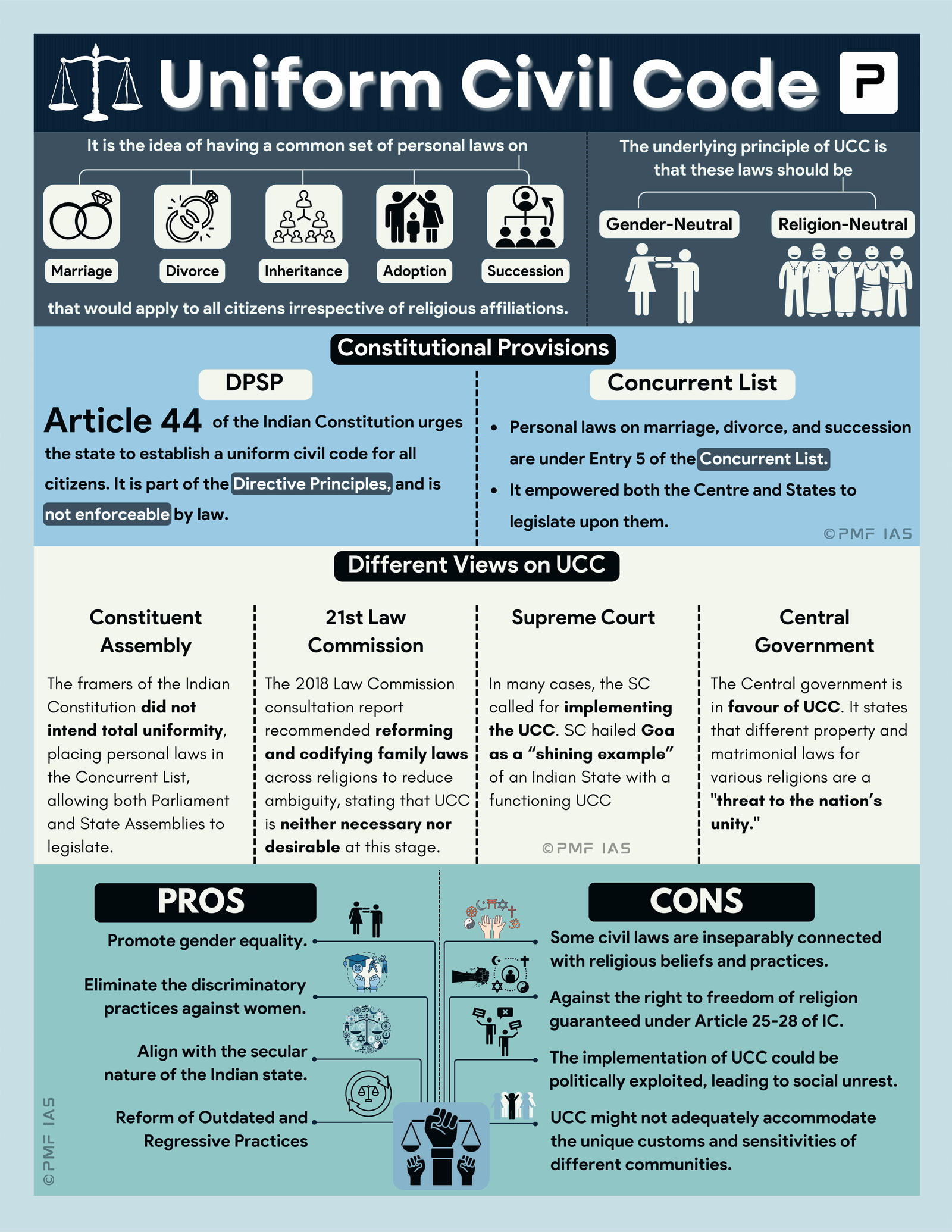
The Constitutional Mandate: Article 44
The call for a UCC is not a recent political demand; it is rooted in the Constitution of India itself. The provision is found in Article 44, which states:
"The State shall endeavour to secure for the citizens a uniform civil code throughout the territory of India."
The crucial element here is the location of Article 44. It is not in Part III of the Constitution, which contains the enforceable Fundamental Rights. Instead, it is in Part IV, which lays out the Directive Principles of State Policy (DPSP).
What are Directive Principles? They are a set of guidelines and principles intended to guide the state in its legislative and policy-making functions. However, unlike Fundamental Rights, they are non-justiciable. This means that a citizen cannot go to court to compel the government to implement a DPSP. They are aspirational goals that the state should strive to achieve as the country develops socially and economically.
This distinction is fundamental to understanding the UCC debate. The framers of the Constitution directed the state to endeavour to create a UCC, but they did not make it a legally enforceable right.
The following video explains this crucial difference between Fundamental Rights and DPSPs, using the evolution of the Right to Education as an excellent example.
One Nation, One Law | Uniform Civil Code 2023
This video by Priya Jain clearly illustrates the nature of Directive Principles and how they can evolve into enforceable laws.
Watch the segment from this discussion. It explains that DPSPs were rights the state could not guarantee at the time of independence but hoped to implement as the nation progressed. The journey of the Right to Education from a DPSP to a Fundamental Right is a perfect illustration of this intended path.
A Deliberate Compromise: The Constituent Assembly Debates
This raises a critical question: If the framers valued the idea of a UCC, why did they place it in the non-enforceable Directive Principles? The answer lies in the intense and divisive debates within the Constituent Assembly that drafted the Constitution. The placement of Article 44 was a deliberate compromise.
- Proponents of the UCC, including figures like K.M. Munshi and Dr. B.R. Ambedkar, argued forcefully that it was essential for national integration, secularism, and, critically, for securing gender justice. They saw disparate personal laws as a barrier to creating a modern, unified nation and believed that many of these laws were discriminatory towards women.
- Opponents, primarily Muslim members of the Assembly, voiced strong apprehensions. They argued that imposing a uniform code would violate the freedom of religion guaranteed by the Constitution. For them, personal laws (like the Shariat) were not just legal rules but an integral part of their religious and cultural identity. They feared that a UCC would be an instrument of majoritarian homogenization.
Faced with this deep division, the framers chose a middle path. They acknowledged the UCC as a desirable goal for the nation but decided that it should not be imposed on an unwilling populace. By placing it in the Directive Principles, they signaled that the UCC should be achieved through social reform and evolving consensus over time, not through immediate state coercion.
The following academic text provides a nuanced analysis of these foundational debates, revealing how the placement of Article 44 was a strategic act of "constitutional gradualism."
[PDF] Debating Uniform Civil Code: the making of Article 44 in the ...
This paper by Sambaiah Gundimeda offers a deep dive into the historical context and intellectual currents that shaped Article 44. It aligns perfectly with your preference for analytical depth over mere facts.
First, read the paragraph that establishes the UCC's constitutional locus. It perfectly frames Article 44's placement in the non-justiciable Directive Principles as a "deliberate compromise." Next, move to the section "Demanding a uniform civil code in the name of national unity." Read the two paragraphs that describe how the UCC was formally proposed and then placed in the DPSP. This part shows the journey of the idea from a potential right to an aspirational directive. Finally, read the section on "Ambedkar’s ethics of incrementalism." Focus on the first paragraph, which explains his pragmatic rationale for this placement. He saw it not as a rejection of uniformity, but as a calibrated, democratic route to reform.
For a more straightforward summary of the constitutional provisions and the tensions they create, you can also refer to the iPleaders article.
Article 44 of Indian Constitution - iPleaders
This article provides a clear legal summary of Article 44 and its relationship with other constitutional rights.
First, read the section titled What is Article 44 of the Indian Constitution for a direct definition. Then, skim the section on "Constitutional provisions relating to Article 44," particularly the parts on Article 25 and Article 26. This will help you understand the constitutional tension between the push for a uniform code (Article 44) and the guaranteed right to freedom of religion (Articles 25 & 26).
Conclusion
In this lesson, we have established the foundational concepts necessary to engage with the Uniform Civil Code debate. We have defined what the UCC is and clarified its unique and often misunderstood constitutional position.
Key Takeaways:
- A Uniform Civil Code (UCC) is a proposed single set of secular laws to govern personal matters like marriage, divorce, and inheritance for all citizens, replacing the current system of religion-based personal laws.
- The constitutional mandate for a UCC comes from Article 44, which is located in Part IV of the Constitution, the Directive Principles of State Policy (DPSP).
- As a DPSP, Article 44 is non-justiciable, meaning it is an aspirational goal for the state, not an enforceable right that citizens can demand through the courts.
- This placement was a deliberate compromise by the framers to balance the ideal of national unity and gender equality with the need to protect religious freedom and cultural diversity in a newly independent nation. The intent was to pursue uniformity through consensus and gradual reform, not immediate imposition.
Now that we have a firm grasp of the UCC's conceptual and constitutional basis, we are equipped to tackle the contemporary political battle over its implementation. In our next lesson, we will analyze the competing arguments for the UCC (advocating gender justice and national integration) and against it (fearing a threat to pluralism and the targeting of minorities).