Hello! Welcome to the next lesson in your Go-to-Market course.
In our last session, you conducted a thorough analysis of your competitive landscape, identifying both direct and indirect competitors and, crucially, unearthing the key differentiators for your e-learning platform. This was a vital intelligence-gathering mission.
Today, we will put that intelligence to work. Your learning outcome is to develop a clear positioning statement that communicates your unique value. This statement will serve as the strategic compass for your entire GTM strategy. It’s the internal document that aligns your sales, marketing, and product teams, ensuring everyone tells the same powerful story about why customers should choose you. For you as a sales leader, this provides the core logic that your team will use in every pitch to win deals and drive toward that 5 crore revenue goal.
1. What is Positioning?
Before we can write a positioning statement, we must be crystal clear on what positioning is—and what it isn't. It’s not a tagline, a mission statement, or a block of marketing copy. Positioning is the foundational act of setting the context for your product in the customer's mind. It answers the fundamental questions: What is this? Why should I care?
To get a firm grasp of this concept, let's turn to one of the leading experts on the topic, April Dunford.
The Marketing Expert: Sell Anything with this Trick | April Dunford
In this clip from 'The Knowledge Project Podcast,' April Dunford masterfully explains the concept of positioning. She clarifies common misconceptions and uses a simple, memorable analogy to illustrate how context shapes customer perception.
Watch from 00:31 to 04:36. Pay close attention to: Her definition of positioning as the 'foundation' for marketing and sales. The distinction between positioning and messaging or taglines. The 'muffin vs. cake' analogy, which brilliantly demonstrates how changing the market category changes everything—competitors, price, and customer expectations—even if the product is the same.
As Dunford explains, positioning is about deliberately choosing the market context in which your product will be judged. For your platform, are you a "corporate training tool," a "test-prep solution," or a "B2B partnership platform for education consultants"? Each choice implies a different set of competitors, a different value proposition, and a different price expectation.
This is especially critical in the EdTech space, where you are selling to a diverse group of stakeholders, from administrators to teachers.
EdTech Positioning, Go-To-Market Strategy & Branding
The article 'EdTech Positioning, Go-To-Market Strategy & Branding' from Insivia explains why positioning is the 'compass' that guides ventures in the world of educational technology.
Read the short section under the image, starting with 'Positioning isn’t just a marketing buzzword...' and ending just before the section 'All Great Positioning Starts...'. This will reinforce the importance of positioning specifically within your industry.
2. The Positioning Statement: Your Internal North Star
Now that we understand positioning as a concept, we need a tool to capture and communicate it. That tool is the positioning statement.
Crucially, this is an internal document. It's not meant for your website or brochures. Its purpose is to guide the leadership and GTM teams in making consistent decisions about messaging, branding, and sales strategy.
Write A Strategic Brand Positioning Statement [With This Proven 6-Step Formula]
To avoid confusion, it's helpful to see how a positioning statement differs from other common brand assets. This video from Brand Master Academy clearly lays out the distinctions.
Watch the first 3 minutes and 43 seconds of the video. The presenter clearly explains what a positioning statement is not (e.g., a tagline, mission, USP) and defines its true role as an internal guide for leadership.
3. A Framework for Crafting Your Statement
There are several frameworks for building a positioning statement. A traditional model, often associated with Geoffrey Moore's Crossing the Chasm, looks like this:
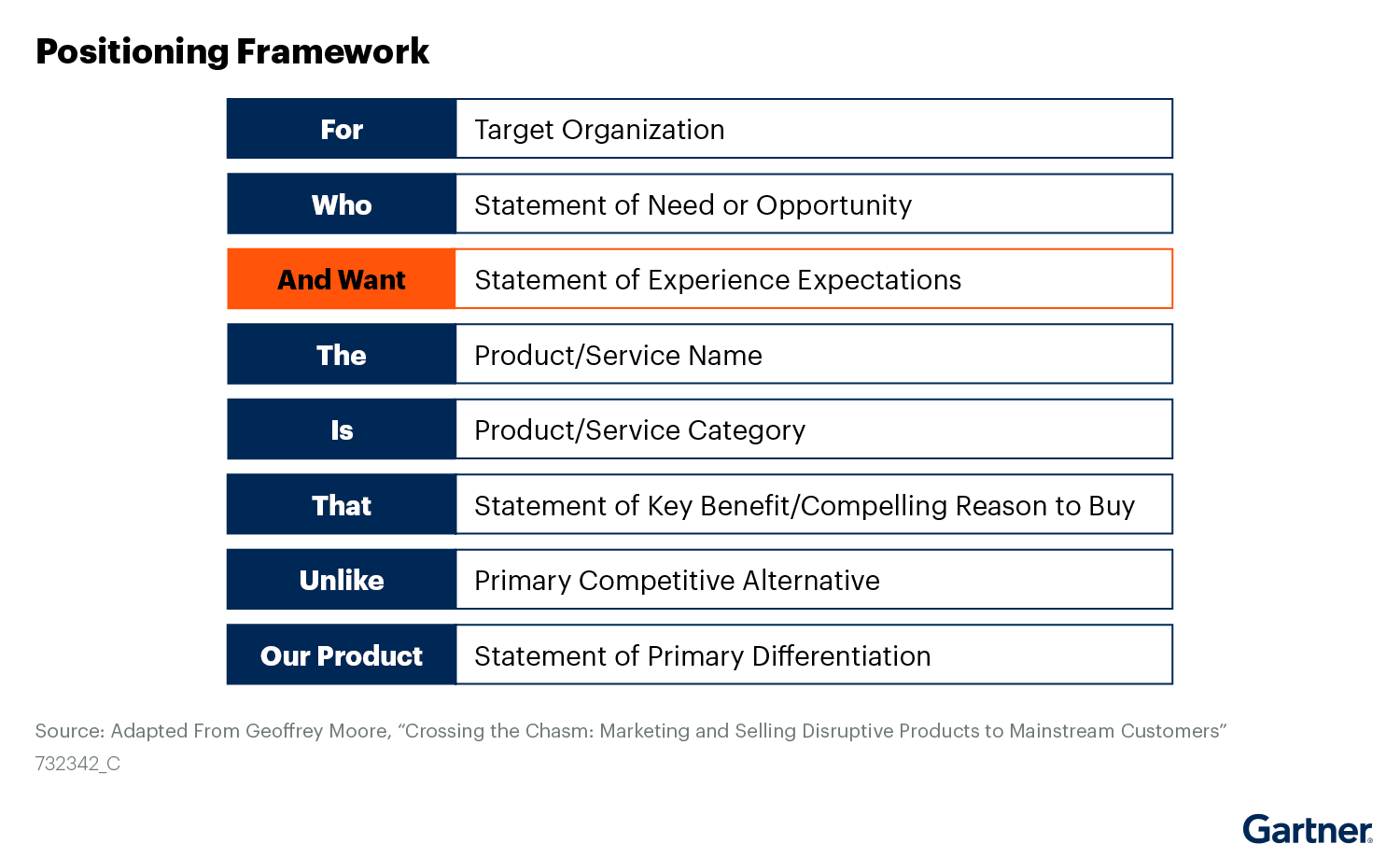
This "fill-in-the-blanks" model can be a good starting point. However, modern approaches, like April Dunford's, emphasize a more rigorous, sequential process. Instead of just filling in blanks, you build the logic step-by-step, starting with the insights from your competitive analysis.
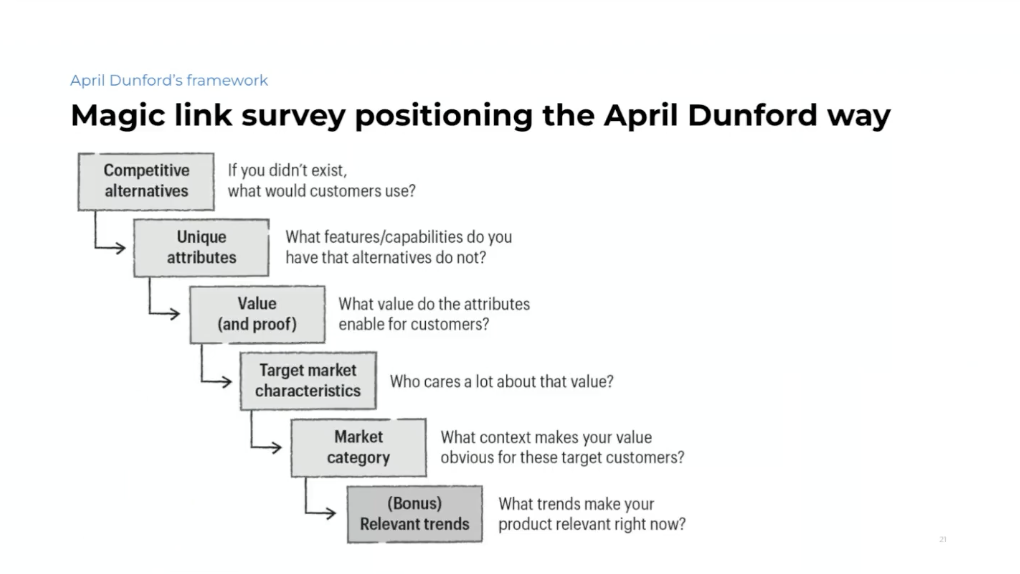
The key difference is the starting point. Dunford's method begins with competitive alternatives, which you already identified in the previous lesson. This ensures your positioning is grounded in the reality of the market and what customers are doing today to solve their problems.
For our practical exercise today, we will use a clear, step-by-step formula that combines the structure of the traditional model with the logic of the modern approach.
4. Building Your Positioning Statement: A Step-by-Step Guide
The Brand Master Academy video you watched earlier introduces a very effective formula. Let's use it to build the positioning statement for your e-learning platform.
The formula is:
We help [Target Audience] who [Challenge/Pain Point] to [Key Benefit/Outcome], unlike [Competitive Alternative], our solution [Unique Point of Difference].
Let's break this down using your business as an example.
1. Target Audience:
- From your earlier work on your Ideal Customer Profile (ICP), who are you targeting? Be specific.
- Example: "mid-sized study abroad consultancies in Tier-2 Indian cities."
2. Challenge/Pain Point:
- What problem does this specific audience face?
- Example: "...who struggle to offer a wide range of high-quality, standardized test prep courses due to the high cost of hiring expert teachers."
3. Key Benefit/Outcome:
- What is the positive transformation you deliver? What does your solution enable them to achieve?
- Example: "...to scale their business by providing world-class, affordable exam preparation for students."
4. Competitive Alternative:
- What are they doing now to solve this problem? This comes directly from your competitive analysis.
- Example: "...unlike hiring individual freelance tutors or using fragmented, unverified online content..."
5. Unique Point of Difference:
- This is your secret sauce—the key differentiators you identified in the last lesson. What can you do that the alternative cannot?
- Example: "...our platform provides a comprehensive, ready-to-deploy curriculum with AI-powered student evaluation tools and dedicated support for their existing teaching staff."
Putting It All Together
When we combine these components, we get a clear, powerful internal statement:
"We help mid-sized study abroad consultancies in Tier-2 Indian cities who struggle to offer a wide range of high-quality, standardized test prep courses due to the high cost of hiring expert teachers to scale their business by providing world-class, affordable exam preparation for students. Unlike hiring individual freelance tutors or using fragmented, unverified online content, our platform provides a comprehensive, ready-to-deploy curriculum with AI-powered student evaluation tools and dedicated support for their existing teaching staff."
This statement now acts as a litmus test for every decision.
- When marketing designs a new ad, does it speak to the pain of hiring expert teachers?
- When a salesperson is on a call, are they highlighting the AI-powered evaluation tools?
- When the product team plans a new feature, does it help consultancies scale their business?
This alignment is how you build a powerful, consistent brand and sales motion.
Test your understanding!
Now it's your turn. Your platform also offers French and German language courses. Using the same five-step formula, draft a positioning statement for the segment of your business that sells language training to educational institutions (e.g., engineering colleges that want to prepare students for opportunities in Europe).
Think about:
- Target: Which institutions?
- Pain Point: Why is teaching foreign languages hard for them?
- Outcome: What do they want to achieve for their students?
- Alternative: What's their current, less-effective solution?
- Differentiator: What makes your platform's language offering unique?
Show answer
Here is an example of what your statement could look like. Yours might be different based on your specific differentiators.
"We help engineering colleges in India who lack specialized in-house faculty to offer job-oriented foreign language skills to enhance their students' global employability and placement rates. Unlike partnering with local, small-scale language institutes, our platform delivers a scalable, certified language curriculum with interactive digital tools and native-speaking instructors, seamlessly integrated into their existing academic schedule."
Conclusion
Today you've moved from analysis to strategy, translating your knowledge of the market into a core guiding principle for your business.
Key Takeaways:
- Positioning Sets the Context: It's the deliberate act of placing your product in a specific market category in your customer's mind.
- The Positioning Statement is an Internal Tool: It is not a tagline. It's an internal North Star to align sales, marketing, and product teams on who you serve, what problem you solve, and why you are the best choice.
- It's Built on a Logical Formula: By systematically defining your audience, their pain points, the outcome you provide, the competitive alternative, and your unique differentiator, you can create a powerful and actionable statement.
- It Starts with Competitors: Your positioning must be grounded in the reality of what customers are doing today, leveraging the differentiators you identified in the previous lesson.
In our next lesson, we will craft specific value propositions that address the pain points of each customer segment. You'll learn how to take the core promise of your positioning statement and translate it into sharp, compelling messages tailored to the specific needs of different buyers within your target organizations.