Pipeline questions become easier to sort once you separate what the pipeline does from what decision is being made. A safety complaint, an objection to a proposed route, and a dispute over access to private land may concern the same pipe, but they need not go to the same authority.
This part of the course examines those boundaries. You will build a checklist for Texas pipeline questions, including the difference between intrastate and interstate operations and what a Railroad Commission of Texas (RRC) operating permit does—and does not—authorize. The next lessons will turn from pipelines to nonproducing wells and the state’s plugging responsibilities.
Start with the pipeline, then identify the decision
The diagram gives a useful first approximation: an interstate pipeline crosses state lines; an intrastate pipeline operates within one state.
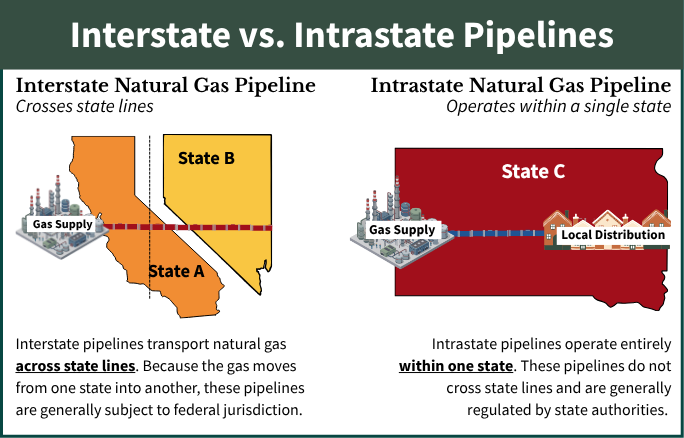
For an ordinary Texas intrastate pipeline, the RRC has pipeline-safety authority. For an interstate pipeline, operational safety falls to the federal Pipeline and Hazardous Materials Safety Administration (PHMSA), rather than the RRC. Confirm the pipeline’s regulatory classification instead of relying only on the particular stretch visible on a map: a stretch located in Texas can be part of an interstate system.
That split answers a safety question, but not necessarily a route question. Safety regulation, permission to build at a particular location, permission to operate, and the right to use someone else’s land are distinct legal matters. Keeping them separate is the central skill of this lesson.
Read the RRC’s explanation with those distinctions in mind.
Pipeline Eminent Domain and Condemnation
The Railroad Commission of Texas explains its pipeline jurisdiction and why its involvement in safety does not make it the general route-approval authority.
Under the page heading “Pipeline Eminent Domain & Condemnation,” begin with the paragraph starting “The Railroad Commission (RRC) is limited in its authority.” Read the jurisdiction overview through the construction-notice paragraph ending “exempted from this reporting requirement.” Focus on the separate statements about safety, routing, prior construction approval, interstate pipelines, and construction notices.
The RRC says it generally does not approve the route or siting of either intrastate or interstate pipelines in Texas. The owner or operator generally determines the proposed route. The agency identifies a limited exception involving pipelines containing sour gas, whose hydrogen sulfide creates particular hazards. An RRC safety role therefore does not imply a general power to choose where a pipeline goes.
The RRC also distinguishes notification from approval. Certain intrastate construction projects require a pre-construction report to its Pipeline Safety Department; the resource specifies a report at least 30 days before construction for an intrastate pipeline longer than one mile, with stated exceptions. Filing that report is not a Commission finding that the route is needed or approved. Other legal requirements may still apply; “no general RRC route approval” does not mean “no permissions of any kind.”
What a Texas T-4 permit establishes
The word permit is especially liable to cause confusion here. An RRC T-4 permit is a permit to operate a pipeline in Texas, functioning substantially as a registration of information about the operator and line. It is not a decision approving the route, establishing a need for the line, declaring the operator legally entitled to common-carrier status, or awarding eminent-domain power.
Pipeline Eminent Domain and Condemnation
Return to the RRC explanation for the distinction between an operator’s reported status and a legally established right to condemn land.
On the same page, find the passage beginning “State law enacted by the Texas Legislature.” Read the T-4 explanation, ending with the sentence assigning the ultimate determination of contested common-carrier status to the courts. Pay particular attention to the paragraphs beginning “A T-4 Permit is a permit to operate,” “Common carriers are not the only pipelines,” and “Information provided by the pipeline companies.”
The T-4 records information including the operator, what the pipeline carries, its location and physical characteristics, and whether the operator reports it as a gas utility, common carrier, or private line. Some lines, including certain production and distribution lines described in the reading, are exempt from the T-4 requirement. Being exempt from T-4 does not, by itself, establish an exemption from safety rules.
For land-access disputes, the crucial distinction is between reporting a status and proving a legal entitlement. Texas statutes, not the RRC’s issuance of a T-4, govern whether an operator has eminent-domain authority. The RRC does not administer or enforce those private-property and condemnation laws. If an operator’s claimed common-carrier status is contested, the courts have the ultimate authority to determine whether it qualifies. A landowner should therefore not treat a T-4 presented during easement negotiations as conclusive proof that the operator can take an easement.
The federal distinction: interstate natural gas
Interstate natural-gas projects introduce another agency with a different job: the Federal Energy Regulatory Commission (FERC). For covered interstate natural-gas facilities, FERC approves location, construction, and operation. PHMSA remains the principal federal pipeline-safety authority during operation. FERC’s role in deciding whether to authorize a project is not the same as PHMSA’s role in setting and overseeing operational safety standards.
FERC’s landowner guide shows how federal project authorization, negotiated easements, court proceedings, and operational safety fit together without becoming a single decision.
In “Background,” read FERC’s role. Then find “How do natural gas companies obtain a right-of-way?” and read the easement explanation. Finally, under “Important Safety Issues,” read from “What authorization allows the pipeline company to use eminent domain?” through “Who is responsible for safety?”, focusing on authorization and safety.
The usual starting point for land access is a negotiated easement. If FERC authorizes a covered interstate natural-gas project and negotiations fail, the Natural Gas Act provides a path for the certificate holder to seek an easement through eminent domain; a court determines compensation under the applicable process. FERC’s authorization does not mean that PHMSA selected the route, nor that a Texas T-4 supplied the federal condemnation right.
Do not automatically extend this FERC natural-gas siting framework to every interstate pipeline. An interstate oil pipeline presents a federal pipeline-safety question, but it is not thereby an interstate natural-gas project receiving this kind of FERC route authorization. For its route and land-access claims, identify the applicable laws and facts rather than assuming there is one federal approval for all commodities.
A jurisdiction checklist
Apply the following checks in order. The first two establish the context; the last three identify the authority for the particular decision.
- Identify the line and its regulatory status. Note what it carries and whether it is intrastate or interstate. Confirm that status when it is disputed rather than inferring everything from a Texas-only map segment.
- Identify the action at issue. Separate a safety complaint from a proposed route, a filing to operate, and a demand for a private-property easement.
- For operational safety, start with RRC or PHMSA. RRC is the state pipeline-safety authority for pipelines within its intrastate jurisdiction; PHMSA is responsible for interstate pipeline safety. The RRC does not gain interstate safety authority merely because a line passes through Texas.
- For a route, distinguish a proposal from its required approvals. The operator generally proposes the route. The RRC generally does not approve Texas pipeline siting, subject to its stated sour-gas exception. For a covered interstate natural-gas facility, FERC authorizes location and construction. Do not treat a construction notice or T-4 as route approval.
- For eminent domain, find the source of the claimed power and the forum for a challenge. For a Texas statutory claim, the RRC’s T-4 does not decide entitlement; contested property-rights questions belong in court. For a FERC-authorized interstate natural-gas project, federal law provides a potential condemnation path if easement negotiations fail, with the courts involved.
This checklist does not imply that these are the only permits, land-use requirements, or courts that could matter to a real project. It prevents one agency document from being mistaken for an answer to every question.
Seeing the distinctions in use
Suppose an operator proposes an intrastate crude-oil line across private property and shows a landowner its T-4. The RRC is relevant to intrastate pipeline safety, and the T-4 supplies operating information. The document does not show that the RRC approved that route or conclusively establish a right to condemn the easement. Any contested claim of that right turns on applicable law and, ultimately, the courts.
Now consider a covered interstate natural-gas project crossing Texas. FERC is the authority to look to for the proposed location and project authorization. PHMSA is the authority for operational pipeline safety. If easement negotiations fail after the requisite federal authorization, the company may seek to use the federal eminent-domain process; the dispute is not resolved by the RRC issuing an operating permit.
Finally, imagine a safety concern about an intrastate gas distribution line that does not require a T-4 under the exception described in the RRC reading. The absence of that particular registration is not a reason to route the safety concern to FERC. Classify the line and the safety issue separately from its T-4 filing status.
Key takeaways
Classify the pipeline, then classify the question. RRC oversight of intrastate safety, PHMSA oversight of interstate safety, FERC authorization of covered interstate natural-gas projects, and courts’ treatment of contested land rights serve different purposes. In particular, a Texas T-4 is an operating permit and information-filing mechanism—not route approval or a conclusive grant of eminent domain.
The next lesson applies the same care with labels to nonproducing wells: inactive, abandoned, and orphaned describe different situations, just as permitted, safely regulated, and entitled to an easement describe different pipeline matters.