Hello! Welcome back to our third lesson in the Optimal Entry Framework module.
In the last session, we built a high-probability buy setup by combining the Optimal Trade Entry (OTE) zone with a bullish Order Block in a discount market. The key takeaway was the power of confluence—when multiple concepts point to the same conclusion, our confidence in a trade idea increases significantly.
Today, we're going to mirror that logic for the sell-side. Our goal is to learn how to combine the OTE with a premium-zone Fair Value Gap (FVG) for a high-probability sell setup. This will give you a complete framework for using OTE models in both bullish and bearish markets, a cornerstone of ICT trading.
1. The Logic of a High-Probability Sell Setup
Just as we seek to buy at a discount, we aim to sell at a premium. The principles remain the same, but the components are inverted:
- Bearish Market Structure: We need to see the market trending downwards, creating lower lows and lower highs.
- Premium Zone: The area above the 50% equilibrium of a bearish dealing range. This is where we look for optimal selling opportunities.
- Bearish Fair Value Gap (FVG): A three-candle pattern that leaves an imbalance or inefficiency during a strong move down. It acts as a magnet for price.
- Optimal Trade Entry (OTE): The 62% to 79% retracement level of the bearish move, which represents a probable turning point.
When a bearish FVG (a sign of aggressive selling) falls within a premium OTE zone (an algorithmic reversal level), we have a powerful confluence. This "hotspot" signals that price has retraced to a level where institutions are likely to re-engage, fill the imbalance, and continue the move lower.
Before we combine these, it's crucial to understand why only certain FVGs are worth trading.
High-Quality Fair Value Gap Trading Strategy
The video 'High-Quality Fair Value Gap Trading Strategy' by Smart Risk provides an excellent explanation of why location is everything. This clip will clarify why we only focus on FVGs in premium zones for sell setups.
Watch the segment from 03:02 to 05:09. Pay close attention to the distinction between premium and discount zones and the reasoning for why selling in the premium zone offers a better risk-to-reward profile and a higher probability of success.
2. The Step-by-Step Framework for a Bearish OTE + FVG Setup
Now, let's codify this logic into a repeatable checklist. This structured approach is fundamental for building both manual trading plans and the logic for future trading bots.
Step 1: Confirm Bearish Market Structure
Start on your analysis timeframe (e.g., 1-hour, 4-hour) and confirm the market is bearish. You're looking for a clear Break of Structure (BOS) to the downside, where price breaks a significant previous swing low.
Step 2: Identify the Dealing Range and the Bearish FVG
Isolate the impulsive move down that caused the BOS.
- The swing high is the start of this down-move.
- The swing low is the end of the move.
- Within this move, identify a clean Bearish FVG. This gap is created by the displacement that broke structure.
Step 3: Apply the Fibonacci Tool to Find the OTE
Draw your Fibonacci retracement tool from the swing high (100% level) of the dealing range down to the swing low (0% level). This maps out the premium zone (above 50%) and the discount zone (below 50%).
Step 4: Check for Confluence
This is the critical step where the setup is validated:
- Is the Bearish FVG you identified located inside the premium zone?
- Does the FVG overlap with the OTE zone (62% - 79%)?
If both conditions are met, you have found a high-probability sell setup. The article "ICT Model 3" from TradeZella gives a great, concise summary of this process.
This article breaks down a core ICT entry model into simple steps. We'll focus on the parts that describe combining the FVG and OTE for a sell setup.
Read the sections titled 'Step 4: Identify the Fair Value Gap (FVG)' and 'Step 5: Use Optimal Trade Entry (OTE)'. Notice how it explicitly states to ensure the FVG is in a premium zone for shorts and how the overlap with the OTE zone creates the high-probability entry area.
The combination of these elements is also clearly described in the "Entry Based on FVG Within OTE Setup" model within the ForexFactory resource Build Winning Trades With ICT Entry Model. It reinforces the same sequence: a move that breaks structure, followed by a retracement into an FVG that falls within the OTE levels.
3. Visualizing the Setup
Let's look at a static chart example to see what this looks like in practice.
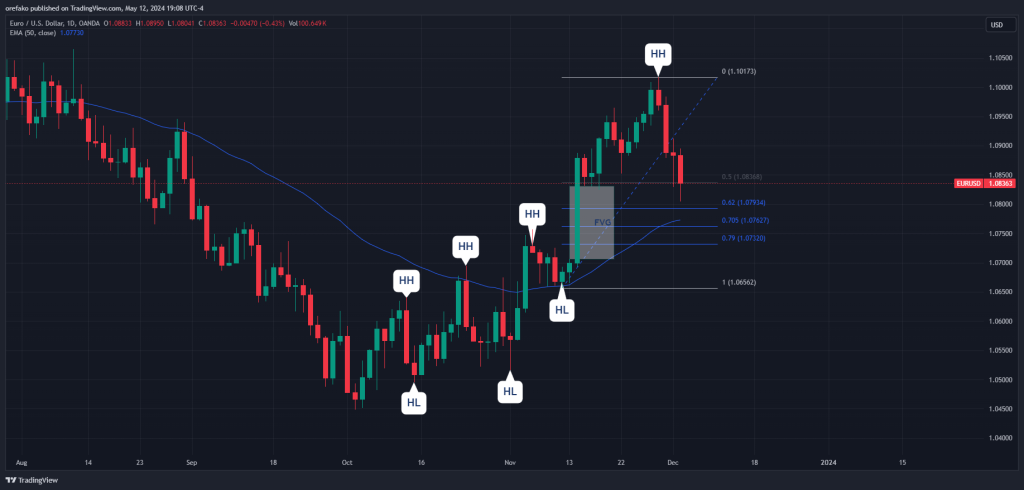
Now let's see it in motion.
ICT Optimal Trade Entry- OTE Primer Simplified
The video 'ICT Optimal Trade Entry- OTE Primer Simplified' by illyrian forex has a very quick and clear example of a bearish OTE setup.
Watch the clip from 02:03 to 02:28. The presenter quickly identifies a market structure break to the downside and shows how the OTE retracement aligns perfectly with a bearish FVG, providing the entry opportunity.
For a more in-depth look that involves multiple timeframes, we can return to the "High-Quality Fair Value Gap" video. This demonstrates a more advanced application, which is a great preview of how you will eventually integrate different analytical layers.
High-Quality Fair Value Gap Trading Strategy
Let's revisit the 'High-Quality Fair Value Gap Trading Strategy' video. This time, we'll see a complete trade walkthrough from higher timeframe analysis down to the entry.
Watch from 05:29 to 10:25 and then the final example from 12:13 to 13:15. Observe how the trader: Identifies a bearish trend and a premium FVG on a higher timeframe (1-hour). Waits for price to retrace into this zone. Drops to a lower timeframe (5-minute) to find a change of character and another FVG for a precise entry. This is the 'FVG within FVG' concept.
Test your understanding!
You are analyzing a bearish market. A recent impulsive move down started at a swing high of $210 and created a swing low at $190. During this move, a bearish FVG was formed between $204 and $206.
- What is the price range of the OTE (62%-79%) zone for this move?
- Does the identified FVG fall within the OTE zone?
- Based on this information, would you consider this a high-probability sell setup? Why?
Show answer
-
OTE Calculation:
- Range = $210 - $190 = $20.
- 62% retracement level = $190 + (0.62 * $20) = $190 + $12.40 = $202.40.
- 79% retracement level = $190 + (0.79 * $20) = $190 + $15.80 = $205.80.
- The OTE zone is between $202.40 and $205.80.
- Note: For a bearish OTE, we calculate the retracement up from the low.
-
Yes. The FVG spans from $204 to $206. The lower part of the FVG ($204 to $205.80) is perfectly contained within the OTE zone.
-
Yes, this is a high-probability sell setup. The FVG (an area of imbalance) is located within the premium OTE zone (a key algorithmic retracement level), creating a strong confluence for a short trade.
Conclusion
Congratulations! You have now learned how to construct high-probability entry models for both buying and selling using the Optimal Trade Entry concept. By waiting for the confluence of an FVG and the OTE in a premium zone, you can filter out lower-quality sell signals and focus on the most promising setups.
Key Takeaways:
- Sell at a Premium: High-probability sell setups occur above the 50% equilibrium level of a bearish dealing range.
- The Sell-Side Confluence: A bearish FVG that aligns with the 62%-79% OTE retracement zone creates a powerful, high-confidence entry signal.
- The Framework is Universal: The step-by-step process of confirming structure, identifying the point of interest (FVG or OB), and validating its location with the OTE tool is the same for both buy and sell models.
Preview for the Next Lesson:
Identifying a great setup is only half the battle. In our next and final lesson of this module, we will focus on execution. You will learn how to define precise entry, stop-loss, and take-profit levels for an OTE setup, turning your analysis into a complete and manageable trade plan.