Welcome to the second module of your ICT deep dive! In the previous module, we established a solid foundation in market structure and liquidity. We ended by discussing the "Draw on Liquidity" and how price moves between external liquidity (highs/lows) and internal liquidity (imbalances).
This lesson marks our first step into analyzing those internal imbalances. We'll focus on one of the most fundamental ICT concepts: the Order Block (OB). You'll learn what an order block is, why it forms, and how to precisely identify both bullish and bearish order blocks on your chart. Mastering this skill is the first step toward pinpointing institutional footprints and finding high-probability zones for your trades.
1. What is an Order Block? The Institutional Footprint
At its core, an ICT Order Block is a specific price zone that marks where institutions (the "smart money") have placed a significant volume of orders. It's the footprint they leave behind before engineering a powerful and decisive move in the market.
Unlike traditional support and resistance, which are based on historical price reactions, order blocks give you insight into the mechanics of institutional order flow. Because institutions can't place massive orders without moving the price against themselves, they accumulate or distribute their positions in these specific zones. When price returns to an order block, it's returning to an area of significant institutional interest, often resulting in a strong reaction.
For a clear introduction to the concept and the institutional logic behind it, please read the first section of the following article.
Master ICT Order Block Strategy for Prop Firm Success [2026]
The article 'Master ICT Order Block Strategy' from Phidias Prop Firm provides an excellent overview of what order blocks are and why they are more than just simple support and resistance.
Read the section titled 'What Are Order Blocks in ICT Trading?'. Focus on understanding the institutional logic and the key differences between order blocks and traditional technical analysis levels.
2. The Two Types: Bullish and Bearish Order Blocks
Order blocks are categorized based on the direction of the institutional move that follows them.
- A Bullish Order Block is the last down-close candle (or series of down-close candles) before a strong, impulsive move up. It represents a zone of institutional accumulation (buying).
- A Bearish Order Block is the last up-close candle (or series of up-close candles) before a strong, impulsive move down. It represents a zone of institutional distribution (selling).

For a concise, formal definition of each type, please review the following text.
What is ICT Order Block and How to Trade it
The article 'What is ICT Order Block and How to Trade it' on innercircletrader.net provides simple, direct definitions for both bullish and bearish order blocks.
Read the two short sections titled 'Bullish Order Block' and 'Bearish Order Block'. Pay attention to the simple rule: it's the last opposite candle before the impulse move.
3. The Four Rules for Identifying a Valid Order Block
Simply finding the last opposite candle isn't enough. A true, high-probability order block must meet specific criteria that validate it as a genuine institutional zone. Memorizing and applying these rules is crucial for accurate identification.
To learn these rules, let's watch a video that breaks them down systematically.
Order Block Simplified - Smart Money Course
The video 'Order Block Simplified' from the Smart Risk channel does an excellent job of defining the four key criteria for a valid order block.
Watch from 03:10 to 04:26. Focus intently on the four rules presented. I've summarized them for you below.
Here are the four essential criteria for a valid order block:
- Takes Liquidity: The candle(s) forming the order block should first take liquidity. For a bullish OB, the down-candle should trade below the low of the previous candle. For a bearish OB, the up-candle should trade above the high of the previous candle. This is often called a "liquidity sweep."
- Creates Imbalance: The strong move away from the order block must create an imbalance, also known as a Fair Value Gap (FVG). This is a three-candle pattern where there's a visible gap between the first candle's wick and the third candle's wick. This signifies an aggressive, one-sided move that left inefficiencies. We'll dedicate a full lesson to FVGs soon.
- Causes a Break of Structure (BOS): The move away from the order block must be powerful enough to break a prior swing high (for a bullish OB) or swing low (for a bearish OB). This confirms the move had institutional power behind it.
- Is Unmitigated: The order block must be "fresh." Price should not have traded back into the range of the order block after it was formed. Once price returns and "mitigates" the OB, it is considered used.
A note on nuance: While many traders focus on the single last candle, the creator of ICT, Michael Huddleston, often refers to an order block as the entire consecutive run of candles before the move. The most important validation factor, in his view, is the presence of the imbalance that follows. Without an imbalance, there is no valid order block.
Test your understanding!
Look at the chart below which shows a potential Bullish Order Block.
Based on the four criteria, is the marked candle a valid Bullish Order Block? Explain your reasoning for each criterion.
- Did it take liquidity?
- Did it create an imbalance?
- Did it cause a Break of Structure?
- Is it unmitigated?
Show answer
Yes, this is a valid Bullish Order Block.
- Takes Liquidity: Yes. The wick of the marked down-candle (the OB) traded below the low of the previous candle.
- Creates Imbalance: Yes. There is a clear gap (FVG) between the high of the candle before the OB and the low of the candle after the OB.
- Causes a Break of Structure (BOS): Yes. The strong move up clearly broke above the recent swing high.
- Is Unmitigated: Yes. At the time of its formation, price has not traded back down into it.
4. Practical Application: Finding Order Blocks on a Real Chart
Now let's apply this theory to a real chart. The process involves scanning the chart for a break of structure, then working backward to see if the origin of that move meets our four criteria.
The video we watched earlier provides an excellent walkthrough of this process on a EUR/USD chart. Watching someone apply the rules in a real market context will help solidify your understanding.
Order Block Simplified - Smart Money Course
Let's return to the 'Order Block Simplified' video to see the identification rules applied to a real chart.
Watch from 08:27 to 11:25. Pay attention to how the presenter finds a break of structure first, then examines the candle that started the move. Notice how he discards invalid or mitigated OBs and finds the correct one.
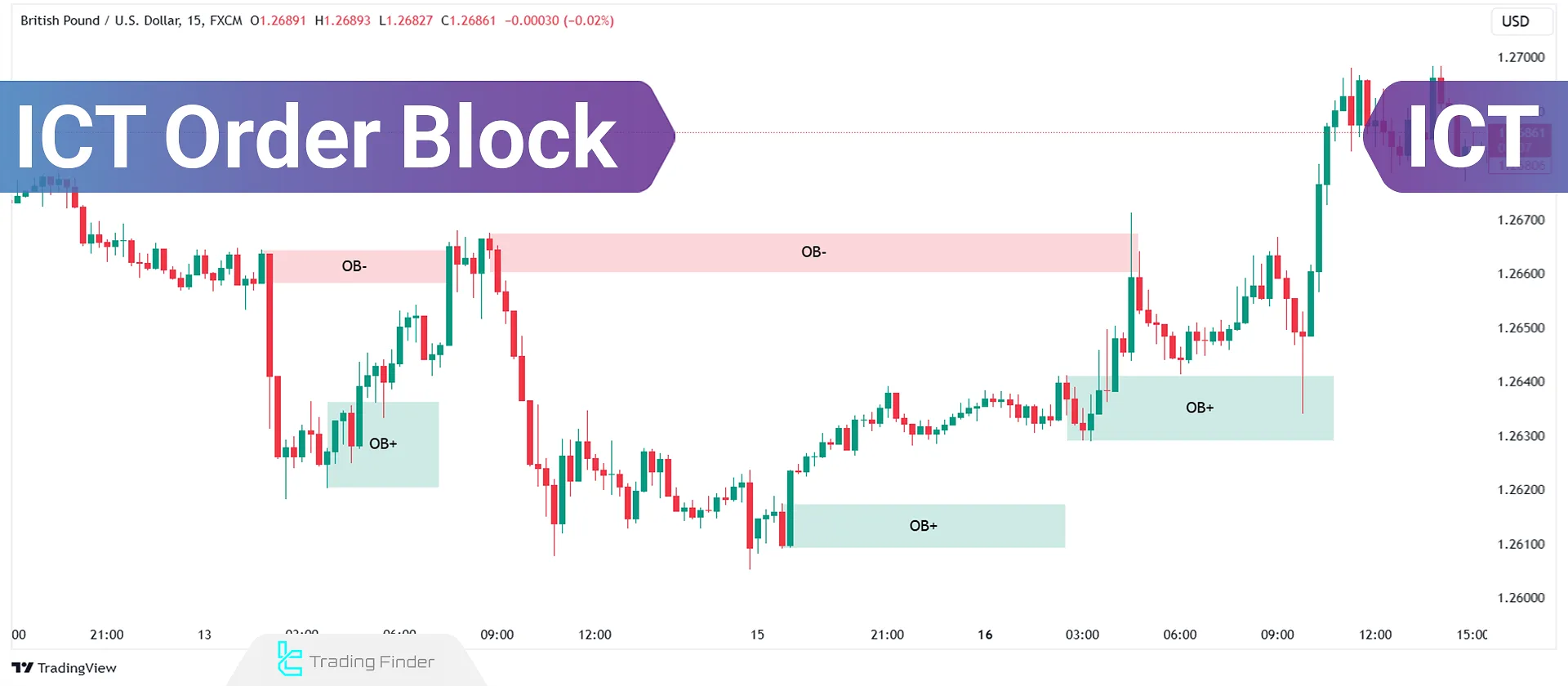
Let's analyze the first bearish order block (OB-) at the top left of the image above:
- BOS: First, we see a strong downward move that breaks a previous swing low.
- Identify OB: We look for the last up-candle before that move down.
- Validate:
- Takes Liquidity? Yes, its wick went above the high of the previous candle.
- Creates Imbalance? Yes, there is a clear imbalance (FVG) right after the OB.
- Unmitigated? Yes, at this point, it is fresh.
This confirms it as a valid, high-probability bearish order block.
From Identification to Automation
As you build your skill in identifying order blocks manually, keep your goal of automation in mind. The rules you've just learned are the direct foundation for an algorithm. In Python, you could program a function to:
- Iterate through candlestick data (
for candle in candles:). - Check for a liquidity sweep (
if up_candle.high > previous_candle.high:). - Check for an imbalance (
if candle_after.low > candle_before.high:). - Confirm a Break of Structure by comparing the move to stored swing points.
This logical, rules-based process is perfectly suited for translation into code, something we will build upon in later modules.
Conclusion
In this lesson, you've moved from the general concept of liquidity to the specific pattern of an Order Block. You now have a precise, rules-based framework for identifying the footprints of institutional traders.
Key Takeaways:
- An Order Block is the last opposite-colored candle (or series of candles) before a strong, impulsive move.
- A Bullish OB precedes an up-move (accumulation), and a Bearish OB precedes a down-move (distribution).
- A high-probability OB must satisfy four key conditions: it takes liquidity, creates an imbalance (FVG), causes a break of structure (BOS), and is unmitigated.
- This systematic identification process is the foundation for both discretionary trading and future automation.
Preview for the Next Lesson:
Now that you can identify an order block, the next question is: "Which ones are the best to trade?" Not all order blocks are created equal. In the next lesson, we will learn how to distinguish high-probability order blocks from low-probability ones by analyzing their context within the broader market structure and price range.