Hello! Welcome to the next lesson in your journey to mastering ICT.
In our last session, you did the critical work of selecting and documenting the specific ICT setups you will specialize in for your trading playbook. By defining precise rules for models like the Silver Bullet or strategies using Candle Range Theory, you've laid the foundation for systematic trading.
Now, we will directly address your dual goal of becoming both a proficient manual trader and a developer of trading bots. The learning outcome for this lesson is to outline the criteria for using automated scripts for signal generation versus analysis. We'll take the playbook entries you just created and determine which steps are best suited for automation, and in what capacity. This is where you begin to design the operational workflow for your personal trading business, deciding which tasks to delegate to a script and which to reserve for your own expert judgment.
1. The Spectrum of Automation: Finding Your Place
It's a common misconception that trading is a binary choice between being 100% manual or 100% automated. In reality, it's a spectrum. The late, great trading coach Van Tharp categorized traders into three main types, which provides a useful framework for our discussion.
To begin, let's explore these categories to understand where your "hybrid" goal fits.
Choosing Between Discretionary and Automated Trading ...
The article 'Choosing Between Discretionary and Automated Trading…' on TradeThatSwing introduces a powerful way to think about different trading styles. It will help you see that your goal is not unusual, but rather a sophisticated blend of approaches.
Please read the first three sections: 'Three Trader Types or Trading Systems': This introduces the core concept. 'Traders Type/System: Mechanical': Understand the mindset and challenges of a fully automated trader. 'Trader Type: Rule-Based Discretionary': Pay close attention to this section. This describes the professional standard of combining a fixed set of rules with expert judgment, which is the model we are building for you.
As the article explains, most professional traders operate as Rule-Based Discretionary traders. They don't trade on whims, but they also don't blindly follow a rigid algorithm. They use a solid framework of rules and then apply their experience and contextual understanding to navigate the market.
Your goal is to build a powerful version of this model. You will use Python scripts not to replace your thinking, but to augment it, making your rule-based discretionary trading more efficient, scalable, and robust.
2. The Two Roles of a Script: Analyst vs. Signal Generator
Within your hybrid system, a script can play one of two primary roles. The distinction is crucial for managing risk and leveraging your strengths as a trader.
- Analysis Agent: A script that acts as your tireless assistant. It scans markets, identifies patterns, performs calculations, and alerts you to potential opportunities that match your criteria. It does the "heavy lifting" of data processing, but you make the final trading decision.
- Signal Generation Agent: A more autonomous script. Based on a strict set of quantifiable rules, it not only identifies a setup but produces a definitive "buy" or "sell" signal. This can be one step away from full, automated execution.
The following resource provides a clear definition of how technology can be used for these purposes.
AI Stock Signal Agent: The Complete Guide to Intelligent ...
The 'AI Stock Signal Agent' guide from Jenova.ai, while focused on AI, provides excellent definitions and concepts that apply directly to the Python scripts you'll be building. It clearly articulates the difference between manual work and automated analysis.
Read the first two main sections: 'Quick Answer: What Is an AI Stock Signal Agent?': Note the key capabilities listed, such as real-time signal generation, pattern recognition, and automated scanning. These are the functions we want to build. 'The Problem: Why Manual Signal Generation Falls Short': This section clearly explains the cognitive and time limitations of manual analysis, justifying why we want to use scripts in the first place.
Now, let's establish the criteria for deciding which role a script should play for any given task in your playbook.
3. The Human-Computer Partnership: A Framework for Decisions
The most effective traders don't see automation as a replacement for human skill, but as a partnership. The key is to assign tasks based on what each partner does best.
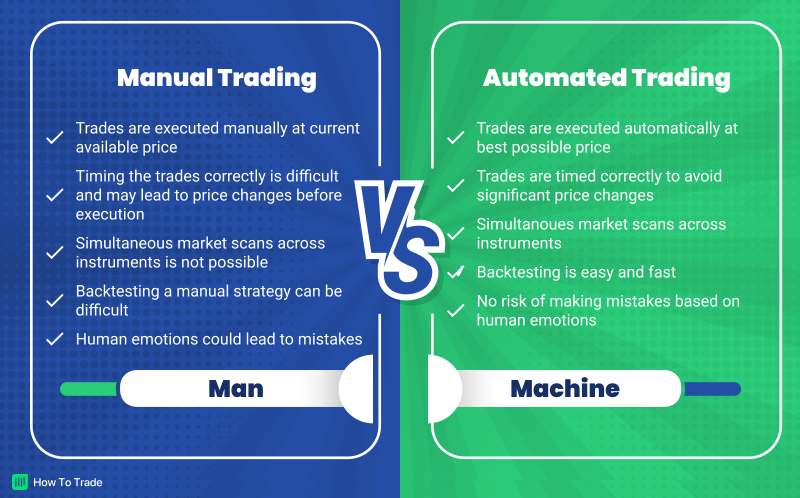
Let's watch a video that explores the nuances of this partnership, including the common pitfalls and realistic benefits.
Automated Trading Strategies vs Manual Strategies: Pros And Cons Of Automated Trading Systems 🔍
The video 'Automated Trading Strategies vs Manual Strategies' from UKspreadbetting offers a grounded, realistic look at the pros and cons. It debunks some common myths and introduces the idea of a hybrid approach.
Watch from 00:30 to 07:41. As you watch, focus on these key points: The Myth of Removing Emotion (00:30 - 04:02): Notice how automation shifts emotion from trade execution to system management (e.g., enduring drawdowns). The Hybrid Approach (04:02 - 04:09): This short but crucial clip validates our goal: using automation for alerts and analysis while retaining manual decision-making. The Benefits of Good Data (04:09 - 06:20): Automation forces you to define your rules precisely, which is invaluable for improving your strategy. The Risks (06:20 - 07:41): Pay attention to the discussion of 'gut feel' and the critical need for safety parameters.
Drawing from these insights, we can build a clear framework. A great reference for this is the "Human-AI Collaboration Model" described in the Jenova.ai article.
- Scripts Excel At: Volume processing, objective pattern recognition, multi-timeframe analysis, continuous monitoring, and speed.
- Humans Excel At: Strategic judgment, interpreting context (narrative), nuanced risk assessment, and final decision-making.
Let's apply this framework to your ICT playbook.
Criteria for an Analysis Script:
Delegate tasks to an analysis script when the task is:
- Repetitive and Tedious: e.g., scanning 20+ pairs for Fair Value Gaps.
- Data-Intensive: e.g., monitoring price action across multiple timeframes (1H, 15M, 1M) at once.
- Requires Constant Monitoring: e.g., watching for price to enter a specific Killzone window or tap into a HTF order block.
- Objective and Quantifiable: e.g., drawing the 50% equilibrium of a range or highlighting all candles that swept a previous high.
Example Application (Your Silver Bullet Playbook):
- [Analysis Script] Alert you when a Silver Bullet time window (e.g., 10:00-11:00 AM EST) begins.
- [Analysis Script] Automatically draw the high and low of the preceding liquidity range (e.g., Asian session).
- [Analysis Script] Alert you when a sweep of that high or low occurs.
- [Human Judgment] You then take over, watch the 1M chart for a convincing Market Structure Shift, assess the quality of the resulting FVG, and decide if the context is right to take the trade.
Criteria for a Signal Generation Script:
Only consider this for a task if the trading rule is:
- 100% Objective: All conditions can be written as unambiguous mathematical or logical statements (e.g.,
if price > X and volume > Y...). There is no room for "it looks about right." - Context-Independent: The rule is valid regardless of the market narrative, news events, or broader sentiment. Very few ICT concepts meet this criterion.
- Rigorously Proven: The strategy has been backtested extensively and demonstrates a clear statistical edge. (We will cover this in Module 11).
- Low-Risk: The potential damage from a bug or a "black swan" event is contained.
Example Application (Simple FVG Entry):
- [Signal Generation Script] If a bullish 15M BOS occurs, and a 15M FVG is created, and price retraces to the FVG... then generate a
BUYsignal. - [Human Judgment / Risk] But what if this happens 2 minutes before a major central bank announcement? A human would likely pass. The simple script would execute. This highlights the inherent risk of removing human oversight. Discretion allows you to adapt to changing conditions in a way a rigid script cannot.

4. Structuring Your Hybrid Workflow
Based on this framework, the most effective and safest path for you is to begin by building Analysis Agents. Your goal is to automate the detection of your playbook setups, not the execution.
Here is a practical table to guide you. For each core ICT concept, consider where it falls.
| ICT Concept/Task | Best for Analysis Script (Detection) | Requires Human Judgment (Decision) |
|---|---|---|
| Killzone Times | ✅ Constantly monitor and highlight active killzones. | Decide if a setup within the killzone is worth taking. |
| Fair Value Gap (FVG) | ✅ Scan and draw every FVG across all pairs and timeframes. | Assess the FVG's quality: was it made with displacement? Is it in a premium/discount zone? Is it likely to be respected or filled? |
| Break of Structure (BOS) | ✅ Detect when a swing high/low is broken. | Determine if the BOS is a true continuation or a potential liquidity grab (fakeout). |
| Optimal Trade Entry (OTE) | ✅ Draw the 62%-79% Fib retracement on a price leg. | Judge if the price leg chosen is significant. Decide if the confluence with a PD array (like an OB or FVG) is strong enough. |
| Candle Range Theory | ✅ Identify and highlight 3-candle CRT patterns on the 4H chart. | Formulate the directional bias and look for a valid LTF entry model that aligns with that bias. |
Test your understanding!
Review the "4H CRT Bias with 15M OTE Entry" playbook you created in the last lesson. Break down the 8 checklist steps into two columns: "Tasks for Analysis Script" and "Tasks Requiring Human Judgment." Justify one of your choices.
Show answer
Here is a possible breakdown:
| Tasks for Analysis Script (Detection) | Tasks Requiring Human Judgment (Decision) |
|---|---|
| 1. Detect if 4H candle swept previous 4H high/low. | 3. Does this occur at a key HTF level? (Requires subjective chart analysis). |
| 2. Check if the candle closed back inside the range. | 4. Is the 15M impulse "clear" and aligned with bias? (Requires interpretation). |
| 5. Check if price is in a Discount/Premium zone. | 7. Place the stop loss "logically". (The best placement is often discretionary). |
| 6. Detect if price is in the OTE zone (62-79%). | 8. Assess if the Risk/Reward is sufficient and if the target is realistic. |
Justification: Step 1, "Has the current (or most recent) 4H candle swept the high or low of the previous 4H candle?", is a perfect task for a script. It's a purely objective, mathematical comparison: is current_high > previous_high AND current_close < previous_high?. A script can check this across dozens of assets every 4 hours without fail, something a human cannot do.
Conclusion
In this lesson, we established a strategic framework for integrating automation into your trading. You are not building a "robot" to replace you; you are building a team of "analysts" to empower you.
Key Takeaways:
- Your goal is to become a Rule-Based Discretionary trader, using scripts to enhance your rule-based process.
- Scripts can act as Analysis Agents (detecting and alerting) or Signal Generation Agents (producing explicit buy/sell commands).
- The safest and most effective starting point is to build Analysis Agents to automate the repetitive, data-heavy parts of your playbook.
- The "Human-Computer Partnership" model delegates objective scanning to scripts while reserving contextual interpretation and final risk-taking decisions for you, the human trader.
Preview of the Next Lesson:
Now that you have a plan for what to trade (your playbook) and how you'll find those trades (your hybrid workflow), the next critical component is managing risk. Our next lesson, "Set a stop loss based on ICT invalidation levels," begins the module on Systematic Risk and Trade Management. We will define how to protect your capital with precision, a rule-set that will be a crucial input for both your manual trading and any future automated systems.