Hello! Welcome back to your deep dive into ICT trading.
In our last lesson, we focused on the Break of Structure (BOS), the key signal that confirms a trend is continuing. You learned that a BOS is the engine of a trend, propelling it to new highs or lows.
Today, we'll study the other side of the coin: the Change of Character (ChoCH). While a BOS signals continuation, a ChoCH is the first credible warning sign that a trend may be losing momentum and preparing to reverse. Mastering the ChoCH is essential for anticipating major turning points in the market and is a critical rule you'll need when you begin developing trading bots that can adapt to changing market conditions.
1. Defining the Change of Character (ChoCH)
A Change of Character is the first break of structure against the prevailing trend. It's the market's way of "changing its character" from bullish to bearish, or vice versa.
- Bearish ChoCH: In an uptrend, which is defined by a series of Higher Highs (HH) and Higher Lows (HL), a bearish ChoCH occurs when price breaks and closes below the most recent Higher Low.
- Bullish ChoCH: In a downtrend, defined by Lower Lows (LL) and Lower Highs (LH), a bullish ChoCH occurs when price breaks and closes above the most recent Lower High.
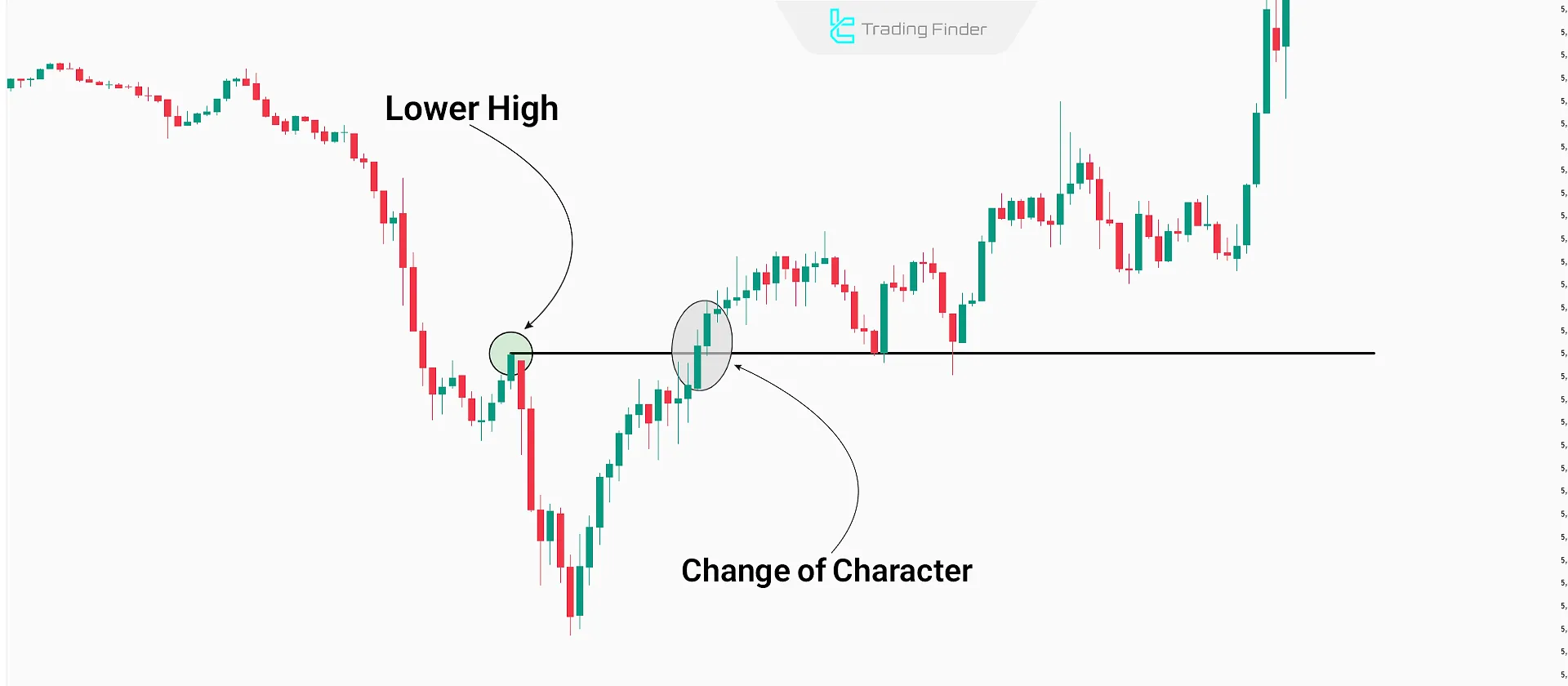
To get a solid grasp of these definitions, please read the following sections from an introductory guide.
The article 'What Is CHoCH in Trading?' by Photon Trading provides clear, foundational definitions and examples for both types of ChoCH.
Please read the sections 'What is CHoCH in Trading?' and 'Types of CHoCH'. Focus on how a ChoCH is defined as a deviation from the established pattern of highs and lows.
2. The Golden Rule for a Valid ChoCH
Now for the most important rule. On any chart, you'll see many small pullbacks that break minor structural points. Most of these are just noise, or "internal structure" breaks. A valid, meaningful ChoCH must break a specific, significant swing point.
The Rule: A valid ChoCH must break the swing point that was responsible for creating the last Break of Structure (BOS).
- In a downtrend, the last BOS was the move that created the final Lower Low. The swing point you must watch is the Lower High that initiated that move.
- In an uptrend, the last BOS was the move that created the final Higher High. The swing point you must watch is the Higher Low that initiated that move.
This distinction between breaking an internal swing point and the external swing point that created the last BOS is what separates a false signal from a real potential reversal.
The following resource explains this rule clearly and concisely.
SMC Market Structure: BoS And CHoCH Made Simple
The article 'SMC Market Structure: BoS And CHoCH Made Simple' from Daily Price Action gives a fantastic, non-negotiable rule for identifying a real ChoCH.
Read the section titled 'How to Confirm a Real CHoCH (Not a Fake One)'. Pay close attention to the statement: 'A valid CHoCH must break the swing that produced the last BoS.' This is a core principle.
Test your understanding!
Imagine an asset is in a strong uptrend. Price makes a Higher High at $105, pulling back from a Higher Low at $100. Then, price rallies again, creating a new Higher High at $110 (this is a bullish BOS). After hitting $110, price starts to fall. It breaks below a minor swing low at $107 but continues down and closes below the $100 level.
According to the golden rule, at what price level did the valid bearish Change of Character occur?
Show answer
The valid bearish ChoCH occurred when price broke below $100. The swing low at $107 was internal structure. The swing low at $100 was the external Higher Low responsible for creating the last Break of Structure (the move to $110). Breaking this level is what signals a meaningful shift in market structure.
3. High-Probability ChoCH: Adding Confluences
A valid ChoCH is your entry ticket, but you want to bet on a horse that's likely to win. High-probability setups occur when a valid ChoCH is supported by other contextual clues, or "confluences." The best ChoCH patterns don't happen in a vacuum.
Let's watch a video that introduces some of these key confluences. Note that the narrator uses the term "Market Structure Shift" (MSS), which for our purposes is the same as a Change of Character (ChoCH).
Market Structure Shift - ICT Concepts
This video, 'Market Structure Shift - ICT Concepts' from TTrades, does an excellent job explaining the characteristics of a powerful and reliable market reversal.
Watch from the beginning to 02:50. Pay close attention to two key ideas he introduces: Displacement: The break of structure should be an 'aggressive move with full-bodied candles,' often creating a Fair Value Gap (which we will cover in a later module). Higher Timeframe Context: The most powerful shifts happen after price has engaged a significant higher timeframe level.
Building on that, let's explore a more systematic checklist for a high-probability ChoCH. Another excellent video breaks this down into clear criteria.
Change of Character Simplified - Smart Money Course
The video 'Change of Character Simplified' by Smart Risk provides a rule-based framework for identifying high-quality setups, which is perfect for your goal of developing automated strategies.
First, watch from 01:03 to 01:26 for a clear definition. Then, watch the crucial section from 05:22 to 08:14, which explains the importance of 'Higher time frame mitigation.' This reinforces the idea that a ChoCH is most reliable when it's a reaction to a major price level.
So, let's summarize the checklist for a high-probability ChoCH:
- Valid Structure: The ChoCH must be valid according to the "golden rule" (breaking the swing that created the last BOS).
- Higher Timeframe (HTF) Context: The reversal should initiate from a significant HTF level of support or resistance (e.g., a daily order block or a 4H fair value gap). This tells you the reversal has a reason to happen.
- Liquidity Sweep: Often, just before the reversal, price will make a final push to spike just above the prior high (or below the prior low) to grab liquidity. This "stop hunt" often fuels the reversal move.
- Displacement: The break that creates the ChoCH should be strong and energetic, leaving little doubt about the shift in momentum. Look for large, decisive candles.
Conclusion
You've now learned to spot the earliest sign that a trend's dominance is fading. The Change of Character is a pivotal concept that, when combined with the right context, allows you to anticipate reversals rather than just reacting to them.
Key Takeaways:
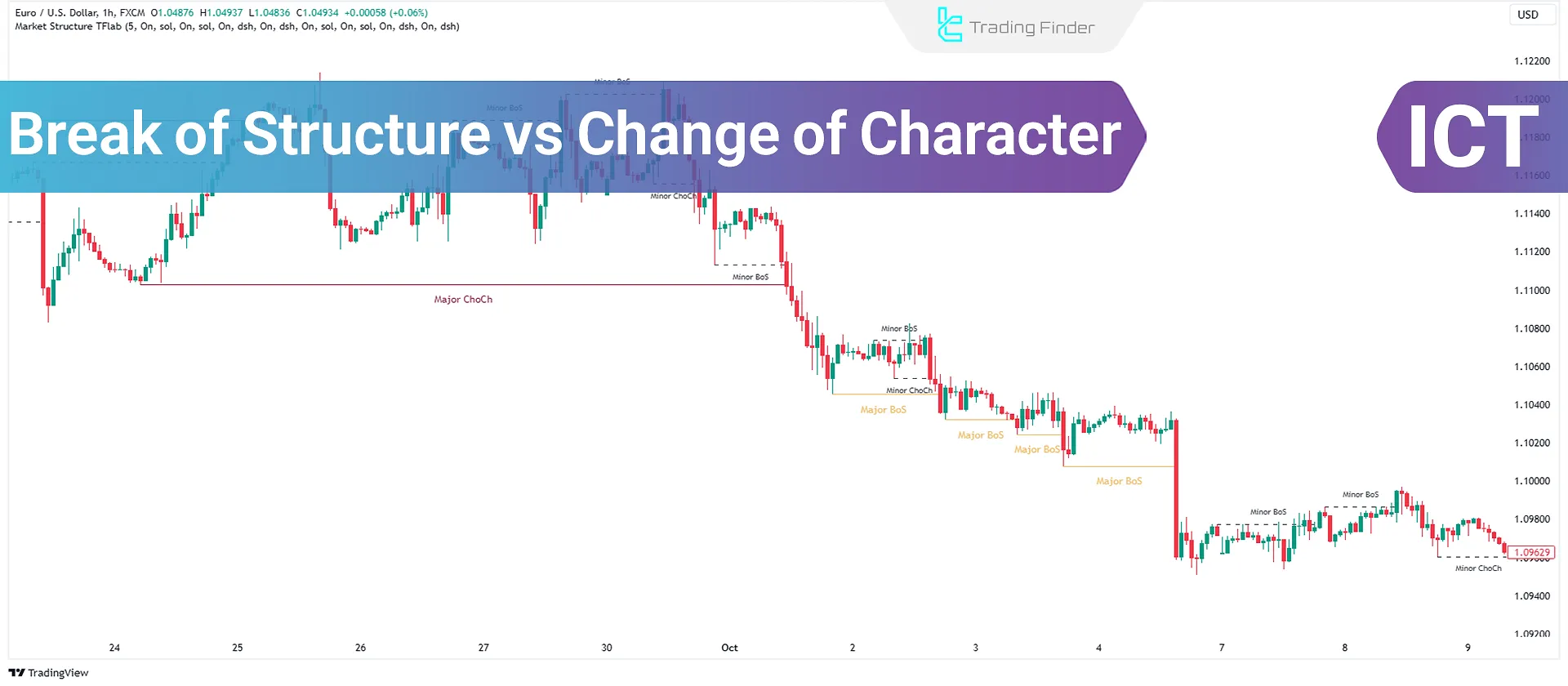
- A Change of Character (ChoCH) is the first break of structure against the prevailing trend, signaling a potential reversal.
- A valid ChoCH must break the external swing point that created the last Break of Structure (BOS).
- A high-probability ChoCH is confirmed by confluences: it occurs after engaging a higher-timeframe level, is often preceded by a liquidity sweep, and happens with forceful displacement.
- BOS signals trend continuation; ChoCH signals potential trend reversal.
Preview for the Next Lesson:
We have now established the two most important structural events: the BOS and the ChoCH. However, a ChoCH on a 5-minute chart might just be a minor pullback on a 4-hour chart. To truly understand the market's intention, you need to see how these patterns fit together across different magnifications. In the next lesson, we will learn how to map market structure across multiple timeframes to establish a robust directional bias.