Hello! Welcome to our next lesson.
In our previous session, we established a powerful framework for anticipating market direction. You learned how to determine a daily bias by analyzing weekly and daily charts, and how to use the Power of 3 (AMD) model to understand the typical template of a daily candle. This answers the crucial questions of which direction price is likely to go and what pattern it might follow.
Today, we add the final piece to this foundational puzzle: time. This lesson focuses on identifying the specific windows during the day when high-probability trade setups are most likely to occur. Our learning outcome is to identify the ICT Killzones (Asian, London, and New York) on a chart. By mastering this, you'll know exactly when to focus your attention on the market, filtering out noise and concentrating on the periods of highest institutional activity.
1. What are ICT Killzones?
The forex and futures markets are open 24 hours a day, but not all hours are created equal. An ICT Killzone is a specific, predetermined window of time where volatility and trading volume are expected to be significantly higher. These are the periods when institutional order flow is most active, often creating the key manipulative moves and directional expansions we look for.
Think of them as appointment times for trading. Instead of watching the charts all day, you can focus your analysis and execution within these windows, which is a more efficient use of your time and mental capital.
A crucial point before we proceed: All ICT Killzone times are based on New York local time (EST/EDT). To avoid confusion, you should set your chart's time zone in TradingView to (UTC-4) New York. This setting automatically handles Daylight Saving Time (DST), ensuring your timings are always correct.
2. The Killzones: Timings and Personalities
There are three primary Killzones, each with a distinct character that often relates to the Power of 3 (AMD) cycle. Let's watch a short video for a quick overview of their characteristics.
Master ICT Killzones in 6 MINUTES! (EASY)
The video 'Master ICT Killzones in 6 MINUTES!' by CallistoFX provides a concise explanation of what to expect during each Killzone.
Please watch the segment from 02:01 to 02:54. Pay close attention to the description of what typically happens during the Asian, London, and New York sessions.
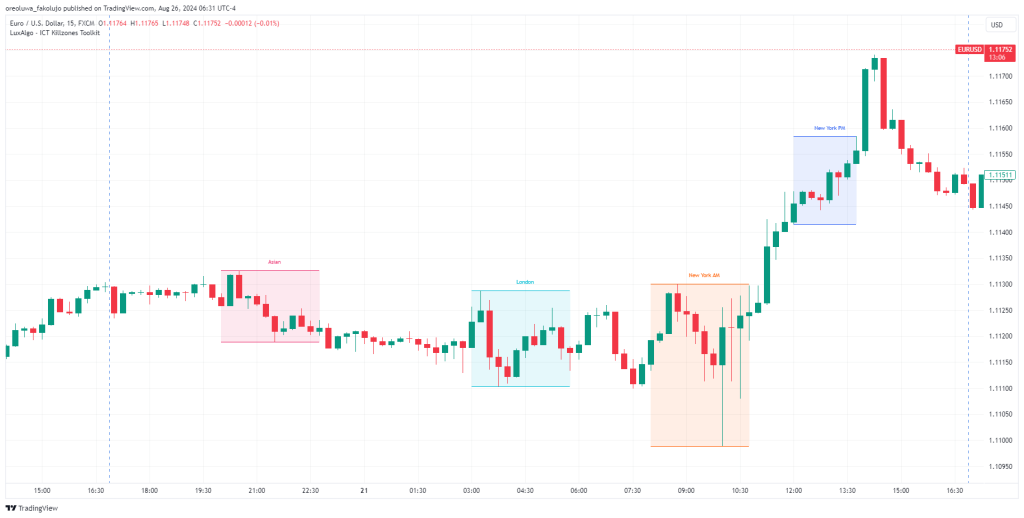
As the video explained, each session has a role:
- Asia: Typically a period of consolidation, creating clear buy-side and sell-side liquidity pools (the highs and lows of the range).
- London: Often a period of manipulation, where price may sweep the Asian range highs or lows (a "stop hunt") before initiating the day's primary directional move. This is where the "Judas Swing" often occurs, which we will cover later.
- New York: Tends to be a continuation of the move started in London. It often begins with a retracement back into the London range, offering an opportunity to join the established trend.
Here are the most commonly used Killzone times (all in NY local time). Note the slight difference in the New York morning session for Forex vs. Indices, which you trade.
| Killzone | Instrument | Time (New York Local) | Typical Characteristic |
|---|---|---|---|
| Asian Session | All | 20:00 - 00:00 (8 PM - 12 AM) | Consolidation / Accumulation |
| London Killzone | All | 02:00 - 05:00 (2 AM - 5 AM) | Manipulation / Reversal |
| New York AM Killzone | Forex | 07:00 - 10:00 (7 AM - 10 AM) | Distribution / Expansion |
| Indices | 08:30 - 11:00 (8:30 AM - 11 AM) | Distribution / Expansion | |
| New York PM Killzone | Indices | 13:30 - 16:00 (1:30 PM - 4 PM) | Late-day trend or reversal |
| London Close Killzone | Forex | 10:00 - 12:00 (10 AM - 12 PM) | Profit-taking / Reversal |
Test your understanding!
You are trading the E-mini S&P 500 futures (ES). Your daily bias is bullish. The Asian session has created a tight consolidation range between 4500 and 4505. During the London Killzone, price drops sharply to 4498, sweeping the Asian session low, and then quickly reverses to trade back at 4503.
What is this price action likely indicating, and what might you anticipate for the New York AM Killzone?
Show answer
This price action is a classic example of a manipulation or "stop hunt." The drop below the Asian low (4500) was likely designed to trigger sell-stop orders and trick traders into shorting. The quick reversal back into the range is a strong sign that the manipulation is complete.
Given your bullish daily bias, you should anticipate that the low of the day has likely been formed during the London Killzone. For the New York AM Killzone (starting at 8:30 AM NY time), you would look for a bullish continuation or expansion. You might expect price to retrace slightly during the NY open before moving higher, targeting buy-side liquidity above the Asian session high (4505) and beyond.
3. How to Identify Killzones on Your Chart
Now for the practical application. You can identify Killzones manually, or you can use an indicator. Since your long-term goal involves automation, getting comfortable with indicators is a great first step.
The following video will guide you through both methods on TradingView.
ICT Killzones & Indicator Settings
The video 'ICT Killzones & Indicator Settings' from TTrades offers a fantastic, practical walkthrough. We'll watch it in two parts.
First, watch the section on manual mark-ups (02:23 - 04:55). Observe how to use vertical lines or boxes to define the session times on your chart. This helps internalize the timings. Next, watch the section on using an indicator (04:55 - 08:52). Pay close attention to how to find a good indicator, and more importantly, how to configure its settings (like time zones, colors, and the specific session times for indices).
Key Steps from the Video:
- Set Your Time Zone: Before doing anything else, ensure your chart's time zone is set to
(UTC-4) New York. - Manual Marking: Use the drawing tools to place boxes or vertical lines at the start and end times of each Killzone. This is a great exercise to do a few times to solidify your understanding.
- Indicator Setup:
- Go to
Indicatorson TradingView and search for "ICT Killzones." Many community-made scripts are available. The one shown in the video ("ICT Killzone and pivots" by TFO) is a popular choice. - Open the indicator's settings. This is the most important step.
- Verify the Times: Adjust the start and end times for each session to match the standard ICT model, ensuring you use the Indices times for the NY AM session (08:30 - 11:00).
- Customize Display: Turn off unnecessary labels or sessions (like the "NY Lunch") to keep your chart clean and readable.
- Go to
Using an indicator automates the process, saving you time and ensuring accuracy day after day. This is a foundational step toward programmatic analysis, where a script will eventually perform these checks for you.
Conclusion
You have now integrated the critical element of time into your trading framework. By pinpointing the specific Killzones, you can align your activity with periods of institutional order flow, dramatically increasing the efficiency of your trading.
Key Takeaways:
- Killzones are Time Filters: They tell you when to look for a trade, not what trade to take.
- New York Time is Law: Always set your charts to New York local time (
UTC-4) to ensure your Killzones are accurate. - Each Killzone has a Personality: Asia consolidates, London manipulates, and New York distributes. This pattern provides a narrative for the trading day.
- Indicators are Your Friend: Use a customizable indicator to automatically display Killzones, which keeps your charts clean and your analysis consistent. This is your first step towards automating parts of your trading process.
Preview for the Next Lesson:
Now that you know your bias (direction), the daily template (AMD), and the high-volatility windows (Killzones), a new question arises: Should I focus on the London session or the New York session? In our next lesson, "Anticipate the high-probability session for a setup based on the daily bias," we will explore how to determine which Killzone is most likely to offer the day's main expansion move, further refining your timing and focus.