Hello! Welcome to our lesson today.
In our previous session, we examined Article 147, the special property regime for cohabiting partners who are capacitated to marry. We saw how the law generously presumes joint acquisition of property and values household management as a valid contribution.
Today, we turn to the other side of the coin. Our goal is to explain the property regime for cohabiting partners where one or both are incapacitated to marry, as governed by Article 148 of the Family Code. This regime applies to unions the law views with less favor, such as bigamous or adulterous relationships. As you will see, its rules are far more stringent and the protections are significantly limited compared to Article 147.
1. The Scope of Article 148: Unions with Legal Impediments
First, we need to be precise about when Article 148 applies. Its scope is defined by the parties' incapacity to marry each other.
To understand which relationships fall under this article, please read the following brief Q&A sections from the Salenga Law Firm.
Property Regime of Union Without Marriage - Salenga Law Firm
This article clearly lists the types of cohabitation that are governed by Article 148. It is a useful starting point for defining the scope of the law.
Please read the sections with the questions: 'What are the cases of cohabitation contemplated in Article 148 of the Family Code?' and 'What is the distinction between Articles 147 and 148 as to applicability?'. This will clarify exactly which unions are covered.
From that reading, we can summarize that Article 148 governs cohabitation between a man and a woman when there is a legal impediment to their marriage. This includes:
- Bigamous or polygamous marriages, where one party is still validly married to another.
- Incestuous relationships (void marriages under Article 37).
- Relationships void by reason of public policy (under Article 38), such as those between collateral blood relatives up to the fourth civil degree.
- Adulterous relationships, where two people cohabit while one or both are married to other individuals.
Essentially, if the couple could not have legally married at the time they were cohabiting, Article 148 is the applicable property regime.

2. The Core Rules of Ownership: A Stricter Standard
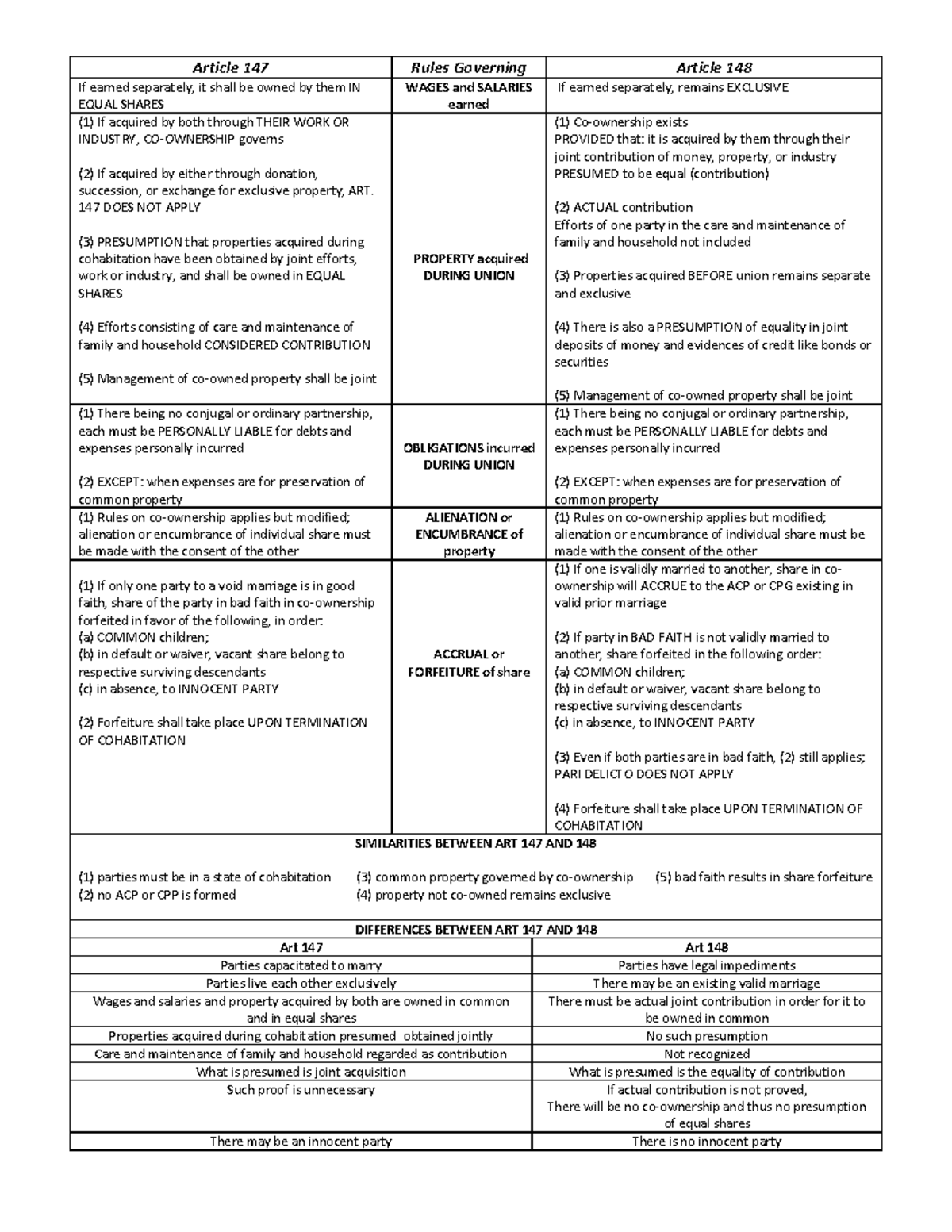
The property rules under Article 148 are fundamentally different from and much stricter than those under Article 147. The law does not presume a partnership; it demands proof.
For a deeper look, let's turn to an academic paper from the U.P. College of Law that discusses these rules in the context of case law.
[PDF] fundamental conflict of laws
This academic text examines the differences between Articles 147 and 148, highlighting the stringent requirements of the latter. It uses the case of Nicdao Cariño v. Yee Cariño to illustrate the contrast.
Please read the section discussing Article 148, starting from the text: 'As to the second marriage that was bigamous...'. Focus on how property is acquired, how contributions are treated, and the exclusion of household care.
Based on that text and the provisions of Article 148, let's break down the key rules:
- Requirement of Actual Joint Contribution: Co-ownership is not presumed. A property is only considered co-owned if it was acquired through the actual joint contribution of money, property, or industry by both parties. There must be concrete proof of this contribution.
- Separate Ownership of Wages and Salaries: Unlike Article 147, the parties' wages and salaries are owned exclusively by the person who earned them. They do not form part of a common fund.
- Proportional Shares: The parties' shares in the co-owned property are in proportion to their respective contributions. The presumption of equal sharing only applies if joint contribution is proven, but the exact proportion cannot be determined.
- Household Care is NOT a Contribution: This is a critical distinction. Efforts consisting of the care and maintenance of the family or household are not considered contributions for the purpose of acquiring a share in the property.
3. Forfeiture and Accrual of Shares
Article 148 also has specific rules that come into play when the cohabitation ends, particularly concerning parties in bad faith or those who have an existing marriage.
The following resource provides a clear breakdown of these rules.
Property Regime of Union Without Marriage - Salenga Law Firm
This section of the Salenga Law Firm article explains what happens to the shares of the co-owned property, especially when one partner is already married or has acted in bad faith.
Please read the section under the question 'What is the distinction between Articles 147 and 148 as to forfeiture?'. Focus on the three scenarios presented for Article 148.
To summarize the rules on forfeiture and accrual:
- If one party is validly married to another: Their share in the co-ownership under Article 148 accrues to the absolute community or conjugal partnership of that valid marriage. The law ensures that the property acquired during an illicit union benefits the legitimate family.
- If a party in bad faith is not married to another: Their share is forfeited in favor of their common children, their descendants, or the innocent party, following the same hierarchy as in Article 147.
- These forfeiture rules apply even if both parties are in bad faith.
4. Applying the Law: A Hypothetical Scenario
Let's test your understanding with a scenario. This may seem familiar, but a key fact has changed.
Scenario: Mario, who is still legally married to his first wife, Maria, separates from her de facto. He then begins cohabiting with Gina, who is single. For 15 years, they live together as husband and wife. Mario works as a doctor, and Gina, a licensed nurse, becomes a full-time homemaker, managing their household. During their cohabitation, Mario buys a condominium unit in Makati using his professional salary, registered solely in his name. The relationship with Gina ends, and she claims a half-share in the condo.
What law applies? Is Gina's claim correct under that law?
Click for Analysis
-
Applicable Law: Article 148 of the Family Code applies. Mario is legally incapacitated to marry Gina because of his subsisting marriage to Maria. This makes their union bigamous for the purpose of property relations.
-
Is Gina's claim correct? No, Gina's claim for a half-share is incorrect.
-
Analysis:
- Source of Funds: The condo was purchased using Mario's salary. Under Article 148, wages and salaries are the exclusive property of the earner.
- Gina's Contribution: Gina's contribution was her 15 years of effort in the care and maintenance of their household. While immensely valuable in a social sense, the law under Article 148 does not recognize this as a contribution for acquiring property. She made no actual joint contribution of money, property, or industry to the purchase of the condo.
- Ownership of the Condo: Since the condo was acquired solely with Mario's funds, there is no co-ownership under Article 148. The property belongs to Mario.
- Accrual to the Legitimate Marriage: Furthermore, since Mario is validly married to Maria, any share he acquires in a co-ownership (and arguably, property acquired solely by him during this time) would be considered part of his absolute community or conjugal partnership with his legitimate wife, Maria. Gina has no claim to it.
This scenario starkly illustrates the strictness of Article 148 and how it operates to protect the property of the legal family.
Conclusion
In this lesson, we have dissected the stringent property regime under Article 148 of the Family Code, which governs cohabiting partners with a legal impediment to marry.
Key Takeaways:
- Scope: Article 148 applies to bigamous, incestuous, and other void unions where the parties are legally incapacitated to marry each other.
- Proof is Required: There is no presumption of co-ownership. Property is shared only if acquired through proven actual joint contributions of money, property, or industry.
- No Value for Household Care: Unlike Article 147, care for the family and household is not legally recognized as a contribution to the acquisition of property.
- Protection of the Legal Family: The rules on the accrual of shares and separate ownership of wages are designed to protect the property of the pre-existing legitimate marriage.
In our next lesson, we will consolidate what we've learned by directly distinguishing the property rules for Article 147 and Article 148 unions. We will use a series of comparative examples to ensure you can confidently identify which rule applies and predict the outcome in different factual situations.