Hello! Let's begin today's lesson.
In our last session, we analyzed the judicial separation of property, a court process that allows married couples to dissolve their property regime (like ACP or CPG) and shift to a complete separation of property during the marriage. This is a remedy for spouses within a valid marriage.
Today, we shift our focus from property relations within marriage to those that govern unions without marriage. Specifically, our goal is to explain the property regime for cohabiting partners who are capacitated to marry each other, as governed by Article 147 of the Family Code. This special regime applies when a man and a woman live together as a couple but choose not to marry, or if their marriage is void for reasons other than a legal impediment.
1. Understanding the Scope of Article 147
Before diving into the rules, it's crucial to understand when Article 147 applies. The law sets out specific conditions for this regime to operate.
A helpful overview is provided in the article "Property Regime of Unions Without Marriage" from Respicio & Co.
Property Regime of Unions Without Marriage
This article clearly defines the scope of Article 147. It explains who is covered and how this regime is distinct from the one that applies to partners with legal impediments to marry.
Please read the sections titled '1. Definition and Applicability' and '2. Article 147: Property Relations When There is No Legal Impediment to Marry'. Focus on the requirements for the couple and the relationship.
Based on that reading and the text of Article 147 itself, the requirements are:
- The Parties: A man and a woman.
- Capacity: They must be capacitated to marry each other, meaning there are no legal impediments (e.g., they are both single, of legal age, and not closely related).
- The Union: They live together exclusively as husband and wife.
- The Circumstance: They do so either without the benefit of marriage or under a void marriage (for example, a marriage celebrated without a license, as we will see in a case later).
This regime is fundamentally about fairness, providing a default set of property rules for couples who function as a family unit but lack a formal marriage contract.
2. The Core Rules of Property Ownership under Article 147
Now, let's break down how property is owned and shared under this special co-ownership. The rules are designed to recognize both monetary and non-monetary contributions to the partnership.
A fantastic, clear explanation of these rules is provided in the following video.
RIGHTS OF A LIVE-IN PARTNER (Art. 147 Family Code of the Philippines)
This video from 'Attorney Promdi' walks through the key provisions of Article 147, explaining the rules on wages, property acquisition, and the important role of non-financial contributions.
Please watch from 00:49 to 06:58. As you watch, pay close attention to: How wages and salaries are treated (00:49 - 02:24). The presumption of joint effort for properties acquired during the cohabitation (02:08 - 04:28). How the law values the contribution of a partner who manages the household (04:28 - 06:58).
Let's summarize the three fundamental rules you just learned about:
- Wages and Salaries: The wages and salaries of both partners are owned by them in equal shares. This is a significant provision. It means that even if one partner earns nothing or significantly less than the other, they are entitled to half of the total income earned by both during the cohabitation.
- Presumption of Joint Acquisition: Any property acquired by either or both partners during their cohabitation is presumed to have been obtained through their joint efforts, work, or industry. Consequently, it is owned by them in equal shares. The burden of proof lies with the party who claims otherwise.
- Contribution through Care and Maintenance: A partner who did not directly or financially participate in acquiring a property is still considered to have contributed jointly if their efforts consisted of the care and maintenance of the family and household. This recognizes that managing a home and family is a valuable contribution to the partnership's ability to acquire assets.
3. Application in Jurisprudence: Nicdao Cariño v. Yee Cariño
Case law provides essential context for how these rules are applied. The case of Nicdao Cariño v. Yee Cariño is a classic example of Article 147 being applied to a marriage that was declared void due to the absence of a marriage license. Since both parties were capacitated to marry, Article 147 governed their property relations.
[PDF] fundamental conflict of laws
This excerpt from a U.P. College of Law publication discusses the Cariño case, illustrating how the court applied Article 147 to divide property in a void marriage.
Please read the paragraph that begins with 'In that case the Court held that since the marriage of Carino to Susan Nicdao was void for lack of a marriage license...'. Focus on how the court treated the deceased husband's 'death benefits' (equivalent to wages/salary).
In the Cariño case, the Supreme Court ruled that even though the death benefits were earned solely by the deceased husband, Article 147 created a co-ownership over them. This entitled his partner in the void marriage, Susan Nicdao, to a one-half share. This is a direct application of the rule that wages and salaries are owned in equal shares.
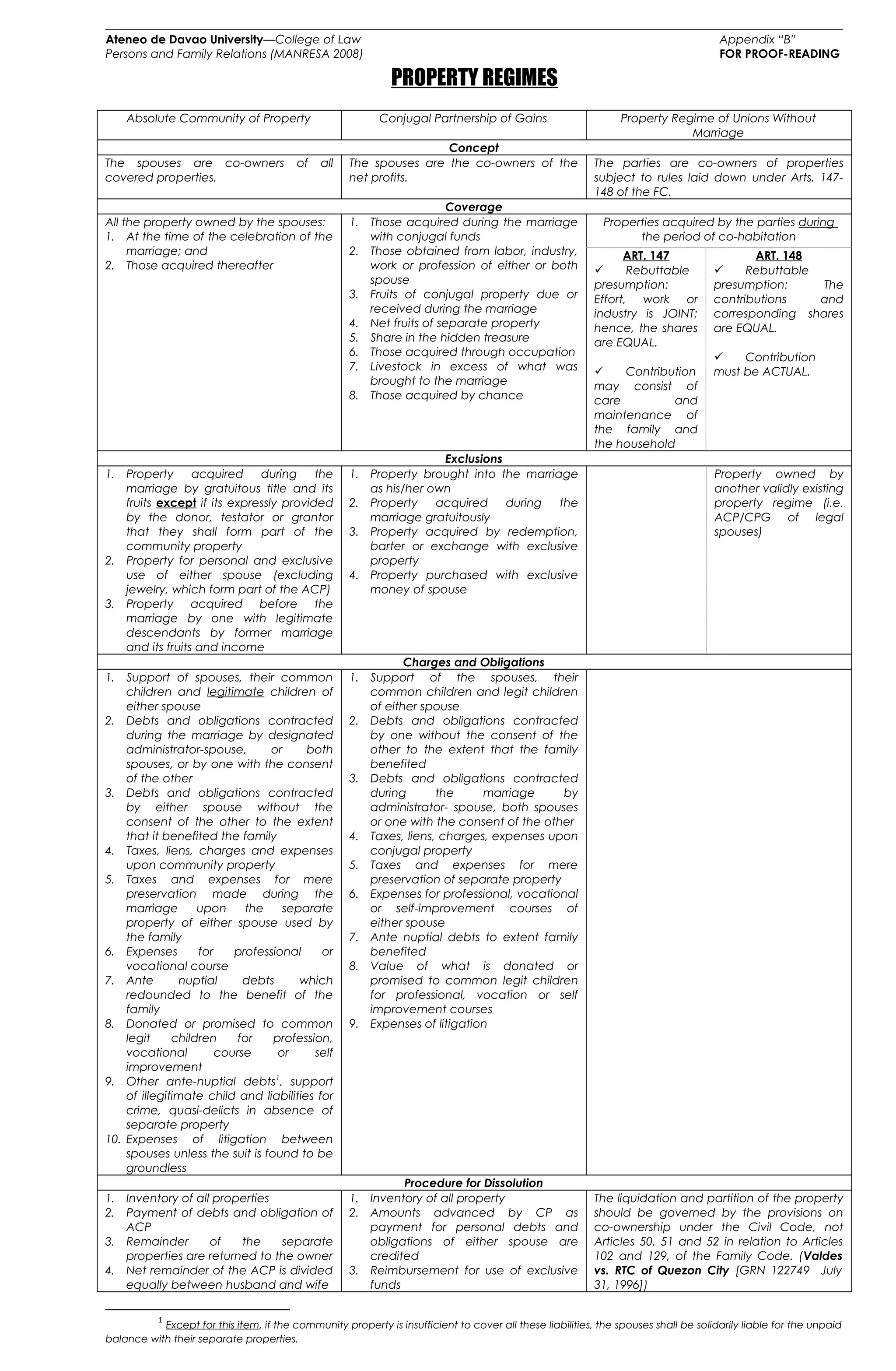
4. Visual Summary
To help situate Article 147 within the broader landscape of property regimes, the following table provides a useful comparison.
5. Let's Apply the Law
Given your background, let's analyze a hypothetical scenario to test your understanding.
Scenario: For 15 years, Mario and Gina, both single, lived together as husband and wife. Mario worked as a doctor, earning a substantial income. Gina, a licensed nurse, chose to be a full-time homemaker, managing their household and raising their two children. During the cohabitation, Mario purchased a condominium unit in Makati and a car, both registered exclusively in his name and paid for from his professional fees. The relationship ends, and Mario claims both properties are his alone because he paid for them.
Is Mario's claim correct? What are Gina's rights, if any, to the condominium and the car under Article 147?
Click for Analysis
-
Is Mario's claim correct? No, Mario's claim is incorrect.
-
Analysis:
- Applicable Law: The relationship between Mario and Gina falls squarely under Article 147. They are capacitated to marry and lived exclusively as a couple.
- Presumption of Joint Acquisition: The condominium and the car were acquired during their cohabitation. Therefore, they are presumed to have been obtained by their joint efforts and are owned by them in equal shares. The fact that the properties are registered only in Mario's name does not defeat this presumption.
- Gina's Contribution: Even though Gina did not contribute financially to the purchase, her 15 years of effort in the "care and maintenance of the family and of the household" are explicitly recognized by law as a joint contribution to the acquisition of those properties.
- Conclusion: Gina is legally entitled to a one-half (1/2) share in both the condominium unit and the car. Mario cannot claim exclusive ownership.
Conclusion
Today, we explored the special property regime under Article 147 of the Family Code, which governs cohabiting partners who are free to marry.
Key Takeaways:
- Scope: Article 147 applies to capacitated couples living exclusively as husband and wife without a valid marriage.
- Equal Sharing of Income: Wages and salaries are owned in equal shares, regardless of who earned them.
- Co-ownership of Assets: Property acquired during the union is presumed to be co-owned in equal shares, arising from joint effort.
- Recognition of Non-Monetary Contribution: Effort dedicated to the care and maintenance of the family and household is legally considered a joint contribution to the acquisition of property.
In our next lesson, we will examine the contrasting rules under Article 148. This article governs the property relations of cohabiting partners when one or both have a legal impediment to marry, such as a subsisting marriage. As you will see, the rules are much stricter, and the presumptions we discussed today do not apply.