Hello! Welcome back.
In our last lesson, we established a framework for evaluating static ads based on visual hierarchy and persuasion principles. You now know how to deconstruct an image to see if it's designed to stop the scroll and guide the eye effectively.
Now, we're adding the powerful dimensions of time and motion. This lesson moves from static images to video, where the challenge of capturing and holding attention becomes even more critical. We will explore the core principles that separate high-performing video ads from those that get instantly skipped. For your goal of building a scalable creative playbook, mastering video is non-negotiable.
By the end of this lesson, you will be able to describe the key principles of high-performing video ads on Meta (e.g., pacing, subtitles, visual cues).
The Anatomy of Attention in Video: Hook, Hold, and Close
Unlike a static image that's processed in a glance, a video ad is a journey. To be effective, that journey needs a clear structure designed around a single purpose: keeping the viewer engaged until the call to action. We can break this structure into three parts: the Hook, the Hold, and the Close.
The Hook: The First Three Seconds
The first three seconds of your video are the most important. If you don't earn the viewer's attention here, the rest of your ad doesn't matter. A successful hook accomplishes three things: it interrupts the pattern of the feed, creates curiosity, and communicates a clear benefit.
Let's watch a breakdown of what makes a winning hook.
How to Create Irresistible Facebook Ad Hooks (that nobody can skip)
The video "How to Create Irresistible Facebook Ad Hooks" from Chase Chappell's channel provides an excellent framework for the critical opening seconds of an ad.
First, watch the section that explains the three core elements of a winning hook. Next, see a practical application of this principle in the segment on delivering value immediately. Pay close attention to the contrast between the "bad" and "good" ad examples. Notice how the good example immediately states the product and its benefit.
As the video demonstrates, there is no time for long introductions or brand logos. The primary benefit or most compelling idea must be presented immediately, both visually and through on-screen text or audio.
The Hold: Keeping Them Watching
Once you've hooked a viewer, the next challenge is to hold their attention. This is where storytelling, pacing, and visual engagement come into play. A common mistake is to put all the effort into the hook and then let the middle of the video drag.
A powerful technique for maintaining engagement is the interest loop.
How to Create Irresistible Facebook Ad Hooks (that nobody can skip)
Let's return to Chase Chappell's video to understand this concept.
Watch the section that explains how to create an "interest loop." The key idea is to pose a question or create a comparison that makes the viewer curious to see the resolution.
From a performance marketing perspective, it's crucial to connect these creative principles to data. We can measure the effectiveness of our Hook and Hold using specific video metrics in Meta Ads Manager.
Key Meta Ads Video Metrics Explained
This article from Affect Group provides clear definitions for the metrics we use to diagnose video performance.
Read the section titled "Interpreting Video Metrics." Focus on understanding the distinction between Hook Metrics (like 3-second views) and Hold Metrics (like ThruPlays). This will give you a quantitative way to evaluate your video's structure.
To make this even more practical, you can create a custom metric in your own ad account called Hold Rate. It's calculated as ThruPlays / 3-Second Video Plays.
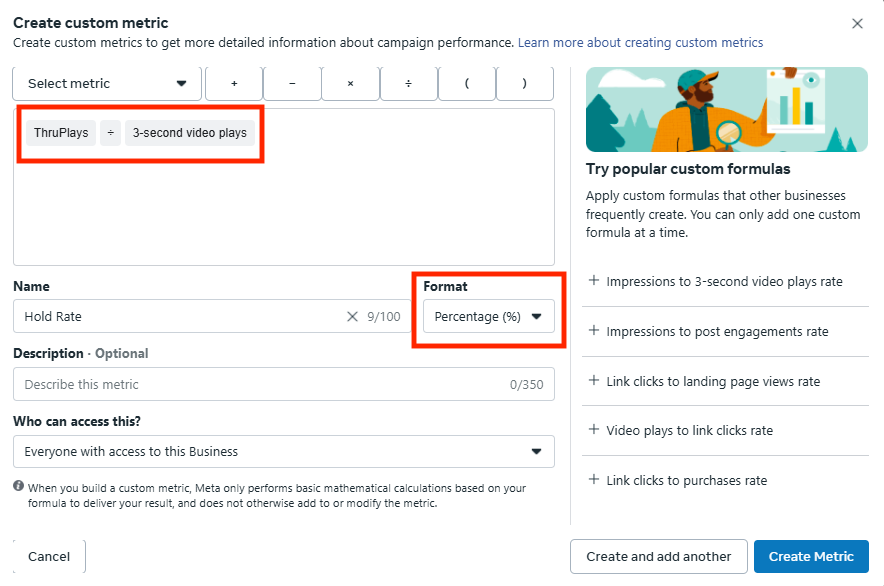
A high Hook Rate but low Hold Rate indicates your intro is working, but the body of the video isn't engaging enough. Conversely, a low Hook Rate tells you the problem is in the first three seconds.
Tactical Principles for High-Performing Video
Now that we understand the high-level structure, let's zoom in on the specific tactical elements that create a compelling video experience. These are the details of pacing, visual cues, and audio that bring the Hook-Hold-Close structure to life.
Pacing, Sound, and Subtitles
Pacing is the rhythm of your ad. For Meta's fast-scrolling feeds, a fast pace is non-negotiable. This means quick cuts, dynamic motion, and constant visual interest.
At the same time, you must design for a "sound-off" default environment while also leveraging sound for users who have it on. This means clear, bold subtitles are mandatory, and sound effects can be used to add emphasis.
10 Video Editing Tips for Meta Ads Creative That Converts
Dara Denney's video, "10 Video Editing Tips for Meta Ads Creative That Converts," offers fantastic, practical advice on these topics.
Watch the following three clips: First, understand the importance of "faster pacing." Notice the recommendation for cuts that are less than a second long. Next, learn about font usage. Using native-style fonts helps your ad feel less like an ad and more like organic content. Finally, watch the section on designing with sound on. This highlights the modern best practice: use captions, but also add sound effects for emphasis, as a majority of Reels viewers now watch with sound on.
The article from Billo.app reinforces this, recommending large black-on-white subtitles for maximum clarity and retention.
Visual Cues and Engagement Techniques
Beyond pacing and text, specific visual techniques can dramatically increase engagement and message clarity.
10 Video Editing Tips for Meta Ads Creative That Converts
Let's go back to Dara Denney's video for some advanced editing tricks.
Watch these sections to learn about subtle but powerful techniques: J-cuts and L-cuts: These audio-visual transitions create a seamless, professional flow that keeps viewers engaged without them even realizing why. Zoom techniques: Simple hard-cut or slow zooms can re-engage a viewer's attention on a key person or product. Overlays: Using elements like stickers or simulated TikTok response overlays can make an ad feel more native and has been shown to improve performance.
To add to this, let's explore some more structured visual formats that perform well on Meta.
Meta Ads Best Practices: What Actually Works in 2025
This article from Billo.app details several proven creative formats and design optimizations.
Read the sections titled "Creative Formats That Perform" and "Design & CTA Optimization." Pay attention to these effective visual cues: Split screens and poster layouts to show multiple angles or steps at once. "Pop-in" product PNGs to boost brand recall. Graphic end cards with a clear CTA to provide a strong "Close." Magnifying glass animations to highlight key ingredients or features.
These tactical elements—fast pacing, clear captions, engaging zooms, and informative overlays—are the building blocks you'll use to construct a compelling video that effectively hooks and holds your audience.
Conclusion
You now have a multi-layered framework for understanding and evaluating video ads, connecting high-level strategy to on-the-ground tactics and the metrics you use to measure success.
Here are the key principles of high-performing video ads on Meta:
- Win the First Three Seconds: Your video must immediately interrupt the scroll with a strong visual hook, an element of curiosity, and a clear user benefit.
- Structure for Attention: Design your video with a clear "Hook, Hold, Close" structure. Use interest loops and continuous visual stimulation to maintain engagement after the initial hook.
- Pacing is Paramount: Employ fast-paced editing with cuts every 1-2 seconds to match the consumption speed of Meta's feeds.
- Design for Sound-Off, Optimize for Sound-On: Use large, clear subtitles as a default. Enhance the experience with sound effects and music for the growing audience that watches with sound on.
- Measure What Matters: Use Hook Rate (3s views/impressions) and Hold Rate (ThruPlays/3s views) to diagnose whether your video's weakness is its opening or its body.
In our next lesson, we will build on this foundation. Now that you understand the principles of great static and video creatives, we'll discuss how to adapt your creative structure and format for different Meta placements, such as the distinct environments of the Feed versus Reels and Stories.