Hello! Welcome to the first lesson in our course on advanced Meta advertising.
Given your background in performance marketing, you're likely very familiar with the levers we can pull inside Ads Manager. This course is designed to take that practical experience and layer on the strategic frameworks needed to scale campaigns profitably, with a deep focus on creative.
Today, we'll start with the absolute foundation: understanding the engine that drives every single ad on Meta. Our goal is to explain how Meta's algorithm evaluates and prioritizes your ad creatives. This isn't just theory; understanding this system is the key to unlocking better performance and is the first step toward building the scaling playbook you're aiming for.
We will cover:
- The classic Meta ad auction formula.
- The recent, massive algorithmic shift known as "Andromeda."
- Why the phrase "creative is the new targeting" is now the most important rule for advertisers.
- The strategic implications of this new system for your campaigns.
Let's dive in.
The Ad Auction: How Meta Chooses a Winner
At any given moment, millions of advertisers are competing to show their ads to users on Facebook and Instagram. How does Meta decide which ad gets to appear in a user's feed? The answer lies in the ad auction.
It's not just about who is willing to pay the most. Meta wants to balance two goals: providing value to advertisers (by showing ads that lead to results) and maintaining a positive experience for users (by showing relevant, high-quality content).
To understand this balancing act, let's look at the core formula that governs the ad auction. The video below gives a great overview of the three key components.
How Facebook Ads Algorithm ACTUALLY Works
This video from Jorge Vieira breaks down Meta's official explanation of the ad auction. It clearly explains the formula and its core components, which is the perfect starting point for our lesson.
Please watch from 01:11 to 05:42. Focus on understanding the three main variables in the auction formula: the advertiser's bid, the estimated action rate, and the relevance/quality score.
As the video explains, the winner of the auction is determined by the ad with the highest Total Value. Here is the formula visualized:
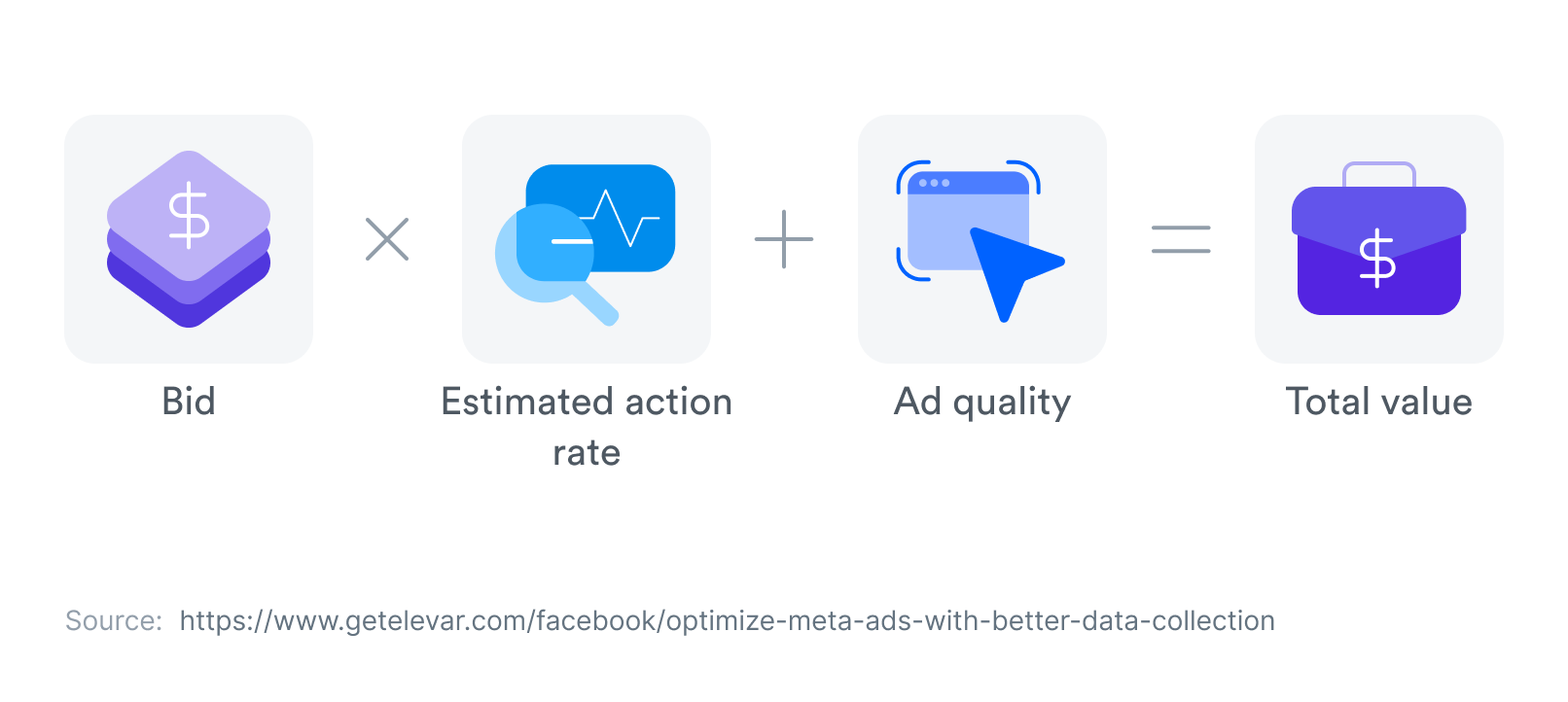
Let's quickly recap the components:
- Advertiser Bid: This is the monetary bid you place to have your ad shown. While you can set this manually (e.g., with a cost cap), most advertisers, as the video notes, use automated bidding ("Highest Volume" or "Lowest Cost"), where Meta manages the bid for you to achieve your objective.
- Estimated Action Rate (EAR): This is Meta's prediction of how likely a specific user is to take the action you're optimizing for (e.g., click, convert, watch a video) after seeing your ad. It's a probability score unique to each user and ad combination.
- Ad Quality & Relevance: This component is Meta's way of protecting the user experience. It's a score based on feedback from users who see your ad. Positive signals (likes, comments, shares, high video watch time) increase your quality score, while negative signals (users hiding the ad, reporting it, low engagement) decrease it.
A high-quality, relevant ad can beat an ad with a higher bid if Meta predicts it's more likely to get the desired action and provide a better user experience. This is why simply increasing your budget doesn't always lead to better results.
Test your understanding!
Imagine you have two ads competing for the same user.
- Ad A has a high bid but a low Ad Quality score because users find it annoying.
- Ad B has a lower bid but a very high Ad Quality score and a high Estimated Action Rate because it's an engaging video that users love.
Which ad is more likely to win the auction, and why?
Show answer
Ad B is more likely to win. Even with a lower bid, its high Ad Quality and Estimated Action Rate will result in a higher Total Value. This demonstrates that creative quality can be more powerful than a high budget in Meta's auction.
The Big Shift: "Creative is the New Targeting"
The auction formula we just discussed is the long-standing foundation. However, in late 2024, Meta rolled out a new machine-learning engine called Andromeda that fundamentally changed how the "Estimated Action Rate" and "Ad Quality" are calculated. This is the single most important update for performance marketers in recent years.
Before Andromeda, the process was straightforward:
- You defined your audience (e.g., women 25-45 interested in yoga).
- Meta showed your ad primarily to people in that group.
Andromeda flips this model on its head. The new process looks like this:
- You upload an ad creative (image, video, copy).
- Andromeda analyzes the creative itself—the colors, the message, the format, the emotional tone.
- It then scours its entire user base to find people whose past behavior suggests they will respond to that specific creative style, regardless of whether they fit neatly into your demographic targeting.
This is why you'll hear the phrase "creative is the new targeting." Your ad creative is no longer just a message you show to a pre-defined audience; it's the primary tool you use to find your audience.
To get a deeper understanding of this shift, the following article provides an excellent, non-technical explanation and a helpful analogy.
Meta's Andromeda Algorithm Explained (2026)
This article from Drivelead Media, titled 'Meta's Andromeda Algorithm Explained,' does a fantastic job of simplifying this complex topic. It clearly explains what changed and why it's so significant for advertisers.
Please read the sections 'What Actually Changed (And Why You Should Care),' 'How Andromeda Actually Works (Without the Tech Jargon),' and the example under 'How Different Creatives Find Different Audiences.' Focus on the matchmaker analogy and the fitness studio example, as they perfectly illustrate the concept.
As the article's fitness studio example shows, two different creatives targeting the exact same audience can end up being shown to completely different sets of people because their styles attract different behavioral patterns. One creative might find people motivated by calm and mindfulness, while another finds those driven by high-energy results.
The Consequences for Your Ad Strategy
So, what does this "creative-first" algorithm mean for your day-to-day work as a performance marketer? It means that feeding the algorithm a sufficient volume and variety of creatives is no longer optional—it's essential for survival and scale.
An ad account with only a few creatives is on what some call an "asset diet." This starves the algorithm of options. When Andromeda has limited creative choices, it can't find optimal matches between your ads and users. This leads to several problems:
- Reduced Competitiveness: The algorithm is less confident your ad will perform well, so you lose more auctions.
- Higher Costs (CPMs): When the algorithm is forced to show a less-than-ideal ad, it charges you more for the impression. This is sometimes called a "monotony tax."
- Limited Reach: You fail to reach entire pockets of your potential audience who would respond to a different creative angle or format.
To succeed in the age of Andromeda, your strategy must focus on providing the algorithm with options. The following article introduces a useful framework for this, built on three pillars.
Creative Scaling: The Ultimate Guide for Meta Ads in 2026
The article 'Creative Scaling: The Ultimate Guide for Meta Ads in 2026' from Admetrics.io explains the practical consequences of the new algorithm. It introduces key concepts that we'll build on throughout this course.
Read the first three sections: 'The Death of Traditional Targeting...,' 'The Asset Diet...,' and 'Understanding the Holy Trinity of Creative Scaling.' Also, read the FAQ at the end titled 'What is creative scaling and why does it matter for Meta Ads?' Pay close attention to the concepts of the 'asset diet' and the three pillars: Velocity, Diversity, and Liquidity.
The three pillars—Creative Velocity, Creative Diversity, and Creative Liquidity—are the solution to the "asset diet."
- Velocity: Launching new ads consistently to keep things fresh.
- Diversity: Testing different messages, angles, and hooks.
- Liquidity: Using various formats (video, image, carousel) optimized for different placements (Feed, Stories, Reels).
By embracing these principles, you give the Andromeda algorithm the raw material it needs to find your best customers at the lowest cost.
Test your understanding!
Imagine you have one "winning" video ad that has delivered a great ROAS for two weeks. Based on what you've learned about Andromeda, what are two major risks of only running this single ad and not introducing new creatives?
Show answer
- Audience Limitation & Saturation: The ad's specific style and message likely resonate with only a segment of your total potential audience. By only running this ad, you're telling Andromeda to ignore everyone else. The algorithm will eventually saturate this narrow segment, leading to creative fatigue, rising costs (CPMs), and a drop in performance.
- Lack of Algorithmic Flexibility: You're not providing Andromeda with options. You miss out on users who prefer static images over video, or who are active on placements where your video isn't a good fit (e.g., a long-form video in a Stories placement). You'll pay a "monotony tax" and be less competitive in auctions where a different creative could have won.
Conclusion and Next Steps
Let's summarize the key takeaways from today's lesson:
- Meta's ad delivery is governed by an auction that values a combination of your bid, the predicted action rate, and the quality of your ad.
- The new Andromeda algorithm represents a fundamental shift, making the ad creative the primary driver of targeting. It analyzes your ad and then finds the audience for it.
- To succeed, advertisers must provide the algorithm with a steady stream of diverse creatives (Velocity, Diversity, Liquidity) to avoid being penalized with higher costs and limited reach.
Your goal is to build a playbook for scaling campaigns. This lesson is the crucial first piece of that puzzle. You can't scale effectively without working with the algorithm, and that means making creative strategy your top priority.
In our next lesson, we'll get practical. Now that we know why we need a diverse range of creatives, we'll explore how to come up with ideas for them. We will analyze competitor creatives to identify strategic patterns and opportunities, giving you a repeatable process for finding winning ad concepts.